
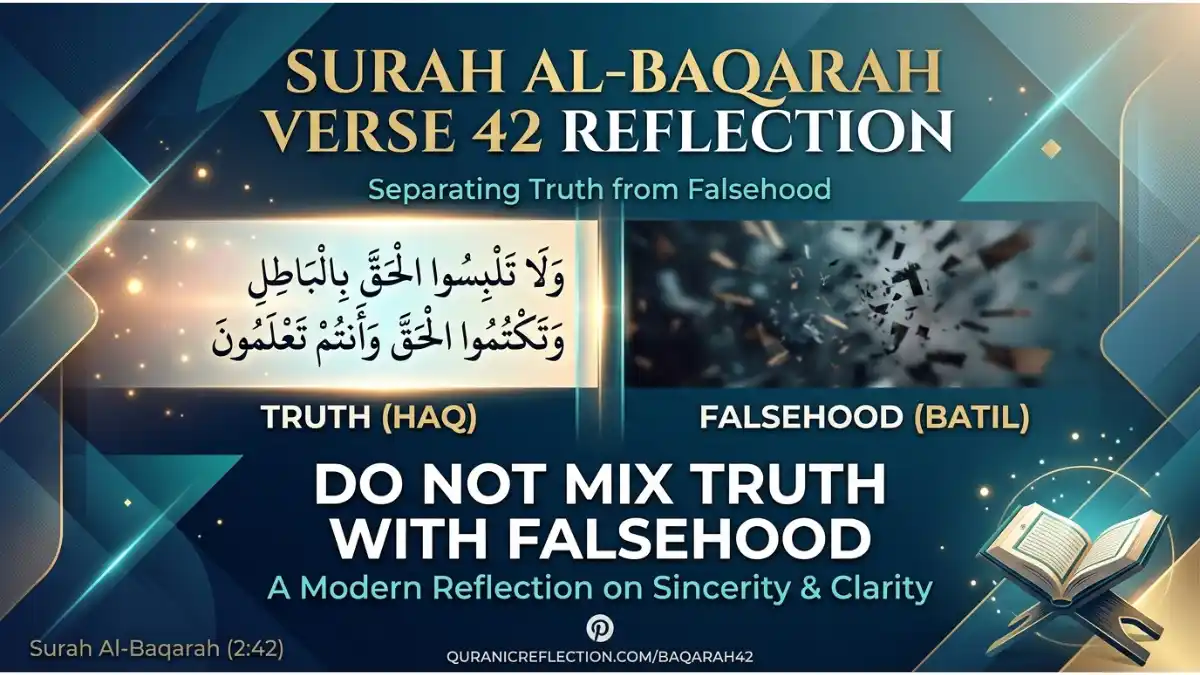
Intellectual Integrity: The Prohibition of Mixing Truth with Falsehood
Following the stern warning in Surah Al-Baqarah verse 41 against trading divine revelation for trivial worldly advantages—such as compromising core principles for power, social standing, or fleeting material gains—verse 42 delves deeper into a more subtle, sophisticated form of intellectual corruption and information manipulation.
Consider the divine command revealed in the Holy Quran:
وَلَا تَلْبِسُوا الْحَقَّ بِالْبَاطِلِ وَتَكْتُمُوا الْحَقَّ وَأَنتُمْ تَعْلَمُونَ
“Wa laa talbisul-haqqa bil-baathili wa taktumul-haqqa wa antum ta’lamuun.”
Translation: “And do not mix the truth with falsehood or conceal the truth while you know [it].” (Surah Al-Baqarah: 42)
Historically, this passage served as a sharp reprimand directed at certain religious scholars and community leaders among the Children of Israel in Medina. Although they possessed clear knowledge of the Torah and recognized the prophetic signs of the final Messenger, Prophet Muhammad (peace be upon him), some chose manipulation over integrity. To protect their status, they either obfuscated scriptural truths with misleading interpretations or remained silent when the truth required clear testimony.
Deconstructing the Two Forms of Intellectual Corruption
Classical commentators note that Surah Al-Baqarah verse 42 targets two distinct yet interconnected methods of information distortion that severely damage both individual faith and social order:
1. Talbis Al-Haqq bil-Batil (Mixing Truth with Falsehood)
Linguistically, talbis originates from labasa, meaning to wrap, mix, or obscure. In this context, it describes the tactical wrapping of falsehood and personal agendas in sacred or scientific terminology so that audiences cannot easily distinguish between factual reality and fabrications.
Perpetrators of talbis rarely reject truth outright; instead, they blend genuine facts with distorted narratives. This form of manipulation is particularly dangerous because falsehood presented alongside partial truth is far more deceptive than blatant lies.
2. Kitman Al-Haqq (Concealing the Truth)
Taktumul-haqq refers to withholding or burying evidence, data, or testimonies of truth. This occurs when an individual possesses clear proof of justice or correctness but chooses to remain a passive bystander out of fear of social backlash, loss of position, or professional friction.
The verse concludes with a powerful emphasis: “wa antum ta’lamun”—”while you know [it].” This underscores that the perpetrators are neither ignorant nor misled; rather, they act with full deliberate awareness, sacrificing ethical responsibility for comfort and self-preservation.
Modern Relevance: Media Manipulation, Framing, and Misinformation
The warnings against talbis and kitman are acutely relevant in the modern digital landscape. Information distortion permeates contemporary media, corporate environments, and public discourse:
- Cherry-Picking Sacred Texts or Data: Quoting scriptures, historical quotes, or research studies out of context (cherry-picking) to legitimize unjust policies, corporate misconduct, or partisan agendas.
- Media Framing and Sensationalism: Publishing provocative headlines combined with moral language while twisting underlying facts to damage reputations or manipulate public sentiment.
- The Silent Bystander Effect: The refusal of knowledgeable professionals to speak up against corporate fraud, systemic corruption, or injustice in their workplaces due to a desire to stay safe.
Intellectual brilliance divorced from moral responsibility often produces cleverness designed to rationalize wrongdoing rather than courage to defend truth.
Linguistic Deep Dive: Key Terminology in Verse 42
A closer examination of the classical Arabic terms in Surah Al-Baqarah verse 42 illuminates deeper moral dimensions:
- Talbis (Obscuring/Mixing): Denotes the deliberate blurring of boundaries between right and wrong, creating moral ambiguity where absolute standards should apply.
- Batil (Falsehood): Refers to anything void of truth, substance, or justice—hollow claims built on vanity and self-interest.
- Taktum (Concealing): Highlights the passive yet culpable act of locking away crucial evidence or truth when testimony is required.
- Ta’lamun (You Know): Elevates accountability, emphasizing that intentional manipulation committed with full awareness carries profound spiritual consequences.
Comparative Framework: Transparent Honesty vs. Manipulative Distortion
Contrasting an honest approach to information with manipulative distortion clarifies the choices highlighted in verse 42:
| Dimension | Manipulative Approach (Talbis & Kitman) | Transparent Approach (Honesty & Clarity) |
|---|---|---|
| Primary Objective | Protecting personal status, avoiding risk, and misleading audiences. | Upholding justice, transparency, and objective reality. |
| Treatment of Facts | Distorted, selectively edited, or intentionally hidden. | Presented fully, accurately, and without bias. |
| Internal Awareness | Conscious awareness of manipulation (wa antum ta’lamun). | Clear conscience aligned with ethical responsibility. |
| Long-Term Social Impact | Erosion of public trust, social polarization, and widespread corruption. | Strengthened institutional integrity, justice, and social harmony. |
Reflective Story: Journalistic Integrity Against Corporate Pressure
The real-world challenge of maintaining honesty in the face of institutional pressure is illustrated by investigative reporting. Consider the case of an investigative journalist who uncovered evidence of severe environmental pollution caused by a major manufacturing corporation.
Coincidentally, that same corporation was the primary financial sponsor of the media network employing the journalist. When the investigative report was submitted, editorial management requested modifications—specifically asking the journalist to tone down key findings and reframe the pollution as an isolated, minor administrative oversight.
The managing editor argued: “Just soften the conclusions slightly so they look ambiguous. If we publish these findings unfiltered, our network will lose its primary sponsor and face severe financial ruin.”
Threatened with dismissal and professional blacklisting, the journalist faced a profound ethical choice. Remembering that professional skills are an entrusted responsibility before God, he refused to compromise or dress up falsehood.
He stepped down from his position and released the unedited findings independently. Although the decision brought temporary career uncertainty, his unwavering integrity earned widespread public respect, eventually enabling him to establish an independent media platform dedicated to uncompromised truth.
Practical Action Steps: Safeguarding Information Integrity
To implement the lessons of Surah Al-Baqarah verse 42 in daily life, apply these practical steps:
- Verify Information (Tabayyun): Before sharing news, articles, or social media posts, thoroughly check their accuracy. Refrain from spreading sensationalized content designed to manipulate emotions.
- Speak Up for Justice: When witnessing injustice, fraud, or misrepresentation in your workplace or community, stand up courageously for the truth within your capacity. If speaking out is unsafe, refuse to endorse the falsehood.
- Purify Intentions in Discourse: When engaging in discussions or writing content, ensure your goal is the objective pursuit of truth rather than winning arguments or defending group bias.
Daily Practice Challenge
- Commit to Fact-Checking: Audit your sharing habits today, ensuring you verify every piece of information before passing it along.
- Refuse Misleading Framing: Avoid exaggerating or misrepresenting details to make a personal narrative sound more impressive.
- Encourage Honesty: Support colleagues or peers who maintain ethical standards under pressure.
Supplication for Clarity and Truthfulness
We ask the Almighty for guidance to uphold truth clearly:
“O Allah, show us the truth as truth and grant us the strength to follow it, and show us falsehood as falsehood and grant us the strength to avoid it. Protect our tongues, pens, and hearts from mixing truth with falsehood or concealing justice. Ameen, O Lord of the Worlds.”
Frequently Asked Questions (FAQ)
Q: How can ordinary citizens identify manipulated media or deceptive religious framing (talbis)?
A: Key indicators include examining whether arguments rely on incomplete quotes taken out of context, checking if multiple reliable and objective sources corroborate the information, and evaluating whether the narrative promotes constructive justice or triggers blind prejudice and division.
Q: Is remaining silent when witnessing minor workplace dishonesty considered “concealing the truth” (kitman)?
A: If silence enables ongoing fraud, harm, or injustice when one has a direct duty or capacity to correct it, it borders on complicity. Upholding integrity requires either addressing the issue constructively or distancing oneself from the dishonest practice.
Have you ever encountered information that appeared authentic at first glance, only to discover it was carefully manipulated? Share your thoughts and experiences in the comments below!