
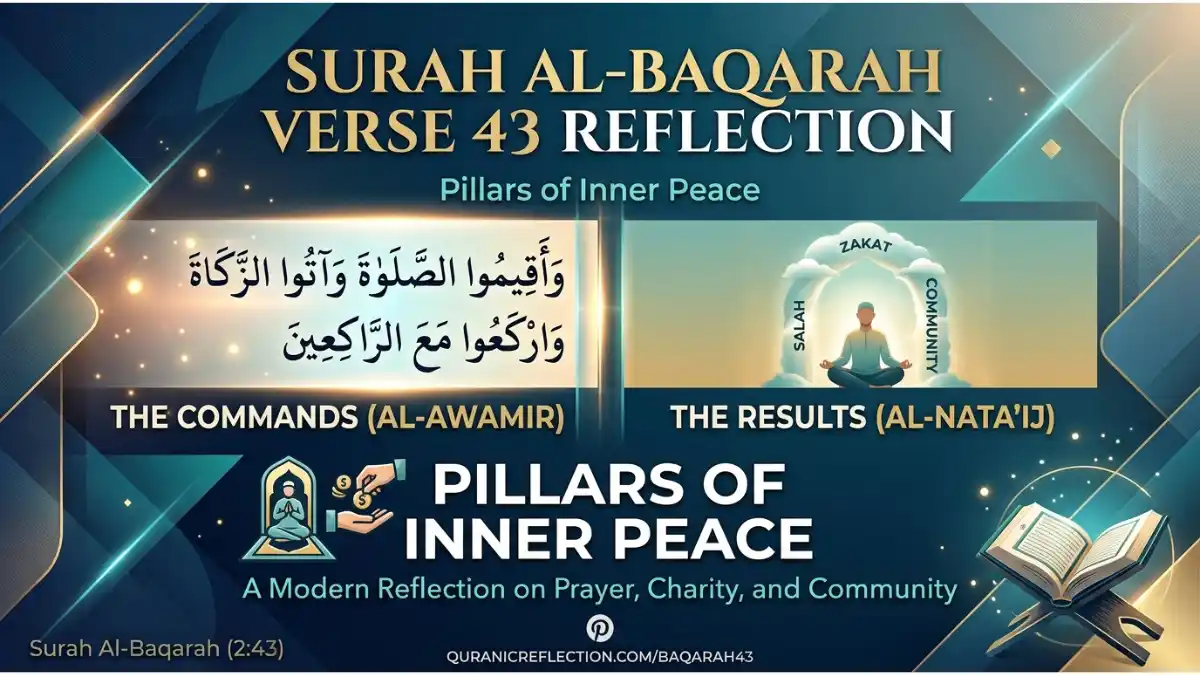
The Spiritual Prescription: Three Pillars of Inner Peace and Societal Resilience
Following the sharp warnings in the preceding verses regarding moral deviations—such as trading divine revelation for worldly gain and mixing truth with falsehood—Surah Al-Baqarah verse 43 offers a concrete, practical spiritual solution. The Almighty does not merely condemn shortcomings; He directly provides the corrective prescription necessary to restore moral clarity, personal discipline, and societal harmony.
Consider the divine command revealed in the Holy Quran:
وَأَقِيمُوا الصَّلَاةَ وَآتُوا الزَّكَاةَ وَارْكَعُوا مَعَ الرَّاكِعِينَ
“Wa aqiimush-sholaata wa aatuz-zakaata warka’uu ma’ar-rooki’in.”
Translation: “And establish prayer and give zakat and bow with those who bow [in worship].” (Surah Al-Baqarah: 43)
This concise verse contains a comprehensive blueprint for human civilization, synthesizing vertical devotion to the Creator, horizontal compassion toward fellow human beings, and social fortification through a righteous community.
Deconstructing the Three Pillars in Surah Al-Baqarah Verse 43
Classical commentators explain that coupling these three specific injunctions creates a balanced framework for spiritual health and moral resilience:
1. Establishing Prayer (Wa Aqiimus-Salah) – Vertical Devotion
The Quran deliberately uses the phrase “aqiimus-salah” (establish prayer) rather than simply performing physical motions. Establishing prayer requires injecting life, mindfulness, and consistent discipline into the act—maintaining purity, focusing attention, honoring timings, and allowing the prayer to restrain one from shameful and unjust deeds.
Prayer serves as a regular spiritual recharge in a fast-paced, stressful world. During prostration (sujud), a believer relinquishes ego, pride, and earthly anxieties, placing their forehead on the ground before the Lord of the Worlds.
2. Giving Zakat (Wa Atuz-Zakah) – Horizontal Compassion
Immediately following the command to worship God, the Quran mandates giving zakat (obligatory charity). This underscores that personal piety remains incomplete if an individual is indifferent to the suffering of the poor and vulnerable.
Zakat purifies wealth by recognizing the rights of others, while simultaneously purging the soul of greed, stinginess, and excessive attachment to material possessions. It creates an institutionalized bridge of empathy that narrows economic divides within society.
3. Bowing with Those Who Bow (Warka’u Ma’ar-Raki’in) – Collective Solidarity
The third instruction emphasizes congregational worship and positive companionship. Human beings are inherently social creatures shaped by their environments. Remaining isolated or associating exclusively with negligent circles weakens resolve.
Bowing alongside a community of believers reinforces mutual accountability, shared purpose, and collective spiritual strength. Congregational worship binds diverse social strata into a unified brotherhood.
Linguistic Deep Dive: Key Terminology in Verse 43
Examining the classical Arabic vocabulary of Surah Al-Baqarah verse 43 reveals deep structural meaning:
- Aqiimu (Establish): Derived from qama (to stand straight or erect), implying stability, permanence, and meticulous attention to structural integrity.
- Salah (Prayer): Literally denoting connection or supplication, establishing a direct, unbroken communication channel between servant and Creator.
- Zakat (Purifying Charity): Derived from roots meaning purification and growth, indicating that giving charity cleanses wealth and fosters spiritual and societal flourishing.
- Raki’in (Those Who Bow): Symbolizes submission, humility, and obedience, highlighting that true worship requires abandoning arrogance.
Modern Relevance: The Antidote to Modern Anxiety and Isolation
In contemporary society, individuals face rising rates of chronic anxiety, loneliness, and hyper-materialism. The three pillars outlined in verse 43 provide a comprehensive antidote:
- Prayer centers the human psyche, offering structured mindfulness that relieves stress and grounds erratic thoughts.
- Charity counteracts consumerist isolation by fostering active social contribution and empathetic connection.
- Congregational Community combats loneliness by embedding individuals in supportive, morally aligned networks.
Comparative Framework: Self-Centered Living vs. Holistic Islamic Worship
Contrasting a materialistic lifestyle with a life anchored in the three pillars clarifies their transformative impact:
| Dimension | Materialistic Individualism | Holistic Worship (Prayer, Zakat, Community) |
|---|---|---|
| Core Focus | Personal accumulation, pleasure, and self-reliance. | Divine connection, social responsibility, and collective well-being. |
| Response to Stress | Vulnerable to burnout, anxiety, and existential despair. | Relieved through prayer, patience (Sabr), and reliance on God. |
| View of Wealth | Hoarded as a measure of personal worth and security. | Shared through zakat as an entrusted resource to help others. |
| Social Engagement | Transactional relationships driven by utility. | Compassionate solidarity within a righteous community. |
Reflective Story: Finding Inner Peace on the Prayer Mat
The therapeutic power of prayer is demonstrated in daily life. Consider the experience of a business owner who faced severe financial distress when his enterprise collapsed under overwhelming debt during an economic downturn.
Overwhelmed by creditor demands and sleepless nights, he began experiencing severe panic attacks. One night, abandoning his anxious calculations, he performed ablution, spread his prayer mat, and engaged in prolonged night prayers (Tahajjud), pouring out his worries in prostration.
He later recalled: “The moment I finished praying, an indescribable wave of peace washed over me. While my financial problems remained unsolved that night, the crushing panic vanished completely. My mind cleared, allowing me to formulate a calm, ethical restructuring plan the next morning.”
Establishing prayer with genuine submission proves to be an effective spiritual reset and a catalyst for divine assistance.
Practical Action Steps: Incorporating the Three Pillars Daily
To apply the lessons of Surah Al-Baqarah verse 43 in daily life, consider these practical steps:
- Elevate Prayer Quality: Focus on preparing for prayer calmly, understanding meanings of recitations, and slowing down physical movements (tumaninah).
- Implement Regular Charity: Cultivate a consistent habit of giving daily or weekly charity, regardless of amount, to cleanse your wealth and nurture empathy.
- Prioritize Congregation: Make a conscious effort to attend congregational prayers at the mosque or build supportive, spiritually uplifting circles of friends.
Daily Practice Challenge
- Punctuality in Prayer: Commit to performing every daily prayer at the earliest recommended time today.
- Intentional Giving: Give an anonymous act of charity to someone in need.
- Strengthen Bonds: Reach out to a righteous friend or family member to encourage mutual spiritual growth.
Supplication for Consistency in Worship
We pray for steadfastness in establishing prayer and charity:
“O Allah, make us among those who properly establish prayer and fulfill zakat with sincerity. Keep our hearts steadfast in Your obedience and place us in the company of the righteous who bow in humility before You. Ameen, O Lord of the Worlds.”
Frequently Asked Questions (FAQ)
Q: What is the practical difference between “performing” prayer and “establishing” prayer?
A: Performing prayer can mean executing physical movements mechanically. Establishing prayer (iqamat as-salah) encompasses perfecting its inner and outer dimensions—maintaining punctuality, achieving concentration (khushu’), absorbing its moral lessons, and letting its influence transform daily behavior.
Q: Why does the verse specifically command bowing with those who bow?
A: It emphasizes the spiritual benefit of communal worship and righteous association, reminding believers that collective solidarity shields against isolation and reinforces moral commitment.
Have you ever experienced a profound sense of inner peace after turning to prayer during a difficult moment? Share your reflections in the comments below!