
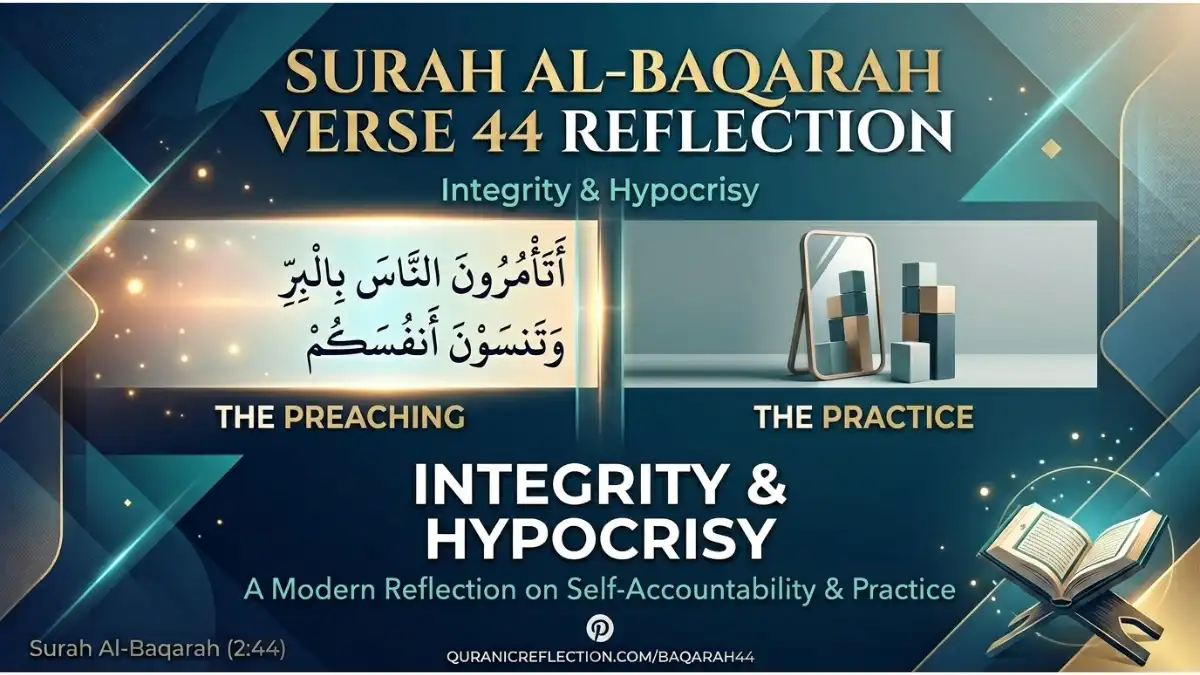
The Integrity Imperative: Why True Guidance Must Begin with Self-Correction
Following the establishment of foundational spiritual practices in the preceding verse—such as establishing prayer, giving zakat, and engaging in communal worship—Surah Al-Baqarah verse 44 delivers a sharp, deeply introspective reprimand. This verse targets one of the most persistent moral failings affecting human communities across generations: the tendency to urge others toward righteousness while neglecting to apply those exact principles to oneself.
Consider the divine words revealed in the Holy Quran:
أَتَأْمُرُونَ النَّاسَ بِالْبِرِّ وَتَنسَوْنَ أَنفُسَكُمْ وَأَنتُمْ تَتْلُونَ الْكِتَابَ ۚ أَفَلَا تَعْقِلُونَ
“A ta-muruunan-naasa bil-birri wa tansauna anfusakum wa antum tatluunal-kitaab, a fala ta’qilun.”
Translation: “Do you order righteousness of the people and forget yourselves while you recite the Scripture? Then will you not reason?” (Surah Al-Baqarah: 44)
Historically, this passage served as a stern warning directed at religious authorities and scholars in Medina who frequently instructed others to accept the final prophet and adhere to scriptural truths, yet refused to follow their own advice due to fear of losing social standing or material benefits. However, classical interpretive principles confirm that the moral message is universal: this critique applies to anyone who masters the art of counseling others while remaining blind to their own personal flaws.
Deconstructing the Danger of Hypocrisy and Self-Contradiction
The core message of Surah Al-Baqarah verse 44 emphasizes integrity—the seamless alignment between spoken words and observable actions. Several critical lessons emerge from this verse:
1. The Peril of Reducing Knowledge to Mere Discourse
The Quran highlights this irony with the phrase “wa antum tatluunal-kitab” (“while you recite the Scripture”). It exposes the severe contradiction of possessing religious knowledge, studying sacred texts, and articulating moral truths, yet failing to let those insights penetrate the heart or shape personal behavior.
2. The Trap of “Self-Forgetfulness” in Public Preaching
The expression “wa tansau anfusakum” (“and forget yourselves”) describes a psychological state where an individual finds emotional satisfaction purely in directing others. Constantly correcting the mistakes of others creates a false sense of personal purity and spiritual exemption. This subtle ego trap is dangerous for spiritual growth.
3. A Direct Challenge to Rationality (A Fala Ta’qilun)
The verse concludes with a rhetorical question: “Then will you not reason?” Sound logic dictates that guiding others toward safety while actively walking toward a cliff is irrational. Discrepancy between speech and conduct represents both a spiritual failing and a breakdown of basic common sense.
Modern Relevance: When Words Lose Their Weight
In the age of social media and digital communication, the warning in verse 44 is increasingly relevant. Sharing wise quotes, delivering online lectures, or critiquing public figures requires minimal effort, yet people often overlook their own private inconsistencies:
- Individuals frequently advise others to exercise patience while losing their temper over minor inconveniences.
- Parents and managers often demand honesty and punctuality from children or staff while making frequent personal exceptions.
- People widely publish messages promoting community kindness online while maintaining poor character within their immediate households.
Advice delivered without personal consistency becomes empty noise. Lasting influence comes from character and lifestyle—modeling behavior rather than just speaking about it.
Comparative Framework: Empty Rhetoric vs. Authentic Role Modeling
Contrasting a lifestyle driven by empty lecturing with one rooted in authentic role modeling clarifies the message of verse 44:
| Dimension | Empty Lecturing Approach | Authentic Role Modeling |
|---|---|---|
| Primary Focus | Correcting external behavior of others while ignoring self-flaws. | Continuous self-examination and personal integrity. |
| Impact on Audience | Creates cynicism, skepticism, and alienation. | Builds deep trust, respect, and organic inspiration. |
| Spiritual State | Vulnerable to pride, hypocrisy, and self-delusion. | Grounded in humility, self-awareness, and sincerity. |
| Long-Term Effectiveness | Fades quickly; words lose credibility over time. | Lasting positive influence that transcends generations. |
Reflective Story: The Power of Quiet Leadership
The profound impact of quiet leadership over excessive lecturing is seen in professional environments. Consider the experience of a young professional who worked under a manager known for avoiding long lectures or public reprimands.
When mistakes occurred, this manager never humiliated team members publicly. Instead, the manager’s influence stemmed entirely from personal consistency: arriving early, maintaining high professional standards, and treating all staff—from executives to maintenance personnel—with equal respect.
During a major corporate crisis, the manager simply stated, “Let us address this challenge with honesty and collective accountability.” That brief, grounded statement inspired the entire team to work diligently because they knew their leader practiced those exact values daily.
Practical Action Steps: Aligning Speech with Action
To implement the lessons of Surah Al-Baqarah verse 44 in daily life, apply these practical steps:
- Check Yourself First: Before offering advice or correcting someone, pause to verify whether you practice that same principle in your private life.
- Audit Personal Integrity: Identify areas where your public advice conflicts with private habits, and commit to closing that gap.
- Prioritize Action Over Words: Let honesty, patience, and diligence form the foundation of how you guide those around you.
Daily Practice Challenge
- Practice Self-Correction: Catch yourself before giving unsolicited advice today, focusing instead on personal improvement.
- Model Good Behavior: Demonstrate a positive trait—like patience or punctuality—silently through actions rather than verbal reminders.
- Reflect on Consistency: Review your daily communication to ensure alignment between what you say and what you do.
Supplication for Alignment and Sincerity
We ask the Almighty for consistency between our words and actions:
“O Allah, protect us from preaching righteousness to others while neglecting our own souls. Make our speech completely consistent with our actions, and guard our hearts against hypocrisy, arrogance, and self-delusion. Ameen, O Lord of the Worlds.”
Frequently Asked Questions (FAQ)
Q: Does this verse mean we should stop advising others if we are not completely sin-free?
A: No. Islamic scholars clarify that inviting others to good and correcting wrong are independent duties. An individual should never abandon encouraging good simply because they feel imperfect. The condemned behavior in this verse is intentional self-forgetfulness—satisfying oneself with telling others what to do while making no personal effort toward self-correction.
Q: How can someone balance giving necessary guidance while maintaining personal humility?
A: By offering advice gently, viewing oneself as a fellow learner rather than a moral superior, and actively working on personal shortcomings alongside public responsibilities.
Have you ever felt challenged when realizing your own actions did not match the advice you gave to others? Share your reflections in the comments below!