
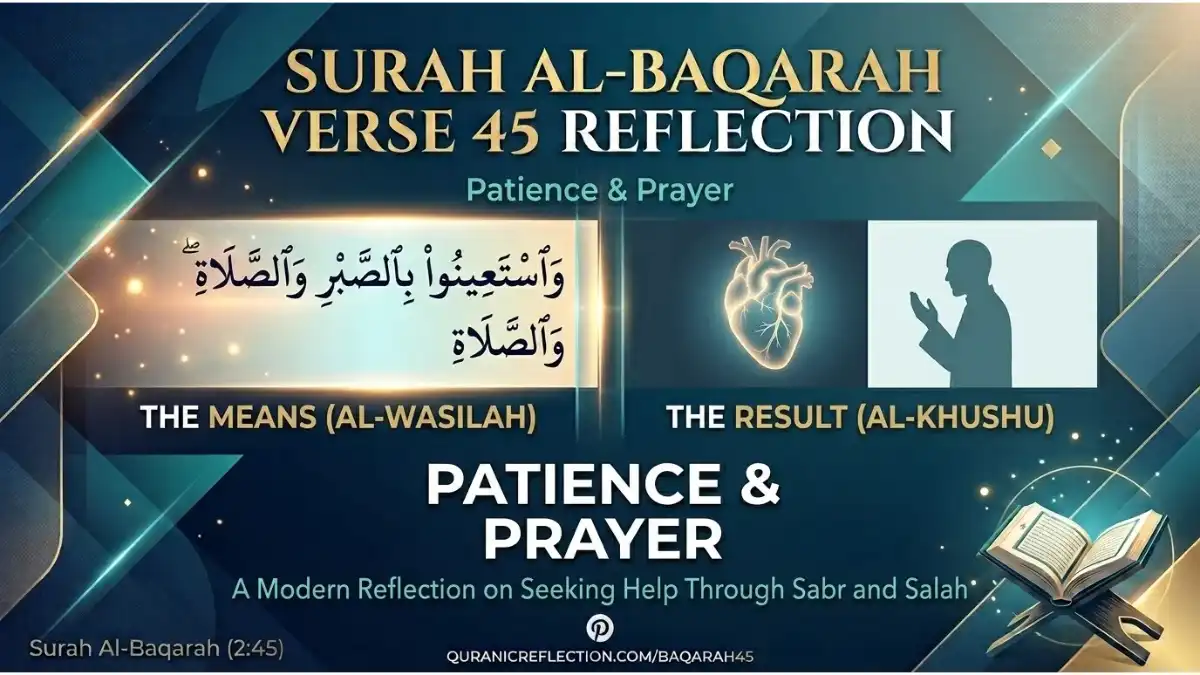
The Ultimate Divine Formula: Overcoming Heavy Life Burdens Through Patience and Prayer
Following the severe reprimand in the previous verse against preaching righteousness while neglecting personal self-correction, Surah Al-Baqarah verse 45 provides a profoundly comforting, powerful spiritual remedy. When human beings are overwhelmed by life’s trials, professional stress, financial crises, broken relationships, or social pressures, the Creator offers the ultimate mechanism for psychological and spiritual rescue.
Consider the divine command revealed in the Holy Quran:
وَاسْتَعِينُوا بِالصَّبْرِ وَالصَّلَاةِ ۚ وَإِنَّهَا لَكَبِيرَةٌ إِلَّا عَلَى الْخَاشِعِينَ
“Wasta’inu bis-sabri was-salati, wa innaha lakabirotun illa ‘alal-khasi’in.”
Translation: “And seek help through patience and prayer, and indeed, it is difficult except for the humbly submissive [to Allah].” (Surah Al-Baqarah: 45)
This verse delivers a fundamental life strategy that is frequently neglected. When confronted with complex hardships, human nature often pushes individuals toward destructive outlets: venting on social media, isolating in despair, questioning destiny, or seeking unprincipled shortcuts. Yet, the Originator of the soul has provided the two most effective, time-tested pillars of strength: Patience (Sabr) and Prayer (Salah).
Deconstructing the Two Pillars of Spiritual Resilience
A deep examination of these two core concepts clarifies how they function as psychological and spiritual anchors during crises:
1. The Reality of Patience (As-Sabr) in Quranic Perspective
Patience is often misunderstood as passive resignation, helpless silence, or passive submission to injustice. In Islamic tradition, patience is far from weakness; it is active mental endurance, deep fortitude, and emotional self-mastery that prevents faith from fracturing during storms.
Patience acts as an emergency psychological brake, stopping the tongue from reckless complaining, shielding the mind from negative assumptions about God, and restraining the body from desperate, harmful reactions. Classical scholars categorize patience into three dimensions:
- Patience in Obedience: Maintaining consistency in doing good and fulfilling worship even when physical and emotional energy is depleted.
- Patience in Avoiding Disobedience: Resisting moral compromises and unlawful shortcuts during times of severe financial or emotional distress.
- Patience Under Trials: Accepting bitter realities with inner calm, trusting that every divine decree conceals ultimate wisdom and goodness.
2. The Reality of Prayer (As-Salah) as a Divine Communication Hub
If patience serves as the protective shield of the soul, prayer functions as the spiritual charging station. Prayer is not merely a ritual obligation or a mechanical set of physical movements; it is a temporary disconnection from worldly noise to establish a direct, personal link with the Lord of the Universe.
When a servant falls into prostration (sujud) to whisper confidential concerns to God—especially in the stillness of the last third of the night or amidst a chaotic workday—crushing mental burdens gradually lift. Human frailty is exchanged for infinite divine strength.
Why Do Patience and Prayer Feel So Difficult?
The verse concludes with a striking, honest appraisal: “Wa innaha lakabirotun illa ‘alal-khasi’in”—”And indeed, it is difficult except for the humbly submissive.” Why do these two practices feel so heavy to most people?
During moments of intense anger, panic, or sorrow, human ego naturally demands instant reactions: shouting, complaining, mourning, or seeking human validation. Slowing down physical tempo, performing ablution, resetting intentions, and standing in focused concentration before the Almighty requires extraordinary self-discipline.
Only those possessing khushu’—a heart characterized by deep humility, conscious awareness of divine majesty, and certainty of the ultimate return to God—find these practices comforting necessities rather than burdensome tasks.
Reflective Story: Finding Strength at Life’s Lowest Point
Real-world experiences demonstrate how this verse operates practically. Consider the testimony of an individual who experienced a devastating series of personal and professional losses: a long-standing business collapsed completely, a beloved father passed away, and a sudden fire damaged his family home.
By standard human calculation, these cascading tragedies were more than enough to cause clinical depression. Yet, amidst the wreckage, he maintained an unusual, steady composure.
When asked about the source of his resilience, he shared a moving reflection:
“Whenever my chest felt suffocatingly tight from panic, I refused to let my thoughts spiral into despair. I immediately went to the bathroom, made ablution, performed voluntary prayers, and wept openly on my prayer mat. After prostration, a profound, cooling peace washed over my heart. I realized that relying solely on my limited human logic would drive me mad. Through patience and prayer, God supplied extraordinary strength to rebuild my life entirely from scratch.”
This account proves that patience and prayer are not merely theoretical concepts; they are active psychological mechanisms that soothe the nervous system and expand constricted hearts.
Practical Action Steps: Applying Patience and Prayer Daily
To integrate this profound wisdom into everyday life, apply these practical steps:
- Redirect Your Complaints: When facing minor inconveniences or major crises today, resist the urge to vent immediately on social media. Instead, perform ablution, spread your prayer mat, and lay your struggles before God.
- Practice Pause-and-Breathe Patience: When triggers arise—such as traffic jams, difficult criticism, or unexpected setbacks—take a deep breath, restrain impulsive words, and respond with a cool, measured demeanor.
- Enhance Prayer Concentration: Slow down your physical movements during prayer (tumaninah), absorb the meanings of your recitations, and consciously remind yourself that you are in private dialogue with the Almighty.
Supplication for Inner Fortitude
We ask the Almighty for steadfast endurance and beautiful patience:
“O Allah, bless us with expansive patience and spiritual fortitude to properly establish prayer with deep humility. Strengthen our hearts to navigate every storm of life, and make You alone our ultimate refuge and source of assistance. Ameen, O Lord of the Worlds.”
Frequently Asked Questions (FAQ)
Q: How can someone maintain patience and focus in prayer when experiencing severe emotional distress or a racing mind?
A: Start by slowing down physical movements to calm the nervous system. Performing ablution with cool water scientifically helps soothe physical tension. When standing for prayer, honestly admit your frailty to God in your heart: “O Allah, I am overwhelmed and weak, please calm my soul.” Honest vulnerability during prayer quickly invites divine tranquility.
Q: Does seeking help through patience and prayer mean we should abandon hard work or practical planning?
A: Absolutely not. Patience in Islam includes persevering through diligent effort, while prayer provides the mental clarity, emotional stability, and spiritual alignment needed to execute practical solutions effectively.
Have you ever experienced a heavy life burden suddenly feeling lighter after turning to patience and prayer? Share your reflections in the comments below!
- [Return to Verse 44: Do Not Order Righteousness and Forget Yourself]
- [Return to Introduction to Surah Al-Baqarah]
- [Proceed to Verse 46: Certainty of Meeting the Lord (Coming Soon)]