
Why Do We Need Firm Principles Amidst Social Pressures?
Following verse 13—which confronted individuals who arrogantly label sincere believers as naive while blind to their own spiritual foolishness—Surah Al-Baqarah verse 14 pulls back the curtain even further. Allah Almighty exposes the psychological mechanics of the hypocrites when navigating two completely opposing social environments:
“Wa idza laqul-ladzina amanu qalu amanna, wa idza khalau ila syayathinihim qalu inna ma’akum, innama nahnu mustahzi’un”
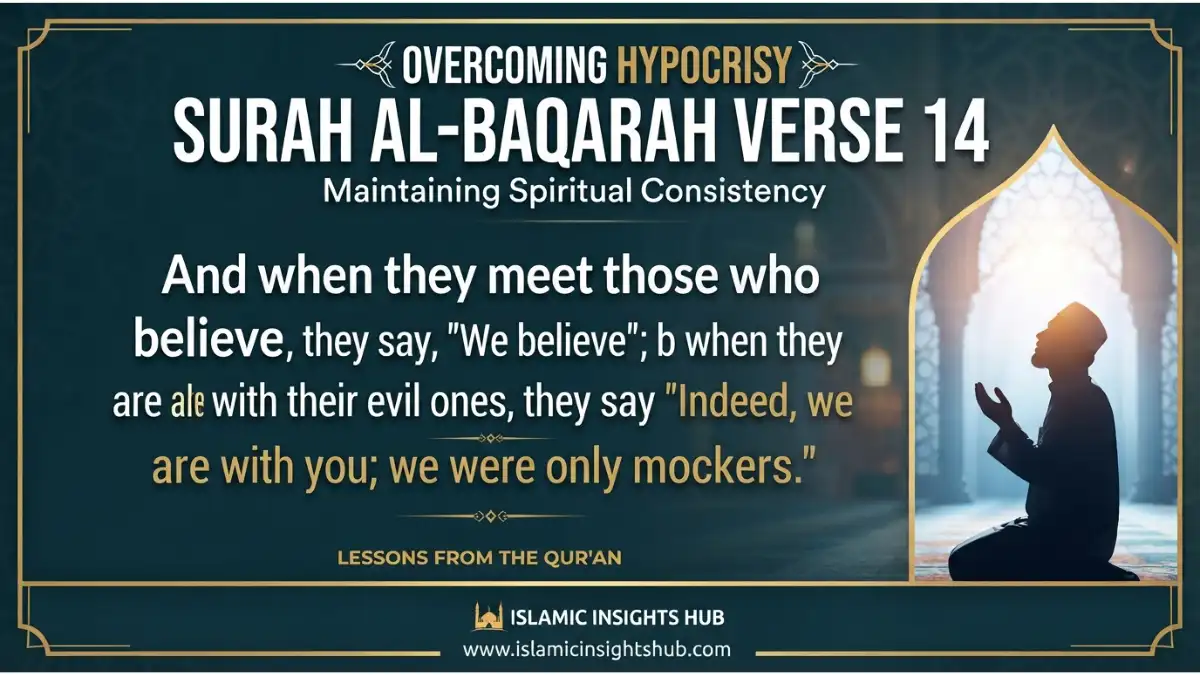
Translation: “And when they meet those who believe, they say, ‘We believe’; but when they are alone with their evil companions, they say, ‘Indeed, we are with you; we were only mocking.'” (QS. Al-Baqarah: 14)
Have you ever found yourself in an environment that pressured you to put on a social mask or adopt a double identity?
Consider a common scenario: when gathered with workplace colleagues or a social circle that casually engages in backbiting, unethical compromises, or behavior that violates core religious values, one might feel compelled to laugh along and validate their actions simply to remain liked, avoid awkwardness, or prevent social isolation. Yet, when transitioning to a family gathering or a faith-based community, the same individual instantly switches modes—appearing deeply pious, wise, and morally grounded.
This stark contrast illustrates what we define as the crisis of spiritual consistency.
Why Is the Chameleon Mindset Viscerally Destructive?
The Quran compares the hypocrite to a chameleon, lacking a grounded anchor within the soul. In the presence of believers, they perform masterfully to secure social safety, political alliance, or worldly prestige. However, when returning to their “satans”—their corrupt leaders, toxic influencers, or rebellious peers—they immediately issue clarifications: “Rest assured, we were merely playing along to mock them; our true allegiance remains with you.”
From both a psychological and spiritual standpoint, living with a fragmented identity inflicts severe long-term damage:
- Erosion of Core Identity: Constantly shifting moral colors to appease every crowd eventually erases a person’s authentic self. The soul becomes empty, driven entirely by external expectations rather than internal convictions.
- Structural Character Weakness: Living without firm principles renders a person weak. They lack the courage to stand upright for truth because they are perpetually governed by the fear of human judgment and rejection.
- Accumulation of Chronic Anxiety: Managing multiple masks is mentally exhausting. Double-faced individuals are secretly haunted by the constant fear that their true motives will be exposed across their conflicting social circles.
The central call of this verse is clear: Do not live as a social chameleon! Stand firm as an individual anchored in principles. While standing out in a compromised environment can feel daunting, living a life of perpetual self-deception and moral compromise is far more exhausting.
The Psychology of Dual Allegiance: Worldly Opportunism vs. Divine Integrity
The behavior described in verse 14 reveals a deep-seated psychological reliance on immediate social validation over ultimate accountability. The hypocrites constructed dual allegiances to hedge their bets: securing potential benefits from the growing Muslim community while retaining safety nets among influential opposition leaders.
Modern behavioral psychology identifies this as opportunistic compartmentalization—separating one’s moral values based on immediate social contexts. When individuals prioritize short-term comfort over long-term principles, their ethical baseline gradually degrades.
| Aspect | The Opportunistic Mindset (Verse 14) | The Principle-Centered Mindset (Istiqomah) |
|---|---|---|
| Primary Motivation | Seeking social approval, security, and immediate worldly gain. | Seeking divine pleasure, inner peace, and ultimate accountability. |
| Social Behavior | Adopting different moral masks depending on the audience. | Maintaining unwavering integrity regardless of social company. |
| Handling Peer Pressure | Compromising principles to avoid standing out or being rejected. | Politely setting clear ethical boundaries with courage and grace. |
| Internal Condition | Chronic anxiety, fragmented self-worth, and fear of exposure. | Tranquility, structural confidence, and spiritual freedom. |
Linguistic Analysis and Classical Exegesis: Unpacking *Syayathin* and *Mustahzi’un*
Classical Quranic scholars (mufassirun) like Ibn Kathir, Al-Qurtubi, and Al-Tabari provide illuminating insights into the linguistic choices of verse 14.
The term Syayathinihim is the plural of Shaitan. In classical Arabic exegesis, the word Shaitan stems from *shatana*, meaning “far removed from truth or goodness.” In this verse, classical scholars explain that it refers to the ringleaders of disbelief, corrupt advisors, and evil companions who led others away from divine guidance. By referring to these human leaders as *syayathin*, the Quran emphasizes their deceptive influence and malicious intent in undermining sincere faith.
Furthermore, the phrase “Innama nahnu mustahzi’un” highlights the depth of their arrogance. The word mustahzi’un derives from *huzu’*, meaning mockery, ridicule, or treating serious matters as a joke. By claiming they were only “mocking” the believers, the hypocrites sought to reassure their leaders that their apparent piety was nothing more than a tactical farce. However, as subsequent verses reveal, this mockery ultimately rebounds upon themselves.
Case Study: Standing Firm for Integrity in the Modern Workplace
Consider the experience of Alex (a representative composite case), a project lead at a high-growth tech firm. Within his department, a culture had developed where team members routinely inflated performance metrics, misrepresented project timelines to clients, and mocked anyone who insisted on rigorous compliance reporting.
Initially, Alex felt immense pressure to go along with the exaggerated reporting during client presentations to fit in with senior leadership. He recognized that speaking up risked public ridicule, being labeled “uncooperative,” or getting sidelined from high-visibility accounts.
However, reflecting on his personal ethics, Alex decided he could no longer maintain a dual standard—acting honestly in private while validating deception in public. During a major quarterly review, he presented accurate, unvarnished data alongside realistic remediation plans, despite subtle pushback from peers.
Though he faced initial coldness from certain colleagues, his unyielding transparency caught the attention of the executive board. When an independent external audit later flagged severe discrepancies in other department projects, Alex’s division was identified as the only reliable unit in the branch. His refusal to act as an opportunistic chameleon preserved his professional reputation, earned him genuine respect, and secured his long-term career advancement.
Three Practical Steps to Build Unshakeable Consistency
To avoid falling into the trap of social hypocrisy and build authentic spiritual consistency (istiqomah), integrate these three practical steps into your daily life:
- Perform an Environment Audit: Take time to reflect on your social and professional circles. Are there specific environments where you feel pressured to compromise your core values just to fit in? Establish healthy boundaries to protect your ethical integrity.
- Practice Polite Courage: When invited to engage in unethical or harmful behavior, decline with grace and firmness. You do not need to lecture others; simply state your boundary with a respectful smile: “I respect your perspective, but I cannot participate in this.”
- Maintain One Authentic Identity: Strive to carry the exact same values of honesty, humility, and faith across all settings—whether you are with superiors, subordinates, close friends, or entirely alone.
Supplication for Firmness of Heart and Integrity
We ask Allah Almighty to grant us steadfast hearts and protect us from dual identities:
“O Turner of the hearts, keep our hearts firm upon Your religion. Grant us the courage to live with unwavering integrity, free from the desire for hollow human praise. Protect us from hypocrisy, and make us among those whose private actions reflect their public convictions. Amin.”
Frequently Asked Questions (FAQ)
Question: “How can we maintain good relationships with non-religious or toxic colleagues without compromising our faith values?”
Answer: Islam does not call for social isolation or hostility. You can remain kind, professional, and helpful toward everyone. The key is to be an active positive influence rather than a passive recipient of negative culture. Engage in beneficial, neutral conversations, but draw a firm, respectful line the moment an interaction requires you to violate moral boundaries.
Have you ever faced pressure to put on a mask to fit into a group? How did you handle that situation? Share your thoughts and experiences in the comments below!
This article is part of the thematic study series: Tadabur Al-Qur’an Surah Al-Baqarah