
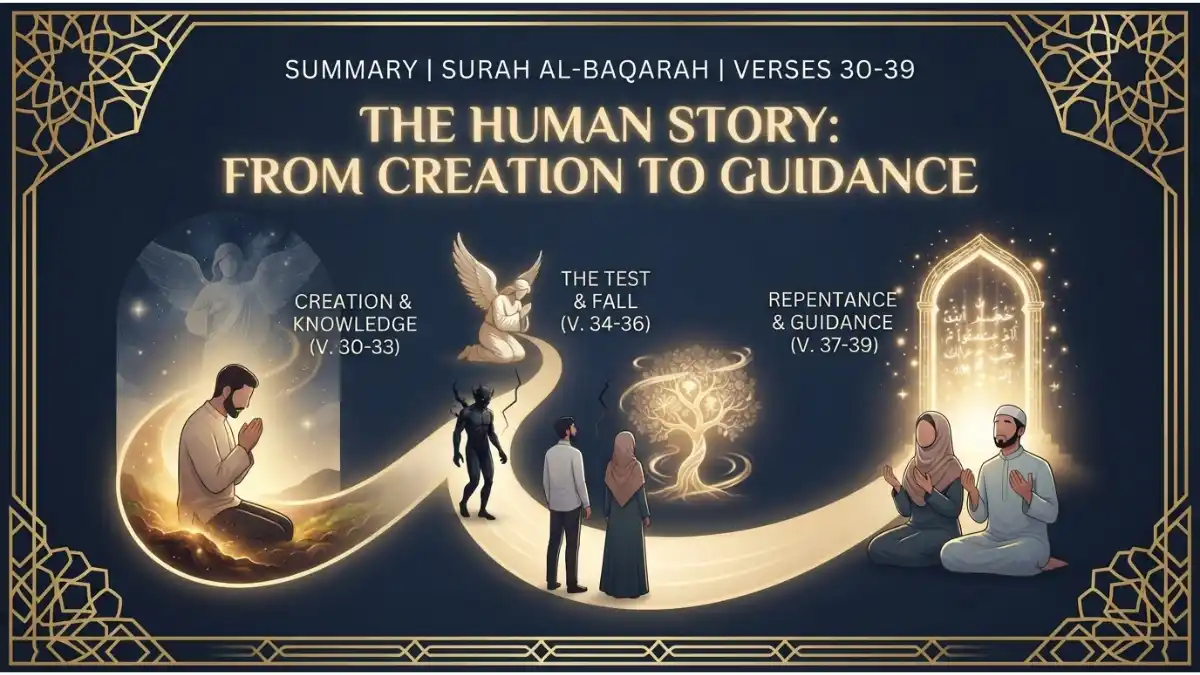
The Grand Human Saga: A Comprehensive Analysis of Surah Al-Baqarah (30–39)
The ten-verse thematic block spanning Verses 30 to 39 in Surah Al-Baqarah presents one of the most profound, intellectually stimulating, and spiritually rich narratives in divine revelation. Rather than serving merely as a historical recounting of ancient events, this passage articulates the foundational archetype—the spiritual blueprint—for every human being traversing earthly existence.
This divine chronicle traces the origins of humanity: from the cosmic announcement of human stewardship to the angelic dialogue, the demonstration of intellectual capacity through named concepts, the spiritual pitfall of Satanic pride, the temptation and stumble in Paradise, the mechanics of sincere repentance, and the ultimate establishment of divine guidance as humanity’s primary navigation tool on Earth.
Understanding this narrative as a cohesive whole grants believers critical insight into four fundamental dimensions of life: human purpose, cognitive gift, spiritual adversary, and the divine navigation system. Below is an itemized breakdown and thematic synthesis of these verses.
1. Surah Al-Baqarah Verse 30: The Declaration of Earthly Stewardship (Khalifah)
The Heavenly Dialogue: The narrative opens with a monumental proclamation where Allah Almighty announces to the angels His decree to create a vicegerent on Earth: “Indeed, I will make upon the earth a successive authority.” Observing previous creatures who caused corruption, the angels inquired with reverence regarding human potential for bloodshed. The Creator responded with absolute knowledge: “Indeed, I know that which you do not know.”
- Core Theological Insight: Human existence is neither an evolutionary accident nor a purposeless event. Humanity is explicitly commissioned as a Khalifah—a trustee, steward, and moral agent charged with cultivating justice, order, and spiritual harmony on Earth.
- Practical Application: Recognize your intrinsic value and responsibility. You were created to contribute meaningfully to society and act as a force for good rather than existing passively.
- Key Reflection: Humanity was created with an intentional divine mandate to build, heal, and lead creation with moral responsibility.
2. Surah Al-Baqarah Verse 31: The Primacy of Knowledge and Intellect
Demonstrating Human Potential: To demonstrate the justification for human stewardship, Allah taught Prophet Adam (peace be upon him) the names of all things (al-asma’)—representing language, conceptual thought, taxonomy, and scientific cognition—which the angels did not possess.
- Core Theological Insight: Human superiority over other created beings lies not in physical strength or innate sinlessness, but in intellectual capacity, conceptual reasoning, and the ability to learn and apply knowledge.
- Practical Application: Commit to lifelong learning. Knowledge paired with faith remains humanity’s primary instrument for solving complex societal problems and advancing civilization ethically.
- Key Reflection: The primary instrument for human leadership is curiosity, cognitive intellect, and sacred knowledge.
3. Surah Al-Baqarah Verse 32: Angelic Humility and Intellectual Integrity
The Ethics of Knowledge: Upon realizing their inability to name the concepts, the angels responded with immediate praise and humility: “Exalted are You; we have no knowledge except what You have taught us. Indeed, it is You who is the Knowing, the Wise.”
- Core Theological Insight: The angels’ response models absolute intellectual honesty. Acknowledging human limitations in the presence of Divine Wisdom represents the highest form of spiritual maturity.
- Practical Application: Cultivate the courage to say “I do not know” when facing topics beyond your expertise. False intellectual pretense breeds arrogance and leads to destructive errors.
- Key Reflection: Humbly admitting knowledge limits before Truth is far nobler than projecting false competence.
4. Surah Al-Baqarah Verse 33: Verification Through Demonstrated Competence
Fulfilling the Demonstration: At Allah’s command, Adam articulated the names and concepts to the angels. Allah then affirmed His absolute knowledge of the unseen reality in the heavens and the earth.
- Core Theological Insight: Skepticism and doubts are best addressed through quiet competence, proven ability, and tangible results rather than defensive arguments.
- Practical Application: When others doubt your capability or motives, remain focused on personal development, integrity, and producing meaningful work.
- Key Reflection: Refute skepticism not with emotional arguments, but with consistent competence and ethical action.
5. Surah Al-Baqarah Verse 34: The Danger of Arrogance and Ego (Iblis)
The Fall of Iblis: When Allah commanded the angels to prostrate before Adam in respect, all complied except Iblis (Satan). He refused out of pride (stakbara), asserting superiority and becoming of the disbelievers.
- Core Theological Insight: Satan’s downfall resulted not from a lack of intellect or devotional worship, but from ego, entitlement, and spiritual pride (kibr).
- Practical Application: Guard your heart continuously against feelings of moral superiority or entitlement. A single moment of unyielding pride can destroy years of good deeds.
- Key Reflection: Arrogance corrupts spiritual standing; maintain humility regardless of your achievements.
6. Surah Al-Baqarah Verse 35: Abundance and Moral Boundaries
Paradise and the Forbidden Tree: Adam and Eve were placed in Paradise to enjoy its vast provisions freely, with a single explicit boundary: “And do not approach this tree, lest you be among the wrongdoers.”
- Core Theological Insight: True freedom exists alongside ethical boundaries. Divine law provides extensive permissible options while establishing clear limits to protect human well-being.
- Practical Application: Enjoy lawful blessings with gratitude, but respect moral and spiritual guardrails. Indulgence without discipline leads to self-wrongdoing.
- Key Reflection: Abundance requires discipline; moral boundaries exist to safeguard freedom, not restrict it.
7. Surah Al-Baqarah Verse 36: Temptation, the Slip, and the Earthly Descent
The Stumble and Re-allocation: Satan deceived Adam and Eve, causing them to slip from their exalted state. Consequently, Allah commanded them to descend to Earth, initiating an era of struggle, social friction, and temporary provisions.
- Core Theological Insight: Human beings are vulnerable to lapses, but error does not equal total destruction. The term azalla highlights that Adam’s error was a slip, not an act of permanent malice.
- Practical Application: When you stumble or make a mistake, avoid falling into paralyzing guilt. Treat failures as catalysts for spiritual growth and immediate course correction.
- Key Reflection: Slipping is human; standing back up through repentance marks true spiritual resilience.
8. Surah Al-Baqarah Verse 37: The Mechanics of Divine Repentance
Inspired Words of Forgiveness: Adam received inspired words of prayer from his Lord, expressing humble remorse. Allah accepted his repentance, affirming His attributes as At-Tawwab (Accepting of Repentance) and Ar-Rahim (The Merciful).
- Core Theological Insight: The critical distinction between Adam and Satan lies in their response to sin. Satan justified his pride, whereas Adam owned his mistake and sought divine mercy.
- Practical Application: Never doubt God’s willingness to forgive. Whenever you make a mistake, turn back immediately with sincere humility and a commitment to improve.
- Key Reflection: God does not seek excuses to punish; He awaits our sincere return to restore us with mercy.
9. Surah Al-Baqarah Verse 38: The Divine Guarantee of Peace
The Heavenly GPS: As humanity arrived on Earth, Allah issued a permanent law: “Whenever guidance comes to you from Me, whoever follows My guidance—there will be no fear concerning them, nor will they grieve.”
- Core Theological Insight: Adhering to revelation provides complete psychological and spiritual security, freeing the human heart from future anxiety (khauf) and past grief (huzn).
- Practical Application: Make divine revelation your primary compass in personal, professional, and ethical decisions to achieve true peace of mind.
- Key Reflection: Divine guidance is the ultimate anchor, freeing the soul from future fears and past regrets.
10. Surah Al-Baqarah Verse 39: The Consequence of Rejecting Guidance
The Serious Warning: In contrast to those who follow guidance, those who disbelieve (kafaru) and deny divine signs (kadzdzabu) become companions of the Fire, abiding therein eternally.
- Core Theological Insight: Rejecting truth carries severe spiritual consequences. Deliberately ignoring moral guidance leads to spiritual alienation in this life and ultimate loss in the Hereafter.
- Practical Application: Avoid stubbornness when presented with truth. Keep your heart receptive to moral advice and divine warnings.
- Key Reflection: Rejecting guidance is like discarding a map at a cliff’s edge; it leads inevitably to ruin.
Comparative Framework: Lessons from the Passage
The table below summarizes the contrasting paths highlighted across Surah Al-Baqarah, Verses 30–39:
| Subject / Figure | Core Choice & Attitude | Spiritual Consequence | Practical Lesson for Humanity |
|---|---|---|---|
| The Angels | Immediate submission, humility, and acknowledging limits. | Elevated status and eternal divine proximity. | Practice intellectual humility and submit to Divine Wisdom. |
| Prophet Adam (AS) | Learning concepts, acknowledging mistakes, repenting sincerely. | Forgiveness, elevation, and earthly stewardship (Khalifah). | Embrace learning and turn quickly to God when stumbling. |
| Iblis (Satan) | Arrogance, self-justification, and refusing divine commands. | Permanent rejection, expulsion, and eternal damnation. | Guard against ego, pride, and justifying errors. |
| Followers of Guidance | Active adherence to divine revelation (Verse 38). | Total freedom from fear and grief; eternal Paradise. | Use divine revelation as your primary decision-making compass. |
| Rejecters of Guidance | Active denial (kafaru) and mocking divine signs (Verse 39). | Spiritual disorientation and eternal companionship of the Fire. | Avoid stubbornness and keep your conscience open to truth. |
Synthesizing Conclusion: Humanity’s Earthly Mission
Surah Al-Baqarah verses 30 to 39 establish a clear understanding of human existence. Earth is not a place of punitive exile; rather, it is a purposeful arena for stewardship, moral growth, and spiritual development. Humanity is equipped with intellect, language, and moral agency, but remains vulnerable to spiritual arrogance and subtle temptation.
Navigating this journey successfully requires combining knowledge with humility, seeking forgiveness promptly when we make mistakes, and using divine revelation as our primary guide. By aligning our choices with divine guidance, we can navigate earthly trials with peace and return safely to our ultimate home in Paradise.
Which of these lessons from Prophet Adam’s narrative resonates most with your current life journey? Share your thoughts and reflections in the comments section below!
- [Return to Summary of Verses 21–29: The Call to Return]
- [Return to Introduction to Surah Al-Baqarah]
- [Proceed to Verse 40: Remembering the Sacred Covenant]
- [Proceed to Summary of Verses 40–46 (Coming Soon)]