
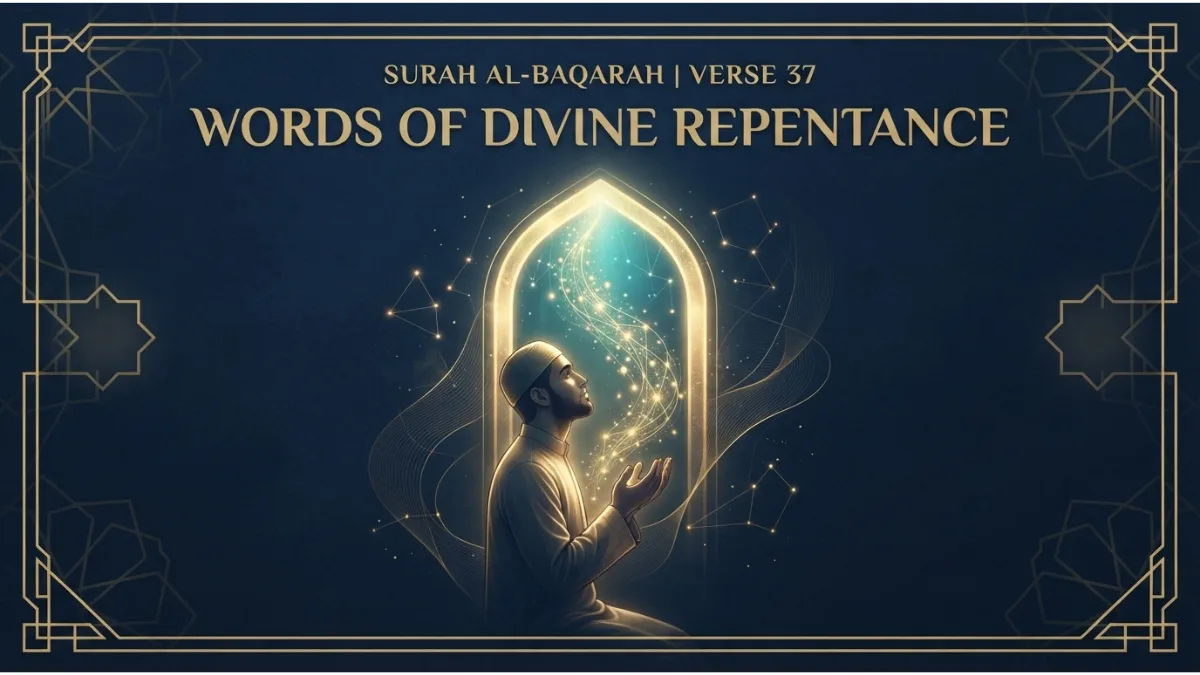
An Elegant Return: God’s Infinite Compassion for Human Frailty
Following the profound narrative in the preceding verse—where Prophet Adam (peace be upon him) and Eve (Hawa) slipped from their exalted station in Paradise and were commanded to descend to Earth—Surah Al-Baqarah verse 37 presents one of the most moving, comforting, and spiritually uplifting scenes in the Holy Quran. The departure of humanity from Paradise to Earth was never an act of divine vengeance or an eternal, hopeless curse. Instead, it marked the unfolding of a grand divine masterplan for human spiritual development, moral agency, and stewardship (khalifah) on Earth.
Consider the divine words revealed in the Holy Quran:
فَتَلَقَّىٰ آدَمُ مِن رَّبِّهِ كَلِمَاتٍ فَتَابَ عَلَيْهِ ۚ إِنَّهُ هُوَ التَّوَّابُ الرَّحِيمُ
“Fattalaqa adamu min rabbihi kalimatin fa taba ‘alaihi, innahu huwat-tawwabur-rahim.”
Translation: “Then Adam received from his Lord [some] words, and He accepted his repentance. Indeed, it is He who is the Accepting of Repentance, the Merciful.” (Surah Al-Baqarah: 37)
Pause for a moment to visualize the intense emotional and psychological reality experienced by Adam and Eve in that historical instant. Having approached the forbidden tree due to the subtle whisperings of Satan, they were immediately overcome by immense grief, profound regret, self-disappointment, and spiritual shame. They were required to leave the complete peace, security, and effortless abundance of Paradise to step onto an unfamiliar Earth filled with physical labor, struggle, and moral trials.
Yet, amidst this overwhelming vulnerability, the Creator did not abandon humanity to wallow in paralyzing guilt or despair. Before they even began their earthly journey, Allah Almighty initiated the healing process by granting Adam the exact divine tools needed to mend his broken spirit and restore his relationship with the Divine.
Linguistic Deep Dive: The Wisdom of “Fattalaqa” and “Kalimat”
The linguistic construction of Surah Al-Baqarah verse 37 contains profound theological and psychological insights that illuminate the nature of true repentance. The Quranic phrasing is meticulously selected to convey active divine care and human receptivity.
Classical scholars of Quranic exegesis (tafsir) emphasize several crucial linguistic elements:
- The Verb “Fattalaqa” (Active and Eager Reception): Derived from the root la-qi-ya, the verb talaqqa implies an active, mindful, and reverent receiving. It describes how Adam did not merely hear words passively; he eagerly embraced, absorbed, and applied the inspired divine guidance with complete humility.
- Divine Initiative in Repentance: The verse demonstrates that true repentance begins with divine grace. Allah did not merely demand an apology from Adam; He lovingly taught Adam how to articulate his remorse, giving him the precise words to knock on the door of divine mercy.
- The Indefinite Form “Kalimat” (Profound Words): The word kalimat (words) appears in an indefinite form (nakirah) in Arabic, highlighting the sublime weight, honor, and spiritual potency of these divinely taught supplications.
This linguistic dynamic reveals that God does not construct impossible barriers for those seeking reconciliation. When a servant feels lost and lacks even the strength to formulate a prayer, God provides the illumination and inspiration needed to guide them back home.
Unveiling the Sacred Supplication: The Prayer of Adam and Eve
What were these inspired words that transformed human remorse into immediate divine acceptance? Quranic commentators agree that these words are preserved explicitly in Surah Al-A’raf, verse 23. This supplication serves as the timeless foundation for all human repentance:
رَبَّنَا ظَلَمْنَا أَنفُسَنَا وَإِن لَّمْ تَغْفِرْ لَنَا وَتَرْحَمْنَا لَنَكُونَنَّ مِنَ الْخَاسِرِينَ
“Rabbana zalamna anfusana wa il-lam taghfir lana wa tarhamna lanakunanna minal-khasirin.”
Translation: “Our Lord, we have wronged ourselves, and if You do not forgive us and have mercy upon us, we will surely be among the losers.” (Surah Al-A’raf: 23)
Deconstructing this supplication exposes the core components of sincere repentance (taubatan nasuha):
- Absolute Personal Accountability: Adam and Eve began with “zalamna anfusana” (we have wronged ourselves). There was no attempt to blame Satan, rationalize their lapse, question divine wisdom, or externalize responsibility. They owned their mistake completely.
- Recognition of Absolute Need: By stating “if You do not forgive us… we will surely be among the losers,” they acknowledged that human dignity, success, and salvation rest entirely upon God’s grace and forgiveness.
- Absence of Arrogance: Unlike Iblis (Satan), who responded to his disobedience with pride, justification, and stubborn rebellion, Adam responded with immediate humility, vulnerability, and submission.
The moment Adam uttered this prayer with a broken, humble heart, Allah responded with immediate forgiveness: fa taba ‘alaihi. The Arabic conjunction fa signifies immediate succession without delay or obstruction.
The Theological Depth of At-Tawwab and Ar-Rahim
Surah Al-Baqarah verse 37 concludes with two magnificent Divine Names: “Innahu huwat-tawwabur-rahim”—“Indeed, it is He who is the Accepting of Repentance, the Merciful.” The combination of these specific names provides profound spiritual security for believers navigating human flaws.
| Divine Name | Linguistic Root & Meaning | Spiritual Impact on the Believer |
|---|---|---|
| At-Tawwab (الْتَّوَّاب) | Derived from ta-wa-ba (to return). It is an intensive form (mubalaghah) meaning “The One who constantly and repeatedly accepts repentance”. | Removes fear of reaching a “forgiveness limit”. No matter how many times a person stumbles, God continuously accepts their return whenever they are sincere. |
| Ar-Rahim (الرَّحِيم) | Derived from ra-hi-ma (mercy/compassion). Refers to the specific, intimate mercy bestowed continuously upon believers. | Ensures that divine forgiveness is not cold or reluctant. God restores the repentant servant with affection, honor, and complete spiritual warmth. |
This powerful pairing reinforces a central Quranic reality: God is not searching for excuses to punish His creation. Rather, He actively provides pathways for His servants to return, heal, and excel.
Comparative Framework: The Path of Adam vs. The Path of Iblis
To fully grasp the lesson of verse 37, we must contrast Adam’s spiritual response with that of Satan. Both erred, but their responses defined their eternal destinies:
| Dimension | The Response of Iblis (Satan) | The Response of Prophet Adam (AS) |
|---|---|---|
| Core Attitude | Arrogance, pride, and self-righteousness. | Humility, vulnerability, and self-awareness. |
| Reaction to Mistake | Blamed God and justified his disobedience. | Owned the mistake and acknowledged personal frailty. |
| Immediate Action | Persisted in rebellion and swore to mislead others. | Sought immediate forgiveness and turned back to God. |
| Ultimate Outcome | Eternal rejection, distance, and spiritual ruin. | Divine elevation, forgiveness, and earthly stewardship. |
The contrast is clear: perfection is not required of human beings, but sincere repentance and humility are essential. Sinning makes one human; arrogance and persistent justification align one with Satan, whereas humble repentance aligns one with the prophetic path.
Overcoming Toxic Guilt and Satanic Despair
One of Satan’s most insidious weapons after leading a person into sin is whispering despair: “Your sins are too vast, your past is too dark, your prayers are hypocritical, and God will never forgive you.”
This toxic guilt causes individuals to abandon prayer, distance themselves from righteous communities, and sink deeper into destructive behaviors. Surah Al-Baqarah verse 37 shatters this illusion completely. It reminds us that no matter how deep the fall or how heavy the burden of past errors, the lock on the door of divine repentance can never be broken.
True repentance is a transformative spiritual reset. It cleanses the conscience, restores peace of mind, and turns past failures into valuable spiritual wisdom.
Reflective Story: The Midnight Return of a Broken Heart
The principle of divine reception described in verse 37 continues to transform lives today. Consider the true account of a young professional who spent years immersed in a chaotic lifestyle far removed from faith, moral boundaries, and spiritual purpose. He chased material wealth and status, yet felt an unbearable inner emptiness.
Late one evening, after experiencing a painful personal betrayal and the collapse of a major business deal, he sat alone in his room. The weight of years of neglect, spiritual isolation, and moral compromise pressed heavily on his chest. He felt utterly unclean and unworthy.
Desperate for relief, he remembered a prayer his grandfather used to recite. He washed his face, sat quietly in the dark, and began repeating the supplication of Prophet Adam: “Rabbana zalamna anfusana…” Tears flowed freely as he released years of suppressed shame and acknowledged his mistakes before God.
He later recalled: “In that moment, I expected to feel judgment or crushing shame. Instead, as soon as I admitted my wrongs without excuses, an overwhelming sense of peace and lightness entered my heart. It felt as if a physical weight had been lifted off my chest. I knew then that God had not abandoned me.” That night became the turning point in his journey, leading him to reconstruct his life with integrity, purpose, and spiritual clarity.
Practical Action Steps: Performing a Spiritual Reset Today
To operationalize the teachings of Surah Al-Baqarah verse 37 in your daily life, apply these practical spiritual steps:
- Perform a Personal Spiritual Audit: Set aside 10 to 15 minutes of uninterrupted solitude today. Reflect honestly on areas where you have fallen short in your duties to God or fellow human beings.
- Engage in Sincere Repentance (Salat at-Tawbah): Perform ablution (wudu) carefully, pray two voluntary cycles of repentance prayer, and sincerely recite the prayer of Adam (Rabbana zalamna anfusana…) from the depth of your heart.
- Make Amends and Rectify Rights: If your mistake involved harming another person’s rights, reputation, or property, take concrete, courageous steps to seek their forgiveness and restore what was damaged.
- Extend Forgiveness to Others: As you seek and expect God’s vast mercy and forgiveness, open your heart to forgive those who have wronged you. Releasing grudges purifies your spiritual vessel.
Daily Practice Challenge
- Memorize and Internalize: Learn the Arabic text and English meaning of Surah Al-A’raf verse 23, and incorporate it into your daily personal supplications.
- Replace Guilt with Positive Action: Whenever a past mistake comes to mind today, immediately follow that thought with a good deed, charitable act, or sincere remembrance of God (dhikr).
- Support Someone Struggling: Reach out to a friend or family member who feels burdened by past mistakes and encourage them with the message of God’s limitless mercy.
Supplication for Purification and Steadfastness
We ask the Almighty to cleanse our hearts and accept our return:
“O Allah, You are At-Tawwab, the Ever-Accepting of Repentance, and Ar-Rahim, the Most Merciful. We acknowledge our shortcomings, our mistakes, and our vulnerabilities before You. Wash away our sins with the water of Your forgiveness, free our hearts from despair and arrogance, and guide our steps upon the path of righteousness. Accept our return, as You accepted the repentance of our father Adam, and gather us among Your righteous servants. Ameen, O Lord of the Worlds.”
Frequently Asked Questions (FAQ)
Q: How do I know if my repentance has been accepted by God?
A: Islamic scholars explain that key signs of accepted repentance include feeling a genuine aversion toward the past sin, experiencing inner tranquility, and finding renewed ease and consistency in performing good deeds. If you feel motivated to grow closer to God, it is a strong indicator of His grace.
Q: What if I repent sincerely but fall back into the same sin later?
A: Never stop repenting. God’s attribute as At-Tawwab means He repeatedly accepts repentance. Each time you fall, immediately stand back up, renew your intention, make amends, and return to God. Repentance is a lifelong habit, not a one-time event.
Have you ever felt a profound sense of peace after sincerely seeking forgiveness and letting go of past guilt? Share your reflections and thoughts in the comments section below!