
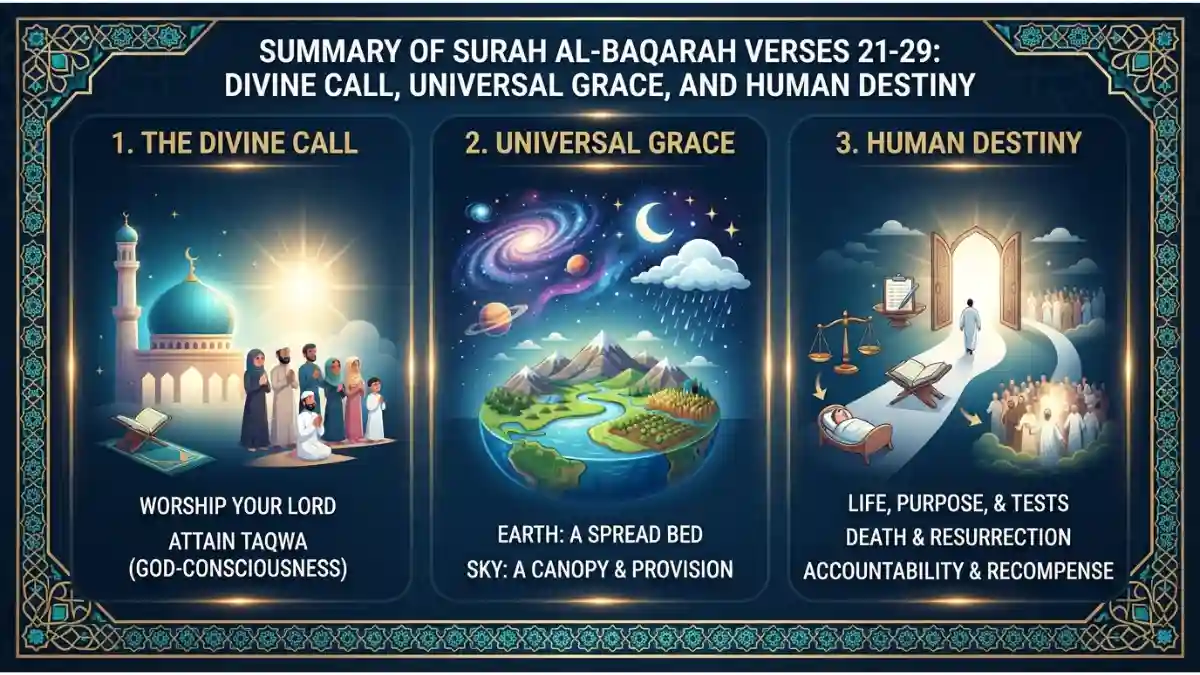
Introduction: The Divine Call to Return Home
The passage spanning from Verse 21 to Verse 29 in Surah Al-Baqarah represents a magnificent shift in the Quranic narrative. After dissecting the traits of believers, disbelievers, and the subtle hypocrisy of the Munāfiqūn in Verses 1 through 20, the Almighty turns directly to all of humankind with an intimate, universal invitation. This section serves as a complete spiritual framework, guiding humanity from its foundational duty of worship to recognizing cosmic proofs, understanding divine challenges, confronting the reality of the afterlife, and fulfilling our purpose on Earth.
Below is an exhaustive thematic study and contemplative summary (tadabur) covering each verse within this pivotal block.
Comprehensive Verse-by-Verse Breakdown (Verses 21–29)
1. Verse 21: The First Universal Call to All Humanity
Quranic Text: “O mankind, worship your Lord, who created you and those before you, that you may become righteous.” (QS. Al-Baqarah: 21)
- Core Meaning: This marks the very first address to humanity in the Quranic order using the universal phrasing “Yā ayyuhan-nās” (“O mankind”). It transcends social, tribal, and religious backgrounds, extending an open invitation to every human soul to worship Allah alone in order to attain God-consciousness (Taqwā).
- Key Insight: True worship (‘Ibādah) is not a restrictive burden imposed by the Creator; rather, it is a spiritual refuge designed to liberate human hearts from the enslavement of worldly desire, social anxiety, and false idols.
- Spiritual Wisdom: “The Almighty does not call upon the sinless alone; He extends His mercy to all human beings, urging them to return to inner peace.”
2. Verse 22: Evidence of Divine Benevolence in Nature
Quranic Text: “[He] who made for you the earth a bed [spread out] and the sky a ceiling and sent down from the sky, rain and brought forth thereby fruits as provision for you. So do not attribute to Allah equals while you know.” (QS. Al-Baqarah: 22)
- Core Meaning: Allah presents logical, observable arguments for His exclusive right to be worshipped. The vast expanse of the Earth serves as a stable floor, the sky acts as a protective canopy, and water yields life-sustaining produce without any cost to us.
- Key Insight: Recognizing daily provisions—such as clean water, breathable atmosphere, and fertile soil—must naturally cultivate deep gratitude and lead us away from setting up rivals (Andād) beside God.
- Spiritual Wisdom: “The air we breathe and the soil beneath our feet are the most visible, unconditional demonstrations of Divine Love.”
3. Verse 23: The Unbreakable Challenge of the Quran
Quranic Text: “And if you are in doubt about what We have sent down upon Our Servant, then produce a surah the like thereof and call upon your witnesses other than Allah, if you should be truthful.” (QS. Al-Baqarah: 23)
- Core Meaning: To those who harbor skepticism regarding the divine origin of revelation, the Quran presents a timeless literary and rational challenge: produce even a single chapter comparable to its eloquence, wisdom, and guidance.
- Key Insight: The absolute failure of humanity across centuries to match the Quran proves that this scripture is not the product of human intellect, but the uncreated word of the All-Knowing Creator.
- Spiritual Wisdom: “The Quran is not merely an ancient historical text, but an eternal divine communication that human ingenuity can never replicate.”
4. Verse 24: A Stern Warning Against Intellectual Arrogance
Quranic Text: “But if you do not—and you will never be able to—then fear the Fire, whose fuel is men and stones, prepared for the disbelievers.” (QS. Al-Baqarah: 24)
- Core Meaning: The Quran boldly predicts that humanity will never meet its literary challenge, warning that persistent rejection rooted in pride leads to catastrophic spiritual consequences.
- Key Insight: Divine warnings serve as spiritual emergency brakes. Hellfire, fuelled by rebellious human hearts and stone idols, stands as the ultimate outcome of deliberate truth denial.
- Spiritual Wisdom: “Soften your heart before it hardens like stone; the greatest remorse stems from refusing clear truth.”
5. Verse 25: Glad Tidings for Doers of Good
Quranic Text: “And give good tidings to those who believe and do righteous deeds that they will have gardens in Paradise beneath which rivers flow…” (QS. Al-Baqarah: 25)
- Core Meaning: In classic Quranic balance, warnings are immediately paired with hopeful promises. Believers who pair faith with righteous actions are promised eternal gardens, pure companions, and perfected provisions.
- Key Insight: Physical weariness experienced while obeying divine commandments is temporary, whereas the joy and spiritual elevated rank earned in Paradise endure forever.
- Spiritual Wisdom: “The fatigue of doing good fades away quickly, but the eternal reward and spiritual peace remain forever.”
6. Verse 26: The Wisdom Behind Humble Parables
Quranic Text: “Indeed, Allah is not timid to present an example—that of a mosquito or what is smaller than it…” (QS. Al-Baqarah: 26)
- Core Meaning: Critics questioned why the divine scripture uses humble creatures like mosquitoes or spiders in its parables. Allah clarifies that truth is independent of physical scale. These parables guide humble hearts while exposing arrogant minds.
- Key Insight: Sincerity determines how one receives divine truth. A humble believer sees profound wisdom in the smallest creature, while an arrogant skeptic searches for excuses to dismiss guidance.
- Spiritual Wisdom: “A sincere heart beholds the majesty of God even within the intricate design of a mosquito’s wing.”
7. Verse 27: The Destructive Nature of Covenant-Breaking
Quranic Text: “Who break the covenant of Allah after its confirmation and sever that which Allah has ordered to be joined and cause corruption on earth…” (QS. Al-Baqarah: 27)
- Core Meaning: This verse outlines the hallmarks of the defiantly disobedient (Fāsiqūn): breaking sacred oaths made with God, severing ties of kinship and human solidarity, and causing widespread corruption on Earth.
- Key Insight: Spiritual corruption always manifests as social ruin. When individuals abandon their duty to the Almighty, their interpersonal relationships and societal commitments naturally collapse.
- Spiritual Wisdom: “Societal ruin across the globe begins when small, sacred commitments made with the Divine are routinely ignored.”
8. Verse 28: The Four Evolutionary Stages of Human Existence
Quranic Text: “How can you disbelieve in Allah when you were lifeless and He brought you to life; then He will cause you to die, then He will bring you to life, and then to Him you will be returned?” (QS. Al-Baqarah: 28)
- Core Meaning: Allah poses a deeply reflective question, walking humanity through our four distinct stages of existence: initial non-existence (lifelessness), worldly life, physical death, and ultimate resurrection for final judgment.
- Key Insight: Understanding our complete journey instills deep humility. We are merely travelers passing through a brief worldly phase before returning to our Originator.
- Spiritual Wisdom: “We emerged from non-being, were granted life to practice goodness, and will inevitably return to account for our stewardship.”
9. Verse 29: Earthly Facilities and Cosmic Sovereignty
Quranic Text: “It is He who created for you all of that which is on the earth. Then He directed Himself to the heaven and made them seven heavens, and He is Knowing of all things.” (QS. Al-Baqarah: 29)
- Core Meaning: The concluding verse of this section affirms that Earth’s entire ecosystem was engineered specifically to sustain humanity, alongside the creation of seven balanced heavens under absolute divine omniscience.
- Key Insight: Humanity is granted a privileged place in creation, accompanied by the responsibility to act as wise, accountable stewards (Khalīfah) over natural resources.
- Spiritual Wisdom: “The cosmos is a finely tuned stage designed by the Creator for humanity to enact faith, gratitude, and moral excellence.”
Summary Matrix: Core Themes of Surah Al-Baqarah Verses 21–29
The table below synthesizes the core themes, primary Quranic lessons, and practical daily actions derived from this profound passage:
| Verse Range | Primary Quranic Theme | Core Theological Insight | Practical Daily Application |
|---|---|---|---|
| Verses 21–22 | The Call to Monotheism (Tawḥīd) | God’s exclusive right to worship is proven through natural provisions. | Cultivate daily gratitude (Shukr) for basic blessings like water, air, and shelter. |
| Verses 23–24 | The Inimitability of Revelation (I‘jāz) | Humanity’s inability to match the Quran proves its divine authorship. | Adopt the Quran as your primary compass for ethical and moral guidance. |
| Verse 25 | Glad Tidings for Believers | Faith combined with righteous action yields eternal reward. | Remain consistent in doing good deeds, knowing no effort is wasted. |
| Verses 26–27 | Divine Parables & Covenants | Sincerity unlocks revelation, while arrogance breeds moral decline. | Honor all personal and spiritual covenants; maintain strong family ties. |
| Verses 28–29 | Life Cycle & Cosmic Stewardship | Humanity moves through set stages of existence on a divinely prepared Earth. | Practice responsible environmental care and live with resurrection in mind. |
Synthesis: The Overarching Narrative Arc
When studied as a cohesive unit, Verses 21 through 29 build an undeniable spiritual argument:
- The Divine Call (Verses 21–22): Establishes why we must worship God based on His tangible blessings around us.
- The Proof of Message (Verses 23–25): Authenticates the Quranic message through its literary challenge and balances warnings with promises.
- The Spiritual Test (Verses 26–27): Demonstrates how human attitudes toward revelation reveal the true state of their hearts.
- The Ultimate Destiny (Verses 28–29): Reminds humanity of its journey through life, death, and resurrection upon an Earth created specifically for its trial.
Frequently Asked Questions (FAQ)
Question: “Why does the address in Verse 21 target ‘all mankind’ rather than only ‘believers’?”
Answer: Surah Al-Baqarah Verses 21–22 establish foundational truths applicable to every human being regardless of background. Because all humans benefit from Earth’s provisions, atmosphere, and water, the call to recognize and worship the Creator of these provisions is naturally extended to all of humanity.
Question: “What is the significance of pairing faith (Iman) with good deeds (Amal Salih) in Verse 25?”
Answer: In Islamic theology, inner faith and outward action are inseparable. Faith acts as the root of a tree, while good deeds represent its fruit. Verse 25 emphasizes that true belief must manifest as active kindness, integrity, and worship in daily life.
Question: “How do the four stages of human existence in Verse 28 help relieve daily anxiety?”
Answer: Remembering that our current life is merely the second phase in a four-stage journey puts worldly challenges into perspective. Hardships become temporary tests, and our primary focus shifts toward preparing for the eternal return to our Creator.
This article is part of the thematic study series: Summary of Tadabur Surah Al-Baqarah