
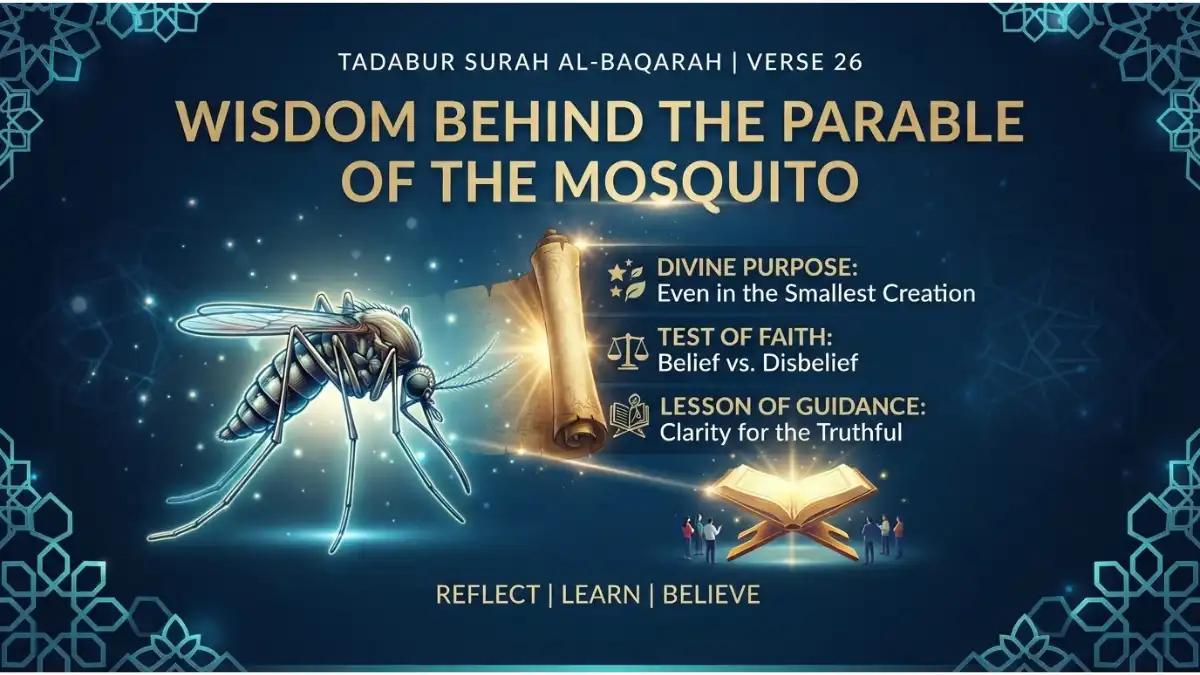
Introduction: Precision and Purpose in Divine Parables
Every single verse within the Noble Quran is revealed with absolute precision, purpose, and spiritual depth. Immediately following Surah Al-Baqarah Verse 25—where Almighty Allah presented glad tidings of Paradise, flowing rivers, and purified companionship—Verse 26 transitions to address the doubts, intellectual arrogance, and dismissive attitudes of skeptics who questioned why divine revelation contains parables involving humble creatures.
When the Quran used analogies involving small insects such as flies, spiders, or ants to illustrate moral truths, critics attempted to mock these parables, arguing that the Sovereign of the Universe would not mention such insignificant beings. Surah Al-Baqarah Verse 26 responds directly to this skepticism, establishing a timeless lesson on humility, biological wonder, and spiritual discernment.
“Inna-Allāha lā yastaḥyī an yaḍriba mathalan mā ba‘ūḍatan famā fawqahā, fa-ammā-lladhīna āmanū fayā‘lamūna annahul-ḥaqqu min rabbihim, wa ammā-lladhīna kafarū fayaqūlūna mādhā arāda-Allāhu bihādhā mathalā, yuḍillu bihī kathīran wa yahdī bihī kathīran, wa mā yuḍillu bihī illāl-fāsiqīn.”
Translation: “Indeed, Allah is not timid to present an example—that of a mosquito or what is smaller than it. And those who have believed know that it is the truth from their Lord. But as for those who disbelieve, they say, ‘What did Allah intend by this as an example?’ He misleads many thereby and guides many thereby. And He misleads not thereby except the defiantly disobedient.” (QS. Al-Baqarah: 26)
Engaging in deep contemplation (tadabur) over this verse reveals that the validity of truth is not dictated by the physical size of the analogy, but by the weight of the moral wisdom it conveys.
Confronting Intellectual Arrogance and Skepticism
Dismissive cynicism regarding divine signs is a recurring human phenomenon. Skeptics during the prophetic era often questioned why divine scripture would discuss humble creatures instead of grand cosmic phenomena. They framed their dismissive questions as critical intellect, when in reality, it reflected deep-seated pride that blinded their hearts from recognizing guidance.
Through this verse, Almighty Allah delivers a clear declaration: The Creator never feels hesitant or reluctant to draw parables from any aspect of His creation, regardless of how small or insignificant it may appear to human eyes—be it a mosquito, an insect, or microscopic organisms like bacteria, viruses, and cellular structures unseen by the naked eye.
True intelligence is demonstrated through humble reflection on the sign itself, whereas intellectual arrogance focuses on superficial technicalities to justify rejecting truth.
Biological Miracles: The Complex Engineering of a Mosquito
Why does the Quran explicitly highlight the mosquito (ba‘ūḍah)? To the untrained eye, a mosquito appears as a minor pest that is easily crushed. However, when examined through modern biological science and microscopic investigation, the mosquito is revealed as an astonishing masterpiece of biological engineering.
Contained within this tiny creature are sophisticated physiological and sensory systems that defy human engineering capabilities:
- Advanced Compound Vision:
Mosquitoes possess hundreds of compound eyes (ommatidia) that allow them to process movement, light spectrums, and spatial dimensions with remarkable speed and precision.
- Thermal and Carbon Sensing Organ:
Equipped with thermal sensors and olfactory receptors, mosquitoes can detect body heat, sweat composition, and traces of carbon dioxide from significant distances in total darkness.
- Intricate Proboscis Apparatus:
The feeding apparatus (proboscis) is not a simple needle; it consists of six distinct microscopic stylets. These blades work together to pierce skin, numb local tissue, prevent blood clotting via specialized enzymes, and draw fluid efficiently.
- Aerodynamic Flight Stabilization:
A mosquito’s wings beat hundreds of times per second, controlled by neural feedback mechanisms that surpass the flight maneuverability of advanced human aviation technology.
- Parasites and Micro-organisms (“What is Smaller Than It”):
The phrase “famā fawqahā” (“or what is smaller/above it in delicacy”) aligns with biological findings showing that mosquitoes host microscopic organisms, parasites, and bacteria on their bodies—demonstrating layers of biological complexity within a single insect.
If all scientists, engineers, and supercomputers on Earth were combined, humanity could never create a living mosquito from nothingness. What humans dismiss as mundane is, in reality, a powerful demonstration of divine design.
Analytical Framework: The Two Human Reactions to Divine Parables
Surah Al-Baqarah Verse 26 presents a clear contrast between two fundamental ways human minds process divine signs and moral lessons.
| Dimension | The Mindset of Believers (Al-Mu’minūn) | The Mindset of the Disobedient (Al-Fāsiqīn) |
|---|---|---|
| Initial Reaction | Approaches with humility and intellectual curiosity. | Approaches with cynicism, mocking, and condescension. |
| Focus of Attention | Seeks the underlying wisdom, lesson, and moral truth. | Fixates on superficial details to argue and debate. |
| Core Attitude | Acknowledges human limitations compared to Divine Knowledge. | Overestimates human intellect and succumbs to pride. |
| Spiritual Result | Gains increased faith, clarity, and guidance (Hudā). | Falls into deeper skepticism, arrogance, and misguidance (Ḍalālah). |
The parable itself remains identical for both groups; it is the condition of the heart receiving the message that dictates whether it becomes a source of guidance or a cause for further misguidance.
Classical Exegesis (Tafsir) on Verse 26
Classical scholars of Quranic exegesis provided deep insights into the structure and meaning of Verse 26:
1. Tafsir Ibn Kathir
Imam Ibn Kathir records that when Allah revealed parables involving flies and spiders in other chapters, critics remarked: “Why does Allah mention such trivial things in the Quran?” In response, Allah revealed Verse 26 to clarify that truth is not measured by physical volume. Ibn Kathir explains that Allah uses both large and small examples to illustrate reality, and a believer recognizes divine wisdom regardless of the scale of the example.
2. Tafsir Al-Qurtubi
Imam Al-Qurtubi discusses the phrase “lā yastaḥyī” (is not timid/hesitant). He explains that bashfulness in human terms stems from fear of criticism or weakness. However, when applied to Allah, it signifies that Allah never refrains from declaring truth or conveying wisdom out of regard for human misconceptions. Al-Qurtubi also highlights that al-fāsiqīn refers to those who depart from obedience, allowing their pride to sever their connection to divine guidance.
3. Tafsir At-Tabari
Imam At-Tabari emphasizes the phrase “yuḍillu bihī kathīran wa yahdī bihī kathīran”. He notes that divine misguidance is not an arbitrary act; rather, Allah allows people to wander into misguidance as a direct consequence of their deliberate choice to mock truth, display pride, and reject clear evidence (fisq).
A Reflective Narrative: A Scientist’s Journey Beyond Pride
The transformative power of observing small creations can be seen in real-world human experiences. Consider the journey of a molecular biologist who spent the early years of his academic career driven by intellectual pride. He believed that modern empirical science could explain all natural phenomena without referencing a Divine Creator.
For years, his research focused on cellular structures, protein folding, and microscopic biological mechanisms. However, as electron microscopy allowed him to observe the incredible complexity of intracellular transport systems within single-celled organisms, his perspective shifted dramatically.
He later shared: “Early in my career, I assumed science made faith redundant. But as I spent thousands of hours analyzing the automated repair systems, genetic coding, and molecular motors inside microscopic cells, my arrogance crumbled. I realized that the microscopic world operates with a level of order, coding, and design that no random process could ever assemble. The very micro-world I once dismissed became the gateway that brought my heart into submission before the Creator.”
His scientific knowledge ceased to be an instrument of pride; instead, it became a lens through which he recognized divine majesty within the smallest details of nature.
Four Practical Lessons for Everyday Life
To apply the practical wisdom of Surah Al-Baqarah Verse 26, we can implement four daily habits:
- Observe the Small Details Around You:
Set aside time daily to carefully observe small natural occurrences—such as the organization of an ant colony, the structure of a leaf, or the movement of water droplets. Reflect on the order sustaining these simple elements.
- Overcome the Tendency to Dismiss Small Things:
Never look down on small acts of kindness, simple words of advice, or modest opportunities for good. Major life blessings often enter through doors that appear minor or ordinary.
- Approach Learning with Humility:
When studying religious texts, acquiring scientific knowledge, or receiving constructive feedback, maintain a humble mindset focused on seeking wisdom rather than searching for flaws to satisfy the ego.
- Guard Against Intellectual Arrogance:
Recognize that human knowledge is inherently limited. True intellect is measured by one’s ability to submit to clear truth rather than using clever arguments to bypass moral accountability.
A Heartfelt Supplication for Guidance and Humility
“Allāhumma arinal-ḥaqqa ḥaqqaw-warzuqnāt-tibā‘ah, wa arinal-bāṭila bāṭilaw-warzuqnāj-tinābah. Allāhumma ihdinā fīman hadayt, wa ‘āfinā fīman ‘āfayt. Allāhumma a‘ūthu bika min ‘ilmin lā yanfa‘, wa min qalbin lā yakhsha‘. Amīn Yā Rabbal-‘Ālamīn.”
Translation: “O Allah, show us the truth as truth and grant us the ability to follow it, and show us falsehood as falsehood and grant us the ability to avoid it. O Allah, guide us among those You have guided, and grant us well-being among those You have granted well-being. O Allah, I seek refuge in You from knowledge that does not benefit and from a heart that does not humble itself. Amin, O Lord of the Worlds.”
Frequently Asked Questions (FAQ)
Question: “How can one cultivate a mind that seeks wisdom in small details rather than falling into superficial criticism?”
Answer: Cultivating mindfulness and sincere humility is essential. When an individual slows down, suppresses the urge to judge immediately, and asks, “What lesson is contained here for me?”, small events, simple advice, and ordinary natural signs become rich sources of spiritual insight and moral growth.
Question: “What does the term ‘Fāsiqīn’ specifically mean in the context of Verse 26?”
Answer: Linguistically, fisq refers to a date breaking out of its skin. In Quranic terminology, al-fāsiqīn refers to those who consciously step outside the boundary of divine obedience and moral uprightness. In Verse 26, it describes individuals who allow arrogance to sever their connection to divine guidance, causing them to reject truth when presented through simple parables.
This article is part of the thematic study series: Summary of Tadabur Surah Al-Baqarah