
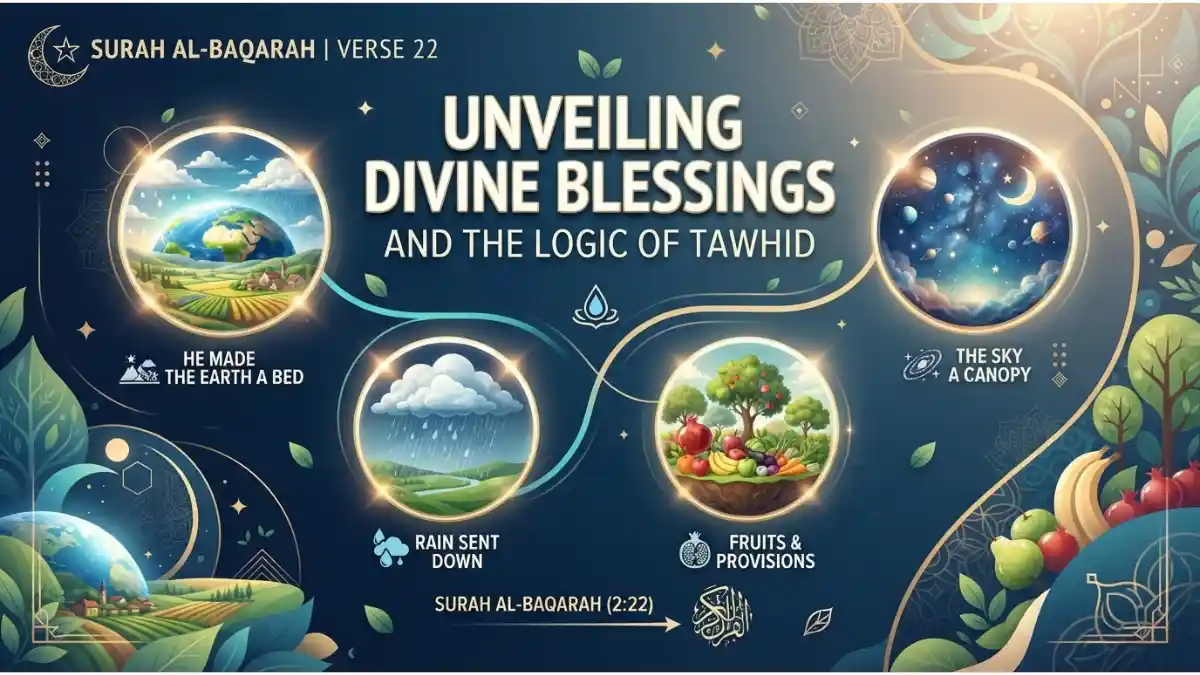
Introduction: The Logical Foundation for Divine Worship
In verse 21 of Surah Al-Baqarah, Allah Almighty issued a warm, universal call addressing all of humanity to worship and devote themselves solely to their Sustainer. Following that universal invocation, verse 22 provides a compelling, highly rational argument explaining why human beings are logically and morally obligated to submit to God alone.
The reasoning presented in the Quran is both profound and accessible to every intellect: God must be worshipped exclusively because He alone engineered, sustained, and provided all the essential “life-support facilities” of the universe—entirely free of cost.
“Alladhī ja‘ala lakumul-arḍa firāshaw was-samā’a binā’aw wa anzala minas-samā’i mā’an fa-akhraja bihī minath-thamarāti rizqal lakum, falā taj‘alū lillāhi andādaw wa antum ta‘lamūn.”
Translation: “[He] who has made for you the earth a bed [spread out] and the sky a ceiling and sent down from the sky, rain, and brought forth thereby fruits as provision for you. So do not attribute to Allah equals while you know.” (QS. Al-Baqarah: 22)
Deconstructing the Four Fundamental Life-Support Facilities
To truly grasp the weight of this verse, imagine the immense challenges humanity would face attempting to inhabit another planet within our solar system. On Mars or the Moon, environmental conditions are brutal: atmospheric pressure is negligible, temperatures swing to deadly extremes, water is locked in ice or absent, and the soil cannot sustain agricultural life. Surviving even a few hours requires millions of dollars in specialized suits and oxygen tanks.
Yet, observe how flawlessly Allah has engineered planet Earth as a habitable sanctuary for humanity:
1. The Earth as a Comfortable Bed (Firāshā)
The term firāshā literally refers to a carpet, mattress, or bed spread out comfortably. Allah did not design the Earth’s surface to be as rigid as jagged rock, nor as unstable as quicksand. The Earth features optimal gravitational pull, stable tectonic foundations, and a climate system that enables humans to build homes, cultivate crops, walk effortlessly, and rest safely without floating into the void of space.
2. The Sky as a Protective Canopy (Binā’ā)
The word binā’ā depicts a sturdy roof, dome, or architectural ceiling. In light of modern astrophysical science, this “sky ceiling” manifests as the Earth’s atmosphere, ozone layer, and magnetosphere. This invisible shield works continuously every second, deflecting lethal ultraviolet radiation, burning up incoming space debris, and maintaining thermal stability against the freezing void of outer space.
3. The Precision Cycle of Rainwater (Mā’an minas-Samā’i)
Water is the foundational liquid of organic existence. Through a sophisticated hydrological cycle of evaporation, condensation, and precipitation, Allah sends down fresh rainwater in precise measures. This purified water quenches human thirst, cleanses ecosystems, and feeds rivers that have sustained human civilization throughout history.
4. Agricultural Abundance and Food Security (Akharaja bihī minath-Thamarāt)
As rainwater saturates the soil, it interacts with essential ground nutrients and sunlight to cultivate thousands of plant species. The diverse sustenance humans enjoy daily—grains, vegetables, and sweet fruits—represents a natural manufacturing system controlled entirely by God to guarantee human survival.
Comparative Analysis: Natural Design vs. Human Needs
The table below summarizes the four primary provisions mentioned in verse 22 and their ecological and spiritual significance:
| Quranic Term | Literal & Physical Meaning | Ecological / Scientific Function | Spiritual Reflection |
|---|---|---|---|
| Al-Arḍa Firāshā | Earth as a spread-out bed | Balanced gravity, crust stability, hospitable terrain. | Acknowledging Earth as a tailored dwelling designed for human ease. |
| As-Samā’a Binā’ā | Sky as a protective ceiling | Atmospheric insulation, ozone filtration, radiation protection. | Recognizing invisible divine guards protecting life from destruction. |
| Mā’an minas-Samā’i | Rainwater from the sky | Water cycle replenishment, soil hydration, ecosystem renewal. | Understanding rain as an active manifestation of divine mercy. |
| Thamarāti Rizqal lakum | Fruits as provision for you | Agricultural output, nutritional variety, food security. | Realizing that true sustenance originates beyond human industry. |
The Subtle Trap of “Modern Idolatry” (Shirk)
Despite these vast provisions being provided without monthly invoices, human nature is prone to spiritual heedlessness (ghaflah). Because these natural systems function consistently every day, people frequently take them for granted or attribute them to blind chance.
This heedlessness often leads to spiritual arrogance, where individuals credit their wealth, health, and security solely to their own intellect, effort, or technological prowess. From this mind-state arises subtle forms of polytheism (shirk):
- Worship of Ego and Career: Viewing one’s job, credentials, or corporate title as the ultimate guarantor of life and security, placing more trust in financial safety nets than in divine providence.
- Deification of Material Wealth: Making the accumulation of money the central purpose of existence, even when it requires violating moral and ethical boundaries.
- Over-Reliance on Creation: Fearing social disapproval, public opinion, or loss of status more than compromising one’s spiritual integrity.
The closing segment of verse 22 delivers a poignant admonition: “falā taj‘alū lillāhi andādaw wa antum ta‘lamūn” (“So do not attribute to Allah equals while you know”). The phrase “while you know” appeals directly to human intellect. Deep down, every person recognizes that no human institution, government, or technology can engineer a single drop of rain or synthesize life from nothingness if God withhold it.
Insights from Classical Tafsir Scholars
Classical commentators have provided profound insights regarding the structure and implications of this verse:
Ibn Kathir emphasizes that this verse serves as a primary proof for the oneness of God in His lordship (Tawḥīd ar-Rubūbiyyah), which inherently necessitates His exclusive right to worship (Tawḥīd al-Ulūhiyyah). He writes that the Creator of these grand systems is the only Being entitled to human devotion.
Al-Qurtubi highlights the phrase “rizqal lakum” (as provision for you), pointing out that Allah explicitly reminds humanity of His generosity to evoke heartfelt gratitude. Gratitude, when nurtured properly, prevents hearts from sliding into idolatry.
Fakhr al-Din al-Razi discusses the cosmic harmony between the sky (the active agent lowering rain) and the earth (the receptive agent yielding crops), demonstrating that the universe operates under a unified, intelligent Will rather than fragmented forces.
An Illustrative Reflection: Recognizing Value in Times of Loss
Consider the story of an individual who spent several weeks in intensive care due to a severe respiratory failure. To survive, he depended entirely on high-concentration medical oxygen tanks. Upon his recovery, he received a hospital bill totaling thousands of dollars solely for his oxygen consumption over a few days.
Overwhelmed with emotion, he remarked: “I lived for decades breathing the open air for free without ever thinking about its cost. It was only when oxygen was metered in a tank at a high price that I realized how immensely blessed I am every second to be sustained by God’s free provisions.”
This reflection serves as a powerful reminder for everyone. Humans often fail to appreciate health, clean air, stable ground, and drinkable water until those blessings are temporarily disrupted by illness or natural adversity.
Three Practical Steps for Daily Implementation
To integrate the lessons of Surah Al-Baqarah verse 22 into daily life, adopt these practical habits:
- Practice Mindful Gratitude in Nature:
Spend 5 to 10 minutes daily outdoors away from digital screens. Observe the sky, feel the breeze, and contemplate the natural systems sustaining life, acknowledging them with a heartfelt “Alhamdulillah”.
- Reflect Upon Meals as Divine Provisions:
Before eating, pause to trace the origin of your food: from rain falling from the sky to crops growing from the soil. Transforming mealtime into a moment of spiritual reflection strengthens gratitude.
- Audit the Heart for Subtle Idols:
Perform regular self-examinations (muḥāsabah). Ask yourself whether anxieties about career, financial security, or social validation have eclipsed your trust in God’s ultimate care, and re-center your reliance on the Sustainer.
Prayer for Firm Monotheism and Gratitude
“Allāhumma a‘innī ‘alā dhikrika wa shukrika wa ḥusni ‘ibādatik. Allāhumma innī a‘ūdhu bika an ushrika bika wa anā a‘lamu, wa astaghfiruka limā lā a‘lam.”
Translation: “O Allah, help me remember You, give thanks to You, and worship You in the best manner. O Allah, I seek refuge in You from knowingly associating partners with You, and I seek Your forgiveness for that which I do not know.”
Frequently Asked Questions (FAQ)
Question: “How can one maintain a spirit of gratitude when facing material hardship or lacking worldly comfort?”
Answer: The key lies in reflecting upon foundational, universal blessings that money cannot buy—such as the air we breathe, the functioning of our internal organs, a stable earth, and the light of guidance. When secondary worldly comforts diminish, remembering these fundamental provisions helps maintain perspective and preserves contentment.
This article is part of the thematic study series: Summary of Tadabur Surah Al-Baqarah