
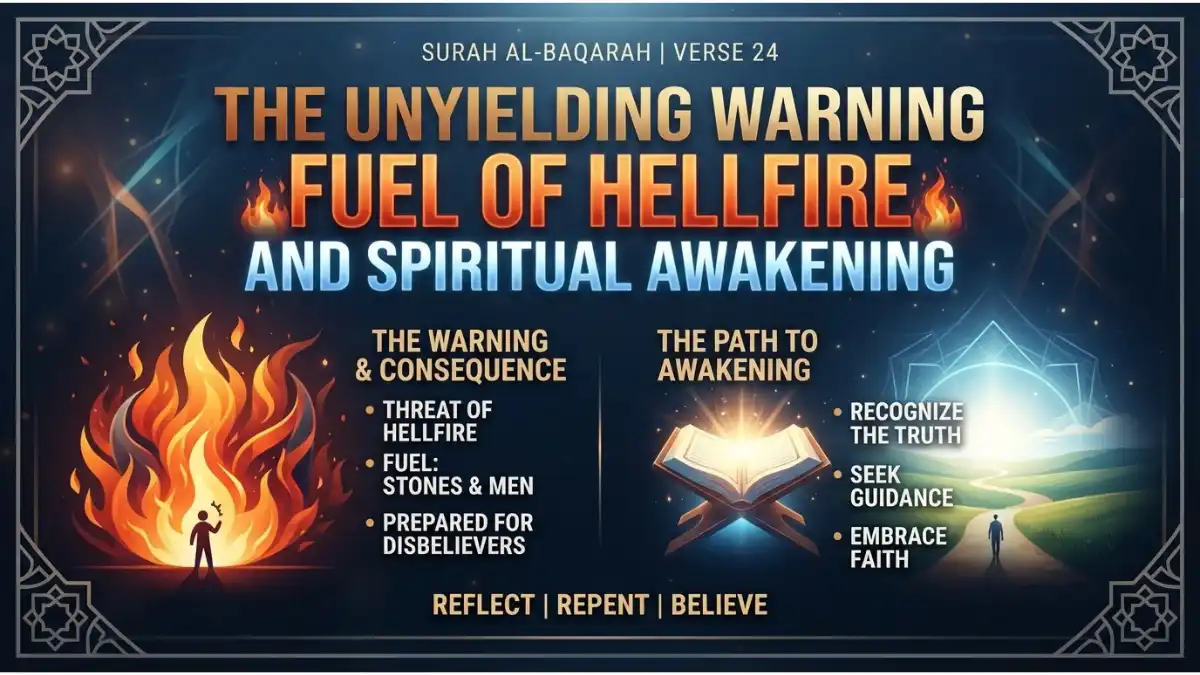
Introduction: The Essential “Emergency Brake” in Human Existence
In the spiritual journey of human life, individuals frequently travel at an overwhelming speed, consumed by worldly pursuits, social ambitions, and ego-driven desires. In the preceding verse (Surah Al-Baqarah Verse 23), Almighty Allah issued a clear, rational challenge to all skeptics and doubters: if they harbored any uncertainty regarding the divine origin of the Quran, they were invited to produce a single chapter comparable to its eloquence, wisdom, and structural perfection. Yet, historical record and empirical reality confirm that no creature has ever met or matched this open challenge.
Having conclusively demonstrated the absolute inability of humanity to emulate divine speech, Surah Al-Baqarah Verse 24 takes a decisive step forward. This verse does not merely affirm human powerlessness; it introduces a logical, unyielding consequence for those who consciously choose to close their eyes to evident truth. It serves as a spiritual wake-up call, halting human arrogance before it leads to self-destruction.
“Fa in lam taf‘alū wa lan taf‘alū fattaqun-nāral-latī waqūduhan-nāsu wal-ḥijāratu u‘iddat lil-kāfirīn.”
Translation: “But if you do not—and you will never be able to—then fear the Fire, whose fuel is men and stones, prepared for the disbelievers.” (QS. Al-Baqarah: 24)
Reading or hearing about the reality of Hellfire often brings an immediate sense of gravity and fear. However, when approached through deep contemplation (tadabur), one realizes that this stern warning is not designed to induce despair. Instead, it functions as a merciful compass, an emergency brake engineered to preserve the human soul from eternal ruin.
Linguistic Precision: The Absolute Certainty of “Wa Lan Taf‘alū”
Within the fabric of this verse lies a remarkable parenthetical phrase that carries profound theological weight: “wa lan taf‘alū” (“and you will never be able to”). In classical Arabic grammar, the particle lan denotes absolute future negation (nafy lil-ta’bīd). This is not merely a statement of present observation; it is a timeless divine prophecy.
Allah declares with absolute authority that no human, jinn, or collective effort throughout time will ever succeed in producing a text like the Quran. Centuries have elapsed since this revelation. Empires have risen and fallen, civilizations have reached literary heights, and modern artificial intelligence has emerged, yet the Quran remains completely unrivaled in its linguistic beauty, spiritual power, and internal coherence.
This absolute human limitation mirrors our inherent vulnerability. When an individual stubbornly rejects divine guidance despite clear proofs, they are not outsmarting God or harming the faith; they are simply driving their own existence toward spiritual bankruptcy.
Symbolism of the Fuel: Men and Stones Coupled Together
One of the most vivid and chilling aspects of Surah Al-Baqarah Verse 24 is the description of the fuel of Hellfire: men and stones. Classical exegesis scholars (mufassirūn) have delved deeply into why these two distinct entities are paired together, uncovering profound moral and allegorical meanings:
- Stones as a Symbol of Hardened Hearts:
Stones represent physical hardness, coldness, and total insensitivity. They neither absorb water nor bend under pressure. This imagery symbolizes the state of a human heart consumed by arrogance, stubbornness, and pride. A heart hardened like stone loses its ability to absorb divine light, rejects sound advice, and remains completely impervious to truth.
- Human Beings as Fuel of Their Own Torment:
The coupling of human beings with stone implies that the punishment of the Hereafter is the direct culmination of one’s own earthly choices and spiritual rigidity. The very arrogance that hardened the heart in this world becomes the catalyst for suffering in the next.
- Destruction of False Deities and Idols:
Scholars such as Ibn Abbas noted that “stones” specifically refers to stone idols and pagan statues carved by human hands and worshipped besides Allah. In the Hereafter, these false objects of devotion will be cast into the fire alongside their worshippers to demonstrate the ultimate futility and foolishness of polytheism.
Analytical Framework: Stern Warnings as Divine Protection
A fundamental theological question often arises: Why does an All-Merciful God issue such severe warnings? The answer lies in understanding the true nature of protective love. Severe warnings are not arbitrary threats; they serve as an essential moral guardrail.
| Concept | Mundane Analogy | Spiritual Reality (Verse 24) |
|---|---|---|
| Warning Sign | A prominent warning banner on a dangerous mountain cliff. | The explicit Quranic description of Hellfire and its fuel. |
| Underlying Purpose | To prevent drivers from plunging into a fatal abyss. | To stop humans from destroying their souls through arrogance and sin. |
| Motivating Force | Care and safety engineering by road authorities. | Divine mercy designed to redirect humanity toward salvation. |
| Human Reaction | Applying the brakes and navigating with caution. | Engaging in repentance (tawbah) and adopting humility. |
Without urgent warning markers, human beings naturally succumb to temporary pleasures, ego-driven desires, and moral complacency. The mention of Hellfire forces the conscience to pause, reassess priorities, and realign actions with eternal reality.
Exegetical Insights from Classical Tafsir
To gain a comprehensive understanding of Verse 24, we examine the classical commentaries of renowned Quranic scholars:
1. Tafsir Ibn Kathir
Imam Ibn Kathir emphasizes that the phrase “u‘iddat lil-kāfirīn” (“prepared for the disbelievers”) confirms that Hellfire is already created and currently in existence. He explains that while the primary destination of Hellfire is for those who obstinately reject faith, the terrifying imagery serves as an urgent deterrent for believers to avoid adopting any characteristics of disbelief, such as arrogance, lying, or persistent sinfulness.
2. Tafsir Al-Qurtubi
Imam Al-Qurtubi focuses on the intensity of the elemental combustion mentioned. Normal earthly fire requires oxygen and wood or gas to burn, whereas the Fire of the Hereafter utilizes stones—specifically sulfur stones according to early authorities—which burn at unimaginable temperatures and produce suffocating odors. This depiction highlights the total transcendence of afterlife realities compared to worldly physics.
3. Tafsir At-Tabari
Imam At-Tabari underlines the rhetorical force of the challenge’s outcome. The phrase “Fa in lam taf‘alū” establishes that failure to emulate the Quran is not a minor oversight, but a decisive intellectual defeat. Continuing to reject the message after such defeat exposes pure obstinacy rather than genuine intellectual doubt.
A Reflective Narrative: The Unexpected Brake That Saved a Life
The concept of a spiritual “emergency brake” can be clearly observed in real-world human experiences. Consider the story of a successful corporate executive who built a vast business empire. In his early career, he was guided by strong values, integrity, and fairness. However, as his wealth multiplied and social influence expanded, subtle arrogance began to cloud his judgment. He began exploiting labor loopholes, falsifying compliance records, and dismissing the ethical concerns raised by trusted colleagues.
Whenever friends attempted to offer sincere advice regarding his unethical practices, his response was defensive and condescending, believing his intelligence placed him above standard rules. His heart was gradually hardening into stone.
Suddenly, a major regulatory investigation exposed his fraudulent practices. Overnight, his reputation collapsed, his assets were frozen, and he faced severe legal consequences. Sitting alone in a quiet room amidst the wreckage of his former glory, the wall of pride crumbled.
He remarked to a loyal friend who came to visit: “I believed I could control everything through my intellect. I dismissed every warning as noise. I failed to realize that I was gathering the very stones that would eventually crush me.” This devastating setback acted as a harsh emergency brake. It halted his destructive trajectory, led him to sincere repentance, and transformed him into a humble individual dedicated to ethical living and community service. The worldly crisis saved him from an far worse spiritual end.
Four Practical Steps to Maintain Spiritual Softness
To prevent our hearts from becoming hardened like the symbolic stones mentioned in Surah Al-Baqarah Verse 24, we can practice four practical spiritual disciplines daily:
- Conduct Daily Long-term Consequence Audits:
Before executing significant career, financial, or personal decisions, ask yourself: “Will this choice bring lasting spiritual barakah, or am I merely satisfying a temporary ego that risks my eternal well-being?”
- Cultivate Humility in the Face of Correction:
When receiving valid criticism or moral advice, actively suppress the instinct to defend your ego. Listen attentively, reflect honestly, and demonstrate the courage to acknowledge mistakes.
- Engage in Active Empathy and Charity:
Hardened hearts are characterized by coldness and self-centeredness. Counteract spiritual hardness by regularly serving the needy, visiting the sick, and engaging in acts of quiet, sincere charity.
- Reframe Divine Warnings as Expressions of Mercy:
View every Quranic warning, life trial, or moment of spiritual discomfort as a compassionate reminder from God pulling you back toward the path of safety and truth.
A Heartfelt Prayer for Protection and Softness
“Yā Muqallibal-qulūbi thabbit qalbī ‘alā dīnik. Allāhumma innī a‘ūdhu bika min qalbin lā yakhsha‘, wa min du‘ā’in lā yusma‘, wa min nafsin lā tashba‘, wa min ‘ilmin lā yanfa‘. Allāhumma ajirnā minan-nār, wa adkhilnal-jannata ma‘al-abrār.”
Translation: “O Turner of the hearts, keep my heart firm upon Your religion. O Allah, I seek refuge in You from a heart that does not humble itself, a supplication that is not heard, a soul that is never satisfied, and knowledge that does not benefit. O Allah, protect us from the Fire, and admit us into Paradise alongside the righteous.”
Frequently Asked Questions (FAQ)
Question: “How can one distinguish between healthy, constructive fear of God (Taqwa) and destructive, paralyzing anxiety?”
Answer: Constructive fear (Taqwa) is always balanced with hope (Raja’) and leads to positive action, spiritual growth, and proactive self-improvement. It motivates a person to seek forgiveness and do good deeds. In contrast, destructive anxiety paralyzes the individual, leads to despair, and causes them to lose hope in God’s infinite mercy—a state explicitly discouraged in Islamic teachings.
Question: “What should a person do if they feel their heart has become spiritually numb or hardened due to routine worldly stress?”
Answer: Spiritual numbness is a common human experience. The remedies prescribed by Islamic scholars include engaging in meaningful Quranic contemplation (tadabur), sitting in gatherings of knowledge, remembering death, seeking forgiveness (istighfar), and spending time in quiet night prayers (Tahajjud).
This article is part of the thematic study series: Summary of Tadabur Surah Al-Baqarah