
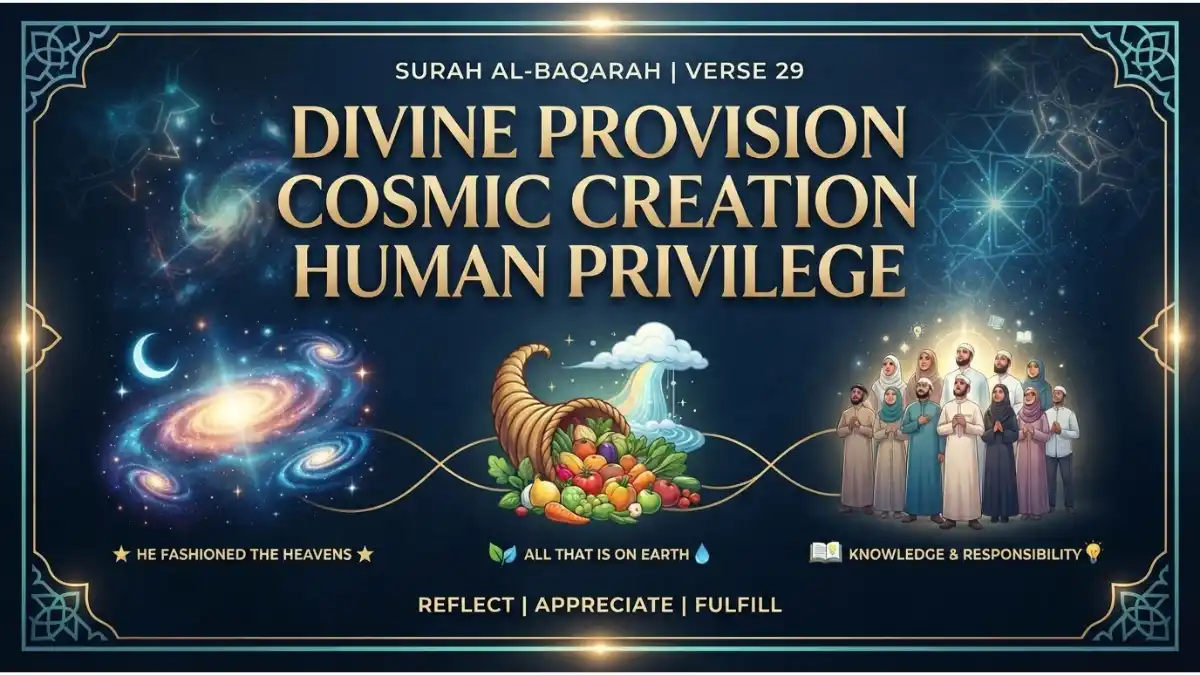
Introduction: Why Does the Almighty Privilege Humanity?
Following the profound existential reflection in Surah Al-Baqarah Verse 28—which systematically walks humanity through the four phases of existence from initial non-being to physical death and ultimate resurrection—Verse 29 turns our attention outward to the vast, magnificent infrastructure designed to support our temporary earthly journey. Having established that our lives belong entirely to the Almighty, the Quran now reveals a breathtaking truth regarding the cosmos: the entire planet Earth, along with its intricate ecological systems, was created specifically for humanity’s sustenance, growth, and moral development.
“Huwal-ladhī khalaqa lakum mā fil-arḍi jamī‘an thummas-tawā ilas-samā’i fa-sawwāhunna sab‘a samāwāt, wa huwa bi-kulli shay’in ‘alīm.”
Translation: “It is He who created for you all of that which is on the earth. Then He directed Himself to the heaven, [his being above all creation], and made them seven heavens, and He is Knowing of all things.” (QS. Al-Baqarah: 29)
A deep contemplative study (tadabur) of this verse brings forward a transformative realization. The universe is not a chaotic accident, nor is Earth a harsh penal colony or a bleak prison. It is a carefully engineered home provided by Divine Mercy. Understanding this verse reframes how we view natural resources, our responsibility as stewards (Khalīfah), and our relationship with the All-Knowing Creator.
The Divine Infrastructure: Understanding “Khalaqa Lakum”
The opening phrase of Verse 29 contains two words of immense theological and spiritual significance: Khalaqa lakum—“He created for you.” The preposition lakum (“for you”) explicitly establishes that human beings occupy a honored position in the terrestrial order. Everything housed upon and within this planet was fashioned with human well-being and moral test in mind.
Consider the staggering variety of gifts encompassed within mā fil-arḍi jamī‘an (“all that is on the earth”):
1. Essential Life-Support Ecosystems
The precise composition of the atmosphere, the vast water cycles driven by oceans and rain, fertile topsoil capable of growing nourishment, and atmospheric layers filtering harmful radiation are all finely tuned facilities. Humanity did not purchase, design, or engineer these systems; they are pure divine gifts granted freely for our survival.
2. Mineral and Energetic Wealth
Deep within the Earth lies an abundance of minerals, metals, petroleum, natural gas, and geothermal energy. These resources have enabled human civilization to develop technology, construct shelters, establish transport networks, and build complex societies across generations.
3. Biodiversity and Natural Beauty
From vast forests and majestic mountain ranges to millions of plant and animal species, the Earth offers not only physical sustenance through food and medicine, but also psychological comfort, artistic inspiration, and spiritual reflection. Observing natural beauty serves as a direct mirror reflecting the perfection of the Creator.
Analytical Framework: Comparative Dimensions of Verse 29
To grasp the balance between human privilege and divine majesty established in Surah Al-Baqarah Verse 29, the table below outlines the core themes, human tendencies, and Quranic realignments conveyed in this verse:
| Dimension | Flawed Human Perspective | Quranic Truth (Verse 29) | Practical Implication |
|---|---|---|---|
| Terrestrial Creation | Viewing Earth as property to exploit greedily for selfish gain. | Earth is a divinely granted trust (Amānah) created for us, not by us. | Practice responsible environmental stewardship and avoid waste (Isrāf). |
| Cosmic Order | Feeling insignificant or isolated in an incomprehensibly vast universe. | The Creator of seven heavens actively attends to human needs on Earth. | Recognize personal value in God’s eyes while remaining deeply humble. |
| Jurisprudence & Law | Assuming everything in nature is restricted unless permitted. | The foundational legal rule: Everything on Earth is permissible (Ḥalāl) by default unless forbidden. | Utilize worldly gifts with gratitude while respecting clear divine boundaries. |
| Divine Knowledge | Believing human efforts or private struggles go unnoticed. | Allah possesses absolute, complete knowledge of all things (Bi-kulli shay’in ‘alīm). | Live with conscious awareness (Taqwā) and find comfort in God’s omniscience. |
From Earth to the Seven Heavens: The Scale of Cosmic Majesty
After describing the terrestrial provisions made for humanity, the verse expands its scope to cosmic dimensions: “Thummas-tawā ilas-samā’i fa-sawwāhunna sab‘a samāwāt”—”Then He directed Himself to the heaven and made them seven heavens.”
Modern astrophysics reveals that planet Earth, immense as it feels to us, is merely a speck of dust in an observable universe containing hundreds of billions of galaxies, each housing billions of stars and planetary systems. Yet, Quranic revelation informs us that all observable outer space—including every galaxy, star cluster, and nebula—belongs merely to the first or lowest heaven (As-Samā’ ad-Dunyā).
The existence of seven layered heavens underscores the absolute sovereignty and unlimited creative power of Almighty Allah. When a believer contemplates this immense cosmic scale, two contrasting yet complementary feelings arise simultaneously:
- Profound Humility: Realizing our physical insignificance within the vastness of creation dismantles ego, pride, and arrogance.
- Deep Spiritual Peace: Knowing that the Sovereign Creator of these seven heavens personally provides for us, hears our quietest prayers, and knows our innermost thoughts provides unmatched psychological security.
Exegetical Insights from Classical Tafsir
Renowned scholars of classical Quranic commentary have extracted key legal, theological, and spiritual principles from Verse 29:
1. Tafsir Ibn Kathir
Imam Ibn Kathir highlights that Verse 29 serves as a powerful argument for monotheism (Tawḥīd). He explains that since Allah alone created the Earth and all its benefits for humanity, and fashioned the seven heavens without any partner or assistant, He alone deserves absolute worship, gratitude, and obedience. Ibn Kathir also notes that this verse proves Earth was created prior to the completion and ordering of the seven heavens.
2. Tafsir Al-Qurtubi and Legal Principles
Imam Al-Qurtubi brings attention to a major principle of Islamic jurisprudence (Uṣūl al-Fiqh) derived directly from the phrase “khalaqa lakum mā fil-arḍi jamī‘an”: **The fundamental default rule for all earthly things—foods, drinks, minerals, and natural resources—is legal permissibility (Al-Aṣlu fil-ashyā’i al-ibāḥah).** Nothing on Earth is deemed prohibited (Ḥarām) unless an explicit divine text or clear harm restricts it. This reflects the expansive mercy and generosity of Islamic law.
3. Tafsir At-Tabari
Imam At-Tabari focuses on the closing divine name: “Wa huwa bi-kulli shay’in ‘alīm” (“And He is All-Knowing of all things”). He points out that divine omniscience guarantees that nothing in creation is neglected. God knows the movement of every particle, the needs of every living organism, and the secret intentions within every human heart.
Reflective Narrative: Finding Peace Under a Starry Canopy
The transformative power of contemplating cosmic design can be seen in a personal account shared by an avid wilderness backpacker. During an expedition into a remote mountain range far removed from city light pollution, he stepped out of his tent late at night and looked up at the open sky. Clear, unhindered views of millions of twinkling stars and the glowing arc of the Milky Way galaxy spanned overhead.
Reflecting on that moment, he recalled: “Standing under that vast sky, I felt smaller than a grain of sand. The sheer scale was overwhelming. Yet, instead of feeling lost or frightened, an unbelievable sense of tranquility washed over me. I remembered Verse 29 of Surah Al-Baqarah.”
He continued: “It occurred to me that if the Supreme Creator can effortlessly maintain the orbits of trillions of stars across seven vast heavens without a single collision, He can certainly handle the small personal anxieties, career challenges, and family burdens I carry. I realized that the God who built this universe for us is actively watching over my life. I went back to sleep that night with complete peace of mind.”
This experience illustrates the core goal of tadabur: connecting the physical wonders of nature back to the living faith and trust we place in the Creator.
Three Actionable Habits for Everyday Life
To honor the divine blessings described in Surah Al-Baqarah Verse 29, believers can adopt three practical practices in daily life:
- Practice Conscious Gratitude for Basic Provisions:
Pause deliberately throughout the day to acknowledge divine gifts that are easily taken for granted—clean drinking water, fresh air, healthy food, and natural sunlight. Express a heartfelt Alḥamdulillāh (Praise be to God) with full awareness of the cosmic machinery supporting your life.
- Commit to Environmental Stewardship and Conservation:
Recognize that receiving Earth as a facility means we are its appointed caretakers. Reduce personal waste, avoid reckless consumption, conserve water, care for plant and animal life, and eliminate littering as a direct act of worship and respect for God’s creation.
- Anchor Your Worries in Divine Omniscience:
Whenever you face uncertainty, stress, or emotional fatigue, remind yourself of the closing words of the verse: “Wa huwa bi-kulli shay’in ‘alīm.” Rest in the comfort that Allah knows your circumstances, struggles, and silent prayers completely, and trust His wisdom to navigate your path.
A Heartfelt Supplication of Gratitude and Stewardship
“Allāhumma lakal-ḥamdu kulluh, wa lakal-mulku kulluh, wa bi-yadikal-khayru kulluh, wa ilaika yarji‘ul-amru kulluh. Allāhummaj-‘alnā min ash-shākirīna li-ni‘amik, al-muḥsinīna fī arḍik, wa lā taj‘alnā minal-mufsidīn. Allāhumma ‘āfinā fī abdāninā, wa fī asmā‘inā, wa fī abṣārinā. Amīn Yā Rabbal-‘Ālamīn.”
Translation: “O Allah, to You belongs all praise, to You belongs all sovereignty, in Your Hand is all goodness, and to You all affairs return. O Allah, make us among those who are deeply grateful for Your blessings and good stewards upon Your earth, and do not make us among those who spread corruption. O Allah, grant health to our bodies, our hearing, and our sight. Amin, O Lord of the Worlds.”
Frequently Asked Questions (FAQ)
Question: “What does ‘seven heavens’ mean in light of modern scientific cosmology?”
Answer: In Quranic terminology, the term samā’ refers to everything that is above us. Islamic scholars explain that all observable stars, planets, and galaxies accessible to human telescopes belong entirely to the first (lowest) heaven. The remaining six heavens lie beyond our current physical detection, representing dimensions of creation known fully to Allah. Science explores the physical workings of the observable universe, while revelation informs us of the complete metaphysical architecture.
Question: “Does the statement ‘created for you all that is on earth’ mean humans have complete freedom to exploit animals and natural resources without limits?”
Answer: Absolutely not. In Islamic theology, creation being made “for you” signifies a trust (Amānah) and a facility for necessity, not an authorization for tyranny or wasteful destruction. Islamic law strictly prohibits cruelty to animals, environmental degradation, deforestation, and overconsumption (Isrāf). Humans will be held accountable for how responsibly they managed Earth’s resources.
Question: “How can I maintain a sense of awe and gratitude when living in a busy, concrete-filled city far from nature?”
Answer: While natural landscapes make contemplation easier, urban settings still offer abundant signs of divine provision. The food on your table, the water flowing from your tap, the air filling your lungs, and even the human intellect that developed urban technology are all rooted in Earth’s natural systems created by Allah. Taking short pauses during your daily routine to reflect on these underlying provisions revives gratitude even in urban environments.
This article is part of the thematic study series: Summary of Tadabur Surah Al-Baqarah