
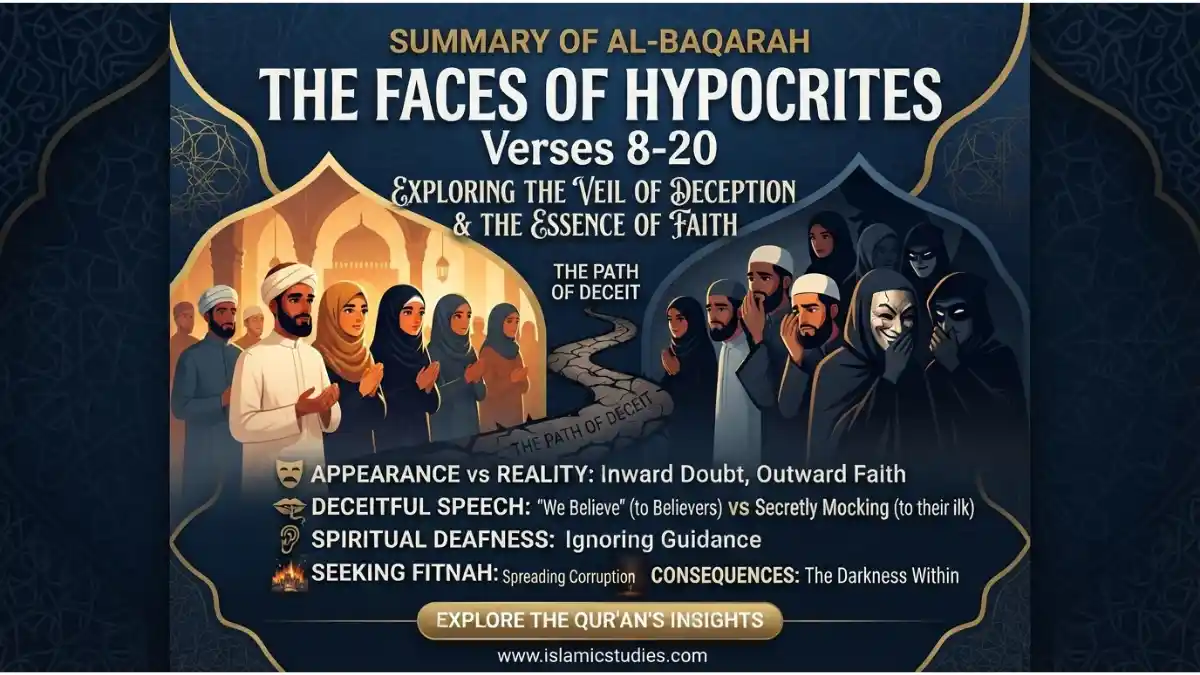
Introduction: The Three Categories of Humanity in the Quran
In the opening section of Surah Al-Baqarah, the Holy Quran classifies humanity into three distinct groups based on their spiritual response to divine guidance. Verses 1 through 5 outline the profile of the first group: the righteous believers (al-muttaqīn) who achieve ultimate success. Verses 6 and 7 briefly describe the second group: the disbelievers who openly reject the truth.
However, starting from Surah Al-Baqarah verses 8 through 20, the Quran allocates a substantial and detailed passage—13 consecutive verses—specifically to expose the third group: the hypocrites (al-munāfiqūn). Why does the Quran dedicate significantly more attention to hypocrites than to open disbelievers? The answer lies in their latent danger. Hypocrites act as “spiritual chameleons” living behind a facade of falsehood; they blend into the ranks of the faithful while concealing destructive intentions from within.
Verse-by-Verse Thematic Exploration: Deconstructing Hypocrisy
To draw profound reflections for self-evaluation, let us analyze the core teachings of each verse in the passage of Al-Baqarah 8–20.
1. Verses 8–10: The Mask of Faith and Internal Spiritual Diseases
The Quran begins by exposing the phenomenon of verbal profession lacking inner conviction. An individual may utter the testimony of faith and participate in religious rituals while their heart remains completely devoid of genuine belief.
- Verse 8 (Beware of the Mask of Hypocrisy): Highlights the stark contradiction between verbal declarations and internal motives. This reflects a lifestyle of image-crafting to gain social acceptance or security.
- Verse 9 (The Illusion of Deception and Deceiving Oneself): Explains the psychological delusion of hypocrites who consider themselves clever for tricking people. The Quran clarifies that they are only deceiving themselves without realizing their own downfall.
- Verse 10 (Spiritual Diagnosis of a Diseased Heart): Identifies the root cause of hypocrisy as maraḍ (diseases of the heart such as envy, arrogance, and doubt). When left unchecked, God allows these internal afflictions to worsen as a consequence of their persistent dishonesty.
2. Verses 11–13: Pseudo-Reform, Blind Ego, and Intellectual Arrogance
When an individual’s moral boundaries blur, they not only commit harm but also build self-serving narratives to justify their actions.
- Verse 11 (The Delusion of Corruption as Reform): Focuses on the behavioral pattern of those with diseased hearts; when admonished not to cause corruption on earth, they claim to be peacemakers or reformers (muṣliḥūn).
- Verse 12 (The Trap of Blind Ego and Self-Delusion): Represents the height of denial. Their arrogance refuses sincere advice, leaving them utterly blind to the damage they cause.
- Verse 13 (Defining True Intelligence vs Spiritual Foolishness): Hypocrites look down upon sincere believers as “foolish” or naive (as-sufahā’) for making sacrifices for moral principles. The Quran reverses this claim: they are the true fools for trading eternal salvation for short-term gains.
3. Verses 14–16: Chameleon Behavior and Bad Spiritual Bargains
Opportunism is the hallmark of a split personality.
- Verse 14 (Overcoming Hypocrisy and Maintaining Spiritual Consistency): When interacting with believers, they claim faith. However, when returning to their evil ringleaders or cohorts (shayāṭīnihim), they reassure them of their true loyalty while mocking the truth.
- Verse 15 (Understanding Divine Mockery and the Trap of Istidraj): As a consequence of playing double games, God leaves them to wander blindly in their transgression and inner confusion (ya‘mahūn).
- Verse 16 (The Spiritual Commerce of Exchanging Guidance for Error): The Quran illustrates their choices through an economic metaphor: trading guidance (hidayah) to purchase misguidance—a bargain that yields zero profit and leaves them utterly lost.
Comparative Summary Table: Characteristics of Hypocrisy in Verses 8–20
The table below summarizes the traits, behavioral manifestations, and spiritual consequences outlined in this passage:
| Verses | Primary Trait | Daily Manifestation | Spiritual Consequence |
|---|---|---|---|
| 8–9 | Duplicity (False Claims) | Expressing beliefs verbally that are not held in the heart. | Self-deception and moral degradation. |
| 10 | Heart Disease (Fi Qulūbihim Maraḍ) | Harboring envy, arrogance, and persistent doubt. | Worsening spiritual health and compound falsehood. |
| 11–12 | Self-Righteousness | Wrapping destructive actions in narratives of “doing good.” | Loss of conscience and resistance to correction. |
| 13–14 | Opportunism & Mockery | Belittling sincere people; shifting loyalties based on peer pressure. | Erosion of integrity and isolation from truth. |
| 15–16 | Disastrous Spiritual Trade | Trading core moral values for temporary convenience. | Complete spiritual bankruptcy and disorientation. |
| 17–18 | Spiritual Blindness & Deafness | Closing eyes and ears to sincere counsel and evidence. | Loss of divine light and inability to return to the path. |
| 19–20 | Seasonal / Opportunistic Faith | Acting righteously only when immediate benefits are visible. | Paralysis by fear and deep internal uncertainty. |
Two Remarkable Allegories: The Kindled Fire and The Night Storm
One of the most powerful stylistic features of the Quran in depicting the psychology of hypocrisy is the use of two vivid parables (amthāl) in verses 17 through 20.
1. The First Parable: The Kindler of Fire (Verses 17–18)
The Quran describes someone trying to light a fire in pitch darkness. Once the fire illuminates their surroundings, God takes away their light, leaving them in absolute darkness, unable to see anything.
This allegory symbolizes hypocrites who temporarily benefit from the safety, light, and social advantages of faith (the light of fire). However, because their intentions were insincere from the start, God removes their inner perception. They become ṣummun bukmun ‘umyun—deaf to truth, dumb to honesty, and blind to guidance—leaving them with no way back (fa-hum lā yarji‘ūn).
2. The Second Parable: The Storm at Night (Verses 19–20)
The second parable depicts travelers caught in a heavy rainstorm from the sky, accompanied by pitch darkness, thunder, and lightning. Terror-stricken by the threat of death, they press their fingers into their ears at every thunderclap.
Whenever lightning strikes and illuminates their path, they take a few steps forward. But as soon as darkness covers them again, they freeze in fear. This is a masterclass depiction of seasonal faith. Hypocrites participate or practice righteousness only when it brings ease, social acclaim, or material gain (the flash of lightning). The moment trials, sacrifices, or heavy duties arise, their progress halts, and they retreat into inner confusion.
Perspectives from Classical and Modern Tafsir
Renowned scholars of Quranic commentary have analyzed these verses to warn believers across generations:
Ibn Kathir notes that hypocrisy is broadly divided into two forms: Nifāq I‘tiqādī (hypocrisy in belief/creed), which expels a person from Islam internally, and Nifāq ‘Amalī (hypocrisy in action), such as lying when speaking, breaking promises, or betraying trusts.
Sayyid Qutb emphasized that hypocrites pose a far greater danger to a community than open enemies. An open opponent is easily identified and guarded against, whereas a hypocrite erodes internal moral foundations while wearing the clothes of the faithful.
Imam Al-Ghazali highlighted that seeds of hypocrisy grow from minor compromises in honesty. When a person habitually projected a false image to earn human praise, they incrementally poison their own spiritual heart.
Modern Relevance: Integrity in a World of Image-Crafting
The timeless lessons of Al-Baqarah verses 8–20 provide vital guidance for contemporary life:
- Avoiding Superficial Image Cultivation: In an era dominated by social media validation, the pressure to curate a holy or flawless persona is intense. These verses urge us to prioritize inner sincerity over public appearances.
- Leadership and Professional Integrity: When leaders or professionals claim to work for the public good while secretly designing policies for self-enrichment, they embody the Quranic description of “wa idhā khalaw ilā shayāṭīnihim.”
- Cultivating Humility to Accept Criticism: Believers must guard against self-righteousness that rejects constructive feedback under the guise of “doing reform.” Honest self-reflection remains the primary remedy for hypocrisy.
Prayer for Protection Against Hypocrisy
The Prophet Muhammad (ﷺ) taught believers to seek refuge from moral corruption and spiritual duplicity:
“Allāhumma innī a‘ūdhu bika minash-shiqāqi wan-nifāqi wa sū’il-akhlāq.”
Translation: “O Allah, I seek refuge in You from financial and spiritual discord, hypocrisy, and bad character.”
Frequently Asked Questions (FAQ)
Question: “If someone occasionally breaks a promise or struggles with honesty, does that automatically make them a major hypocrite doomed eternally as described in Al-Baqarah 8–20?”
Answer: No. Classical scholars clarify that such lapses fall under Nifāq ‘Amalī (practical/behavioral hypocrisy) rather than major hypocrisy in creed (Nifāq I‘tiqādī). While practical hypocrisy harms a person’s faith and character, it does not void faith entirely. Sincere repentance, self-awareness, and active effort to rebuild integrity restore one’s spiritual health.
How do you cultivate sincerity and inner integrity in a world that often values appearances over truth? Share your thoughts and reflections in the comments below!
This article is part of the thematic study series: Summary of Tadabur Surah Al-Baqarah