
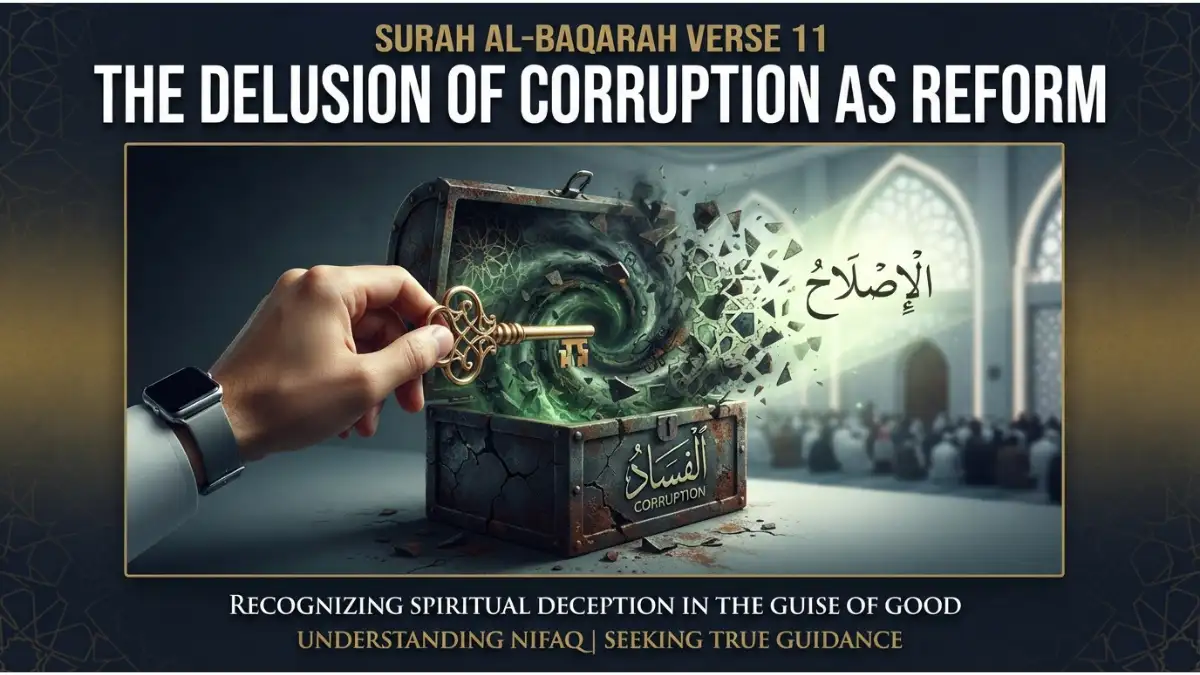
The Anomaly of Self-Righteousness: Corruption Masked as Reform
After dissecting the internal anatomy of spiritual heart diseases in verse 10, the Quran moves to verse 11 to address the external behaviors stemming from a corrupted heart. Here, Allah SWT highlights a sharp, timeless social irony: individuals whose spiritual organs are diseased often engage in destructive behavior while convincing themselves that they are champions of righteousness and societal improvement.
Let us reflect deeply upon the Divine word in Surah Al-Baqarah, verse 11:
“Wa idza qila lahum la tufsidu fil-ardl, qalu innama nahnu mushlihun”
Translation: “And when it is said to them, ‘Do not cause corruption on the earth,’ they say, ‘We are but reformers.'” (QS. Al-Baqarah: 11)
Have you ever encountered someone who, when gently advised about a clear mistake or harmful behavior, immediately becomes defensive and replies, “My intentions are purely good!” or “I am only doing this to fix the situation!”? Yet, everyone around them clearly sees that their actions, words, and attitude only increase tension, break social harmony, and lead to discord.
This psychological and spiritual phenomenon is what the Quran exposes as the delusion of being “The Ultimate Reformer” (*mushlihun*). It is an acute spiritual condition where a person genuinely believes they are executing a noble mission, even while actively destroying the foundations of peace from within.
In today’s digital landscape, this syndrome has evolved into a widespread cultural issue. Online platforms frequently showcase individuals or groups who provoke outrage, spread divisive narratives, or attack the dignity of others under the banner of “advocating truth,” “activism,” or “constructive criticism.” While they view themselves as heroes fighting for a cause, their manipulative tactics behind the scenes yield social corruption (*fasad*), extreme polarization, and endless conflict.
The danger of this ego-driven delusion lies in its paralyzing effect on self-awareness. A person trapped in this state feels no need for introspection, repentance, or course correction. Their internal logic is simple yet destructive: why evaluate oneself if one has already concluded that every action taken is an expression of high virtue?
Surah Al-Baqarah verse 11 serves as a wake-up call for our own hearts. Before we step out to reform society, critique public affairs, or correct others, we must ask ourselves three honest questions:
- Is the method used to convey truth aligned with divine ethics and spiritual wisdom?
- Is the underlying intention purely to seek the pleasure of Allah SWT, or is it driven by a desire to satisfy the ego, gain attention, or feel morally superior?
- Does the tangible outcome of these words or actions foster peace and unity, or does it inflame division and animosity?
Genuine reform does not begin by pointing fingers at external flaws or critiquing society’s shortcomings; it begins with the courage to audit, cleanse, and discipline our own character.
Classical Exegesis: Understanding *Fasad* and *Islah* in Tafsir
Classical scholars of Quranic exegesis (*mufassirun*), including Ibn Kathir, Al-Qurtubi, and Al-Tabari, provided profound insights into the terms *Fasad* (corruption) and *Islah* (reform) as used in verse 11.
Ibn Kathir notes that the corruption (*fasad*) mentioned here refers to committing acts of disobedience against Allah, aligning with disbelievers against the believers, and spreading doubt within the community while claiming that such actions are meant for peace or political diplomacy. By attempting to walk a double line—appeasing conflicting factions for personal gain—they undermine the integrity of the community while convincing themselves they are wise mediators.
Furthermore, scholars emphasize that true reform (*islah*) cannot exist without divine guidance (*Wahy*). Human beings who rely solely on their subjective desires, political expediency, or unpurified intellects often misdefine morality. What they label as “progress” or “reform” frequently leads to moral decay and social instability, fulfilling the exact warning of verse 11.
Modern Manifestations: How *Fasad* Masks Itself as *Islah* Today
The subtle corruption described in Surah Al-Baqarah verse 11 shows up across various areas of contemporary life:
| Modern Context | The Masked Claim (*Islah*) | The Reality of Corruption (*Fasad*) |
|---|---|---|
| Social Media Activism | “Calling out wrongdoing and spreading awareness for justice.” | Publicly shaming individuals, sensationalizing half-truths, and generating outrage for clicks. |
| Interpersonal Relationships | “Just being honest and giving needed constructive feedback.” | Harshly exposing personal flaws in public settings to humble others and boost one’s ego. |
| Community Leadership | “Modernizing policies and bringing necessary institutional change.” | Compromising core ethical standards, fostering factionalism, and sidelining sincere counsel. |
The common denominator in these scenarios is the disconnection between **intention, methodology, and outcome**. When methodology lacks gentleness (*rifq*) and respect for human dignity, even a good goal turns into a source of disruption.
Illustrative Reflection: Good Intentions vs. Destructive Methods
Consider the story of a community organizer named Arthur (a representative composite example). Arthur was passionate about civic discipline and upholding community standards. However, he developed a habit of publicly confronting neighbors over minor rule infractions, often broadcasting these faults in public forums and group messaging chats.
In his mind, Arthur justified his actions by asserting that he was upholding order and serving the common good. In reality, his harsh demeanor left people feeling humiliated and resentful. Neighborhood cohesion deteriorated, giving way to hostility, private backbiting, and mutual distrust.
Arthur’s turning point came during a quiet evening study of Surah Al-Baqarah verse 11. The verse forced him to confront a painful reality: “I believed I was building up the community, but my methods were tearing its social fabric apart.”
Arthur adjusted his approach. When issues arose, he stopped resorting to public call-outs. Instead, he visited neighbors privately, approached them with humility and empathy, and offered solutions respectfully. The response was immediate and positive: people willingly corrected their mistakes without defensive arguments, and peace was restored.
Four Practical Steps to Guard Your Speech and Actions
To avoid falling into the trap of self-righteous corruption, consider adopting these four daily disciplines:
- Audit Your Motives Before Speaking: Pause before posting a critique or delivering unsolicited advice online or in person. Ask yourself: *”Am I saying this to bring genuine benefit, or to validate my ego and appear superior?”* If there is a trace of self-aggrandizement, hold back.
- Evaluate the Projected Impact: Project the consequences of your words before expressing them. Will your statement build trust and encourage positive change, or will it stir needless hostility? When in doubt, lean toward silence.
- Prioritize Personal Reformation: Redirect energy away from monitoring the faults of others and focus on refining your own character. Real progress begins with self-discipline.
- Use Private Channels for Advice (*Nasiha*): If you must correct a genuine error, do so privately with kindness and respect. True advice protects a person’s dignity, whereas public exposure tears it down.
Supplication for Wisdom and Protection Against Ego
We ask Allah SWT to protect us from self-deceit and make us true instruments of peace:
“O Allah, Guide of Hearts, grant us deep wisdom in every word we utter and every action we take. Do not allow us to be deceived by our own egos into believing we are correcting matters while we are causing harm. Make us genuine peacemakers who bring light, unity, and healing, and protect us from spreading division or distress. Amin.”
Frequently Asked Questions (FAQ)
Question: “How can we distinguish between sincere constructive criticism and corruption disguised as good intentions?”
Answer: The difference lies in **methodology and spirit**. Sincere critique (*nasiha*) is delivered with gentleness, seeks to preserve the dignity of others, and aims to restore harmony. Disguised corruption (*fasad*) relies on public exposure, hostility, and methods that humiliate others or divide communities. Sincere counsel builds bridges; disguised corruption burns them down.
Have you ever experienced a situation where someone claimed to be “fixing” something, but their approach made it worse? How did you navigate it? Share your thoughts in the comments below!
This article is part of the thematic study series: Tadabur Al-Qur’an Surah Al-Baqarah