
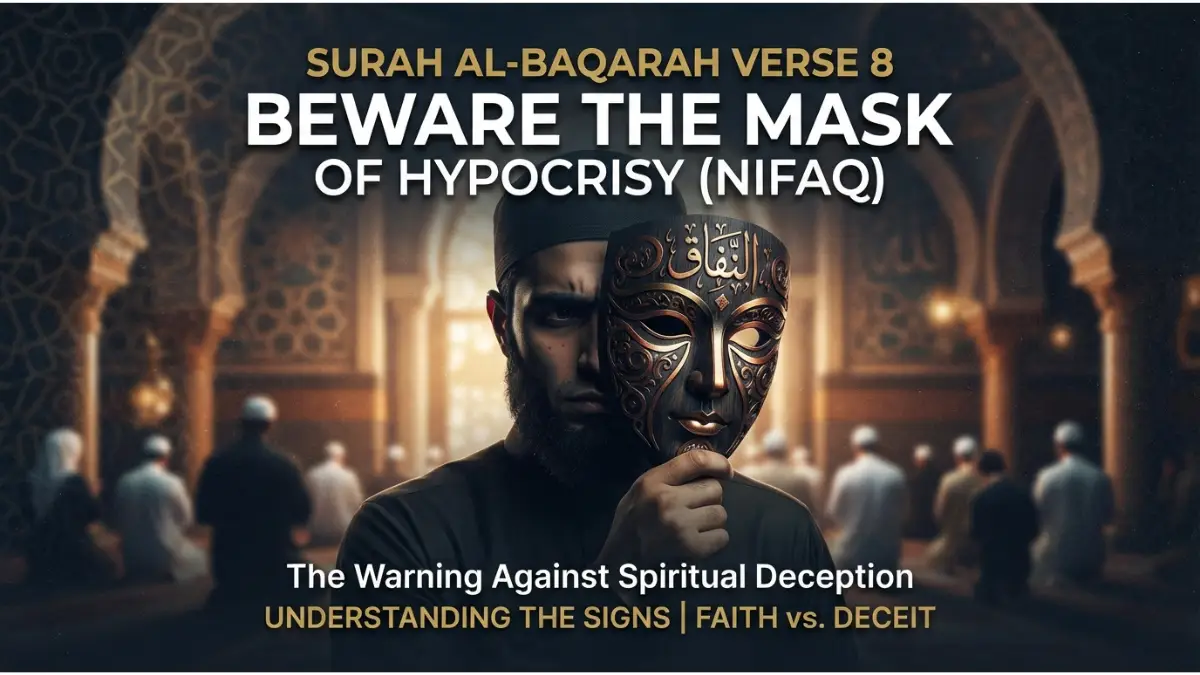
Entering the Gray Zone: The Subtle Danger of Hypocrisy (Nifaq)
After establishing the uplifting qualities of the God-conscious in Verses 1 through 5 and contrasting them with those who openly reject the truth in Verses 6 and 7, Surah Al-Baqarah transitions in Verse 8 into a far more complex, subtle, and psychologically dangerous domain: the phenomenon of hypocrisy (Nifaq).
Unlike open denial, spiritual hypocrisy operates silently under the radar of social awareness. It is an insidious disease of the heart—often unacknowledged even by the person carrying it—yet its destructive capacity impacts personal mental well-being as well as the peace and integrity of the broader community.
Let us reflect on the divine warning in Surah Al-Baqarah Verse 8:
“Waminannasi man yaqulu amanna billahi wabil-yaumil-akhiri wama hum bimu’minin”
“And of the people are some who say, ‘We believe in Allah and the Last Day,’ but they are not believers.” (Surah Al-Baqarah: 8)
This verse acts as a spiritual alarm, calling across time to alert humanity to the danger of living a “two-faced” existence. In our contemporary digital culture, the temptation to wear social masks is heightened. Online platforms provide an incubator where individuals can effortlessly craft ideal public personas that sharply contrast with their private realities.
It is easy to curate a profile filled with wisdom, courtesy, and religious devotion while public lights are on. Yet, when the cameras are off and public scrutiny vanishes, real-world behavior can tell a very different story. Without ongoing self-awareness, the human ego is easily tempted to put on similar masks—polishing external words to secure social approval while the inner soul remains devoid of the sincerity and faith being voiced.
The Psychological and Spiritual Anatomy of Nifaq
In Islamic theology, Nifaq comes from the Arabic root word Nafaq, which refers to a tunnel underground with multiple openings. A person in a tunnel can enter through one opening and exit through another, deceiving anyone watching from the outside. Similarly, a hypocrite enters through a doorway of professed faith while secretly maintaining exit routes of disbelief, compromise, or self-interest.
Scholars traditionally divide hypocrisy into two major categories:
- Major Hypocrisy (Nifaq ‘Iqadi / Doctrinal Hypocrisy): This occurs when an individual outwardly claims belief in Islam while internally harboring absolute disbelief. This is the primary subject of Verse 8. It represents complete deception of the community for material or social gain.
- Minor Hypocrisy (Nifaq ‘Amali / Behavioral Hypocrisy): This occurs when a believer holds genuine faith in Allah, yet displays habits typically associated with hypocrites—such as breaking promises, lying in conversation, betraying trusts, or acting insincerely for public praise. While this does not take one out of Islam, it severely corrupts the spiritual heart.
Root Causes: Why Do We Fall into the Trap of Wearing Masks?
Both psychologically and spiritually, the choice to manipulate one’s public identity generally stems from specific internal vulnerabilities:
1. Fear of Social Rejection (Fear of Isolation)
Human beings possess a fundamental desire to feel accepted within a group. When a social circle expects high moral standards or religious compliance, an individual may pretend to meet those expectations simply to avoid social isolation or judgment.
2. Ambition and Immediate Worldly Gain
A facade of piety or integrity frequently serves as a shortcut to secure status, career advancement, or financial gain. Projecting a trustworthy and righteous image often opens worldly doors more quickly than doing the quiet, honest work of true character development.
3. Loss of Divine Orientation (Riya’ and Sum’ah)
When the primary objective of life shifts from seeking the pleasure of Allah SWT to chasing human praise (Riya’) and reputation (Sum’ah), pretense becomes an everyday habit. The heart begins to value the temporary applause of creation over the permanent approval of the Creator.
Living in a state of professing faith while lacking true conviction is mentally exhausting. Maintaining a false persona drains immense psychological energy. Altering behavior daily to please different groups creates a fragmented self—a split internal reality—that cannot yield lasting peace or authentic happiness.
A Cautionary Story: The Exhaustion of Living Behind a Persona
Consider the journey of a young professional named Ihsan:
In his workplace and social circles, Ihsan was widely admired for his gentle demeanor and polite communication. On his personal social media pages, he frequently posted thoughtful reflections on honesty, moral integrity, and the importance of a clean heart. To anyone browsing his profile, he appeared to be an exemplary model of ethics and character.
Behind the polished public image, however, lay a conflicting reality. As a financial administrator, he gradually began manipulating small procurement data to collect unofficial vendor commissions. He reassured himself that his well-crafted public reputation would act as a shield against suspicion.
That false security evaporated when his company instituted an unannounced internal audit. Within days, every hidden transaction was uncovered. The solid reputation he spent years building collapsed instantly. He lost his employment, faced legal proceedings, and endured severe embarrassment before his family and peers.
Reflecting on his downfall later, Ihsan shared a profound insight:
“Losing my job and reputation was painful, but the most exhausting part of those years was the constant emptiness inside my chest. Every time I posted moral advice online, my inner self knew I was deceiving people for applause. Living behind a fake mask is far more exhausting to the soul than facing the real-world consequences of being honest from the start.”
Three Practical Exercises for Cultivating Genuine Sincerity
To implement the lessons of Surah Al-Baqarah Verse 8 in daily life, practice these three practical habits to align your outer actions with your inner spirit:
- Audit Your Intentions (Niyyah Check): Before sharing content online or performing a good deed publicly, pause for five seconds. Ask yourself honestly: “Am I doing this purely for the sake of Allah, or am I seeking validation and praise from people?”
- Practice Authentic Honesty: Avoid giving insincere compliments or agreeing with unethical behavior merely to appear popular, agreeable, or safe. Express your true principles with gentleness, calm speech, and proper etiquette.
- Conduct a Daily Evening Self-Audit: Before sleeping, take five minutes in quiet reflection to review your actions throughout the day. If you notice moments where you acted insincerely for human praise, acknowledge it humbly before Allah and resolve to move forward with greater sincerity tomorrow.
Frequently Asked Questions (FAQ)
Question: “What is the difference between protecting private personal flaws and acting like a hypocrite?”
Answer: The core distinction lies in your initial intention and ultimate objective:
- Protecting Personal Privacy: Hiding past mistakes, personal shortcomings, or private sins that offer no public benefit to share. The goal is to preserve personal dignity and avoid harm, without any intent to deceive or exploit others. This is a recommended, dignified practice.
- Spiritual Hypocrisy (Nifaq): Actively fabricating and displaying a false image of piety or high virtue specifically to deceive people, gain unearned status, manipulate trust, or secure worldly advantages.
A Prayer for Heart Purification
We invite you to purify your heart by sincerely reciting this supplication to guard against the hidden dangers of hypocrisy:
“O Allah, purify my heart from hypocrisy (Nifaq), purify my actions from showing off (Riya’), purify my tongue from falsehood, and purify my eyes from treacherous glances. Indeed, You know the treachery of the eyes and whatever the hearts conceal. Amin Ya Rabbal ‘Alamin.”
Have you ever felt exhausted from managing expectations or trying to maintain a public persona? Share your personal thoughts and reflections in the comments below so we can support each other in building lives of genuine sincerity!
This article is part of the thematic study series: Exploring Surah Al-Baqarah: A Blueprint for Life
- Return to Introduction to Surah Al-Baqarah
- Previous Summary: Verses 1-7 – The Roadmap to Inner Peace
- Previous Study: Reflection on Verse 7 – Closing Eyes to the Light
- Next Study: Reflection on Verse 9 – Do Not Attempt to Deceive Allah