
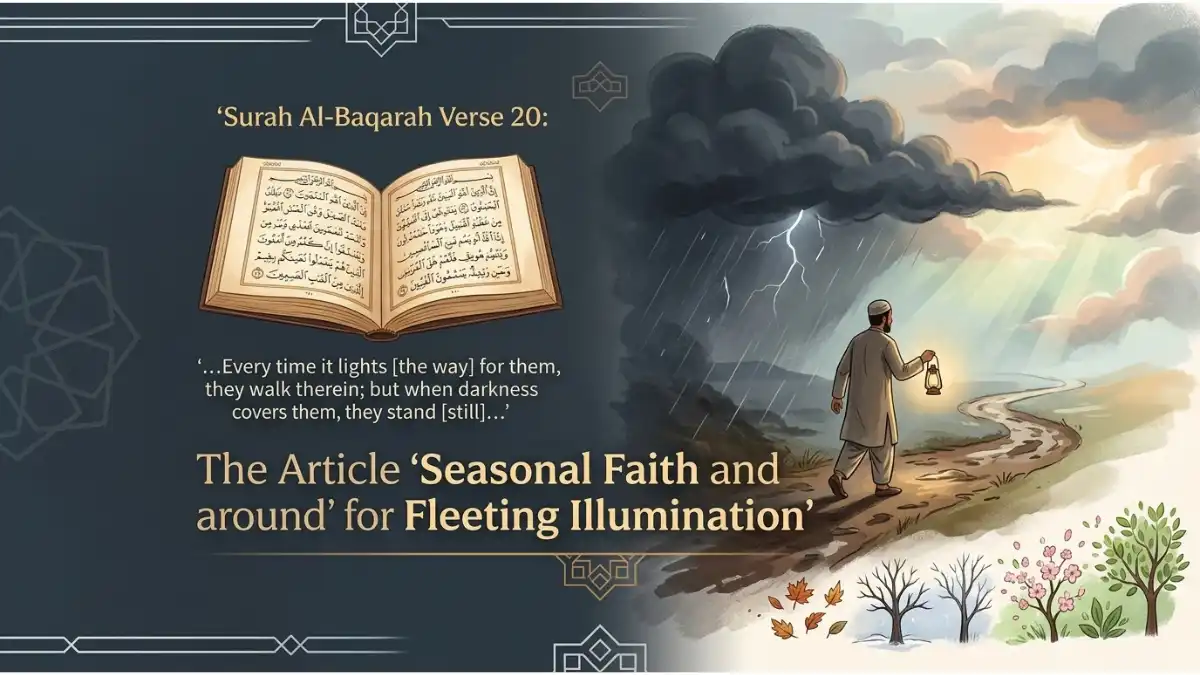
Introduction: The Dilemma of Hesitant Footsteps
Following the vivid depiction of a terrifying midnight storm in verse 19, Surah Al-Baqarah verse 20 brings this cinematic parable of the hypocrites to its ultimate climax. Having established the terrifying atmospheric backdrop of thunder, darkness, and rain, the Quran now turns its attention to the erratic behavior of travelers trying to navigate this landscape without a reliable internal light source.
Allah Almighty states:
“Yakādul-barqu yakhtaafu abṣārahum, kullamā aḍā’a lahum mashaw fīhi wa idhā aẓlama ‘alayhim qāmū, wa law shā’allāhu la-dhahaba bi-sam‘ihim wa abṣārihim, innallāha ‘alā kulli shay’in qadīr.”
Translation: “The lightning almost snatches away their sight. Whenever it flashes for them, they walk therein; but when darkness covers them, they stand still. And if Allah had willed, He could have taken away their hearing and their sight. Indeed, Allah is over all things competent.” (QS. Al-Baqarah: 20)
Revisit this midnight tempest with imaginative precision: The surrounding landscape is enveloped in thick, impenetrable darkness (aẓlama ‘alayhim), making it completely impossible to see a single step ahead. Suddenly, a blinding bolt of lightning rips through the sky (yakādul-barqu yakhtaafu abṣārahum). The flash is so intensely radiant that it almost blinds the travelers.
During that split-second burst of illumination, they rush forward a few steps while the path is briefly visible (kullamā aḍā’a lahum mashaw fīhi). However, the moment the flash dissipates and heavy darkness reclaims the environment, they freeze in their tracks, entirely paralyzed (qāmū). Fearful of stepping off a cliff or wandering deeper into danger, they stand petrified, uncertain, and entirely dependent on the next external flash.
Deconstructing the Psychology of Opportunistic Faith
This striking physical scene serves as a timeless psychological profile of human beings who lack rooted conviction and rely exclusively on external circumstances to dictate their moral momentum:
- The Blinding Flash (Al-Barq) — Temporal Advantages and Moments of Clarity: Lightning represents moments when faith or moral living aligns effortlessly with personal self-interest, emotional comfort, or public approval. It symbolizes times when truth is easy to follow, profitable, or socially celebrated.
- Walking in Light (Mashaw Fīhi) — Conditional Engagement: When circumstances are favorable, these individuals move forward with enthusiasm. They display devotion, speak eloquently about ethics, and participate in good deeds as long as the cost is low and the immediate return is high.
- The Return of Darkness (Aẓlama ‘Alayhim) — Trials, Solitude, and Unfavorable Odds: Darkness represents periods of hardship, economic contraction, social isolation, or moments where standing for truth requires personal sacrifice, humility, or endurance without immediate praise.
- Freezing in Paralysis (Qāmū) — Spiritual Stagnation and Hesitation: The moment difficulty strikes or public applause fades, their motivation vanishes. Lacking an internal anchor of genuine sincerity, they stop progressing, compromise their values, or fall back into passive indifference.
Comparative Analysis: External Illumination vs. Internal Conviction
The operational contrast between an individual dependent on external “lightning flashes” and one driven by an internal “lamp of faith” is broken down in the table below:
| Dimension of Practice | The Opportunistic Pejalan (Lightning-Dependent) | The Anchored Believer (Internal Light) |
|---|---|---|
| Primary Motivation | Social recognition, worldly ease, mood, or material profit. | Sincere devotion to Allah and unwavering adherence to principle. |
| Response to Comfort (Light) | Moves forward enthusiastically; highly visible and vocal. | Expresses deep gratitude and maintains humility. |
| Response to Hardship (Darkness) | Freezes (qāmū), complains, abandons duties, or changes sides. | Exercises patience (ṣabr), maintains consistency, and pushes forward. |
| Dependence Level | 100% reliant on external validation and favorable conditions. | Self-sustained through quiet worship, reflection, and integrity. |
| Long-term Trajectory | Erratic, seasonal, and vulnerable to total collapse during trials. | Steady, reliable, and spiritually resilient across all life cycles. |
Exegesis & Classical Interpretations: The Final Warning of Divine Power
Renowned Quranic scholars provide essential commentary on the nuanced phrases contained within verse 20:
Ibn Kathir notes that the lightning symbolizes the brief moments of clarity that touch the hearts of the hypocrites when they witness the truth of revelation or the victory of the believers. They move toward Islam when it brings them peace, honor, or spoils of war. However, when tested with hardships or commanded to make difficult sacrifices, they retreat into doubt and indecision.
Al-Tabari emphasizes the phrase “wa idhā aẓlama ‘alayhim qāmū” (and when darkness covers them, they stand still). He explains that qāmū does not merely mean standing physically upright; it denotes total moral paralysis. When the benefits of truth are no longer obvious or profitable, they stand bewildered, unable to take a single step forward in righteousness.
Fakhr al-Din al-Razi focuses on the theological solemnity of the conclusion: “Wa law shā’allāhu la-dhahaba bi-sam‘ihim wa abṣārihim, innallāha ‘alā kulli shay’in qadīr.” (And if Allah had willed, He could have taken away their hearing and their sight. Indeed, Allah is over all things competent.). This serves as a stark reminder of divine mercy and boundary. Allah grants human beings time and cognitive faculties to choose sincerity. However, persistently misusing these gifts for opportunistic gain carries the ongoing risk of permanently losing the ability to perceive guidance altogether.
Modern Context: The Danger of “Seasonal Faith” and Social Media Piety
The behavioral pattern described in Surah Al-Baqarah verse 20 is remarkably prevalent in modern society across personal, professional, and spiritual spheres:
- Audience-Driven Morality (The Spotlight Flash): Many individuals exhibit exemplary behavior, generosity, and religious devotion exclusively when an audience is present or when producing content for social media. When the cameras turn off and they return to solitude (the darkness), their moral standards collapse, mirroring the mashaw fīhi / qāmū cycle.
- Transactional Relationship with God: People frequently display intense devotion when seeking a promotion, passing an exam, or recovering from an illness. Once the desire is granted (the light appears), they walk forward briefly. But if an answer is delayed or hardship continues (darkness), they abandon prayer, complain bitterly, and question divine justice.
- Intellectual Antics Without Moral Execution: Many enthusiastically participate in high-minded ethical debates or attend inspiring lectures (experiencing the flash of knowledge), yet become utterly paralyzed when required to apply those principles in workplace environments corrupted by compromise.
Case Study: The Seasonal Activist and the Quiet Builder
Consider two colleagues, Marcus and David, working at an international non-profit organization dedicated to community development.
Marcus was an energetic speaker who thrived during major campaigns, media galas, and public launches. When project funding was abundant and social media engagement was high (the “lightning” phase), Marcus worked long hours, gave passionate speeches, and celebrated the organization’s mission publicly. However, when the organization faced a severe budget shortfall, lost public interest, and required tedious, unglamorous fieldwork in remote areas without media attention (the “darkness” phase), Marcus became demotivated, complained constantly, and eventually stopped showing up for his shifts.
David, by contrast, worked quietly in the background. He spoke far less but maintained an unyielding work ethic regardless of whether the organization was being praised in news headlines or struggling quietly through administrative crises. David possessed an internal moral compass; his commitment was anchored in genuine duty to the people they served, not in the fluctuating warmth of public recognition.
Marcus operated on the lightning flash of verse 20, whereas David cultivated the steady internal flame of true conviction. When the organization eventually survived its crisis, it was David’s quiet consistency that kept the foundation standing, while Marcus had long since moved on to look for another spotlight.
Three Practical Action Steps to Build Unwavering Consistency (Istiqāmah)
To ensure your spiritual path and ethical life do not depend on temporary lightning flashes, implement these three daily disciplines:
- Establish Private Acts of Worship (Unseen Devotion): Dedicate a specific good deed every single day—whether a quiet prayer late at night, anonymous charity, or uncredited assistance to someone in need—that remains completely hidden from public view. This builds an internal reservoir of sincerity.
- Normalize Duty During Low-Energy States (Overcoming Mood Dependence): Train yourself to fulfill your religious and moral duties even when you feel emotionally uninspired, tired, or unappreciated. Consistency during “dark/quiet” moments is the ultimate test of character.
- Continually Audit Your Intention (Niyyah): Before starting any major project, speech, or act of service, pause and ask yourself honestly: *”Would I still perform this action with the exact same quality if no one ever knew I did it?”* Adjust your motivation accordingly.
Supplication for Steadfastness of the Heart
We turn to Allah Almighty, seeking protection from conditional faith and asking for an unwavering heart through all seasons of life:
“O Allah, Turner of the hearts, keep our hearts firm upon Your religion. Protect us from becoming seasonal seekers of truth who walk only when praised and freeze when tested. Grant us true sincerity (ikhlaas) that shines brightly in solitude, grant us steadfastness (istiqamah) through every darkness, and do not deprive us of the light of Your guidance for even the blink of an eye. Amin Yaa Rabbal ‘Alamin.”
Frequently Asked Questions (FAQ)
Question: “Is it normal for faith and motivation to fluctuate, or does feeling uninspired mean I am exhibiting hypocrisy like the people described in verse 20?”
Answer: Fluctuation in spiritual energy and emotional motivation is a natural human experience. The Prophet Muhammad (peace be upon him) acknowledged that faith has peaks and valleys. The crucial difference between a genuine believer and the opportunistic mindset in verse 20 lies in **action during the low points**. A believer may feel less emotional enthusiasm during low phases, but they continue to fulfill their core duties and hold onto their principles. The opportunistic individual, however, abandons their duties entirely the moment the external motivation or benefit disappears.
Have you ever caught yourself relying on external praise or ideal moods to do the right thing? How do you maintain consistency when the environment around you becomes cold or quiet? Share your thoughts and reflections in the comments below!
This article is part of the thematic study series: Tadabur Al-Qur’an Surah Al-Baqarah