
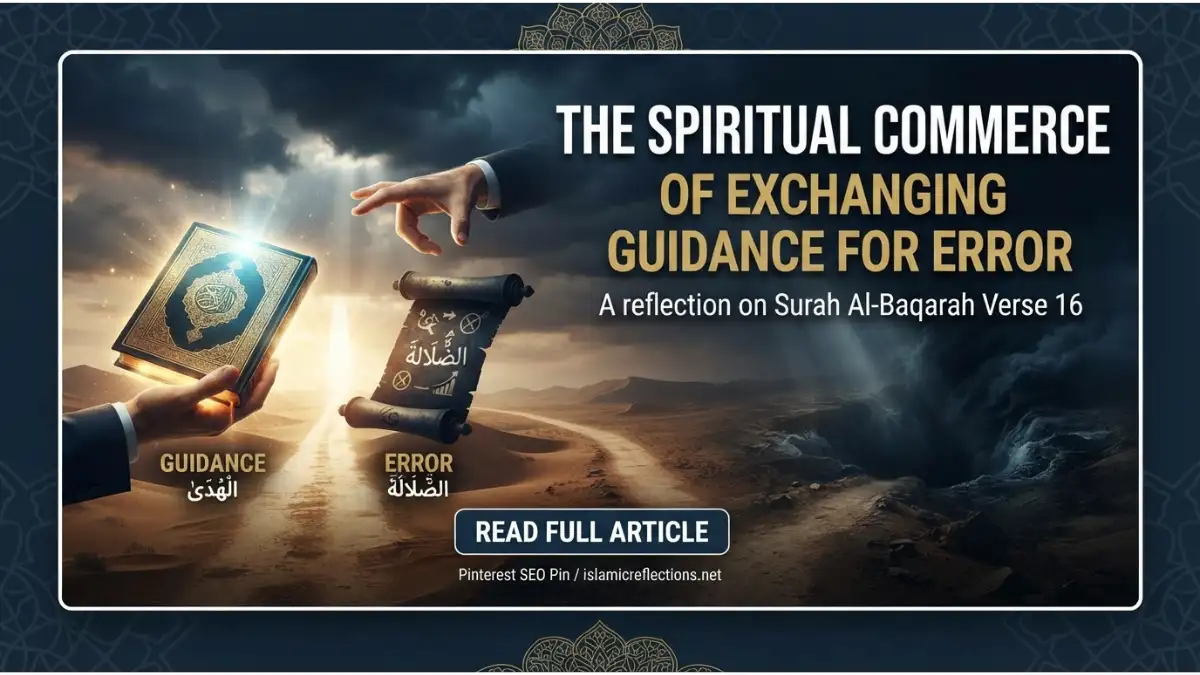
Why Do People Engage in Unprofitable Trades?
Following the previous verse, which described how hypocrites remain caught in their own self-deception and wander blindly in disorientation, Surah Al-Baqarah verse 16 exposes the underlying mindset driving their decisions with exceptional clarity:
“Ulā’ikal-ladhīnashtarawuḍ-ḍalālata bil-hudā fa mā rabiḥat tijāratuhum wa mā kānū muhtadīn.”
Translation: “Those are the ones who have purchased error [in exchange] for guidance, so their transaction has brought no profit, nor were they guided.” (QS. Al-Baqarah: 16)
In this verse, Allah Almighty employs a vivid financial metaphor deeply familiar to human experience: “Purchasing” (ashtarawu) and “Commerce” (tijarah).
Imagine an individual stepping into a world-renowned jewelry house holding a priceless, genuine diamond—representing divine guidance, moral integrity, and deep psychological tranquility. Instead of safeguarding this asset, the individual voluntarily exchanges it for a heap of decaying waste wrapped in shiny gold foil. To any rational observer, such a transaction appears absurd.
Yet, this image illustrates the spiritual miscalculation described in the Quran. Individuals who choose delusion willingly sacrifice divine guidance, personal authenticity, and inner freedom in exchange for fleeting commodities: temporary fame, quick financial shortcuts, social approval, or immediate ego gratification. They convince themselves of their cleverness, assuming they have secured a profitable deal. In reality, they execute the most catastrophic transaction in human history.
Linguistic Breakdown: Why Does the Quran Use Commercial Terminology?
The choice of commercial imagery in this verse contains profound linguistic and psychological lessons for the human soul:
- The Capital of the Soul: Every human enters life endowed with foundational capital from their Creator: innate purity (fitrah), rational intellect, time, and agency. Human existence functions as an ongoing transaction where time and decision-making energy are exchanged either for divine pleasure or self-destructive loss.
- The Act of Purchasing (Al-Ishtira’): In Arabic linguistics, Ishtira’ refers to exchanging a valued asset to acquire something else. The hypocrites consciously surrendered their inherent access to guidance in order to purchase misguidance. They spent priceless spiritual capital on items that guarantee their own harm.
- Double Spiritual Loss: The verse highlights a two-fold consequence: “fa ma rabihat tijaratuhum” (their commerce brought no profit) and “wa ma kanu muhtadin” (they lost their navigational guidance). This signifies that their initial spiritual capital has been depleted, while the acquired substitute delivers nothing but confusion and regret.
Comparative Analysis: Authentic Value vs. Unprofitable Trades
To better understand the economic imagery of verse 16, consider the stark contrast between a trade centered on divine principles versus an opportunistic trade driven by immediate desire:
| Trade Dimension | The Unprofitable Trade (Verse 16) | The Wise Spiritual Trade (Al-Tijarah Al-Rabihah) |
|---|---|---|
| Initial Capital Invested | Divine guidance, moral integrity, conscience, and time. | Time, worldly discipline, wealth, and ego restraint. |
| Acquired Item | Fleeting approval, unethical gains, and self-delusion. | Eternal tranquility, divine pleasure, and moral clarity. |
| Perceived Short-Term Gain | Immediate gratification, status elevation, or social ease. | Requires patience, self-control, and temporary discomfort. |
| Long-Term Net Result | Total depletion of capital, chronic anxiety, and disorientation. | Compounded spiritual growth, peace, and ultimate salvation. |
Modern Realities: Bad Spiritual Deals in the Digital Era
In contemporary society, bad spiritual transactions occur regularly across professional, social, and personal spaces:
- Trading Integrity for Rapid Career Advancement: Individuals may compromise honesty, falsify records, or undermine colleagues to secure a promotion or short-term financial incentive. While their bank balances may temporarily increase, they forfeit restful sleep and genuine self-respect.
- Trading Attention and Time for Cheap Dopamine: Countless hours of productive time, focused prayer, and meaningful family interactions are routinely exchanged for endless digital scrolling. This trade yields heightened anxiety, social comparison, and mental fatigue.
- Trading Principles for Social Validation: To secure digital engagement, views, or peer acceptance, individuals sometimes broadcast private matters or compromise personal dignity. They exchange lasting personal honor for brief public applause.
The central lesson remains clear: Avoid miscalculating value in daily choices. Never exchange lasting internal peace and divine alignment for temporary worldly gratification.
Classical Exegesis: Perspectives from Mufassirun
Classical commentators provide valuable historical and theological depth regarding the phrasing of verse 16:
Ibn Kathir notes that the phrase “purchased error for guidance” applies to two groups: those who possessed faith and subsequently reverted to disbelief, as well as those who preferred misguidance when presented with the truth. In both instances, guidance was available, yet misguidance was actively chosen as the preferred asset.
Al-Qurtubi emphasizes the precision of the phrase “fa ma rabihat tijaratuhum”. In Arabic trade terminology, a business is described as unprofitable when the return fails to cover the original capital investment. By stating that their commerce brought no profit, the Quran indicates that the hypocrites lost both their initial capital (their fitrah and capacity for truth) and failed to gain any lasting benefit from their trade.
Syekh As-Sa’di highlights that every human action is inherently a transaction. A person constantly exchanges life hours for specific outcomes. The truly successful trader is the one who sells temporary personal desires to purchase divine pleasure, whereas the failed trader forfeits ultimate success for fleeting illusions.
Case Study: The Miscalculated Trade in Modern Business
Consider the experience of Jonathan (a composite case study), a founding partner at a boutique investment firm. Seeking to outperform market competitors, Jonathan began utilizing undisclosed insider insights and compromising regulatory protocols. When a trusted mentor warned him of the ethical risks, Jonathan dismissed the concern: “Strict adherence to traditional rules limits growth. Financial success requires taking calculated ethical risks.”
In the initial years, his strategy appeared highly profitable. His firm reported record earnings, he acquired luxury properties, and industry peers celebrated his financial acumen. However, sustaining the illusion required increasingly complex schemes. The constant fear of regulatory discovery led to severe insomnia and chronic stress.
Eventually, regulatory authorities launched a comprehensive investigation. The accumulated paper trail exposed the firm’s non-compliance. Jonathan faced immediate asset seizures, public reputational ruin, and federal prosecution.
Reflecting on his trajectory during legal proceedings, Jonathan acknowledged: “I assumed I was a master strategist. In reality, I made the worst trade possible—exchanging my peace of mind, family stability, and professional honor for numbers on a screen that disappeared overnight.” His experience demonstrates the exact dynamic described in Al-Baqarah verse 16.
Three Practical Action Steps to Preserve Your Capital
To apply the lessons of Surah Al-Baqarah verse 16, implement these three practical safeguards in daily life:
- Evaluate Daily Transactions: Before making major professional or personal commitments, reflect: *”Does this choice align with my core values, or am I compromising long-term peace for short-term gain?”*
- Audit Time and Digital Consumption: Dedicate ten minutes weekly to analyze your time distribution. Identify habits or digital consumption that drain your focus without adding real spiritual or personal value, and reduce them systematically.
- Cultivate Gratitude for Guidance: Regularly express gratitude for moments of ethical clarity and faith. Recognizing guidance as your most valuable asset reinforces your resolve to protect it.
Supplication for Protection Against Unprofitable Trades
We ask Allah Almighty to safeguard our spiritual investments and grant us true success:
“O Allah, Lord of the Heavens and Earth, protect us from making decisions that sacrifice Your guidance for temporary delusion. Preserve our faith, our time, and our integrity as our most valued assets. Grant us the wisdom to recognize profitable spiritual investments and the strength to turn away from deceptive worldly shortcuts. Keep our feet firm upon Your straight path until our final day. Amin.”
Frequently Asked Questions (FAQ)
Question: “How can I resist the temptation of short-term financial or social gains that require ethical compromises?”
Answer: Develop a long-term perspective centered on ultimate accountability. Whenever an ethically questionable shortcut appears, ask yourself: *”Will this benefit offset the loss of my internal tranquility and divine alignment over five or ten years?”* Remembering that wealth acquired through compromised principles cannot purchase inner peace helps reframe the situation and preserve your core values.
Have you ever turned down an attractive opportunity because it required compromising your core principles? How did that decision impact your life long-term? Share your reflections in the comments below!
This article is part of the thematic study series: Tadabur Al-Qur’an Surah Al-Baqarah