
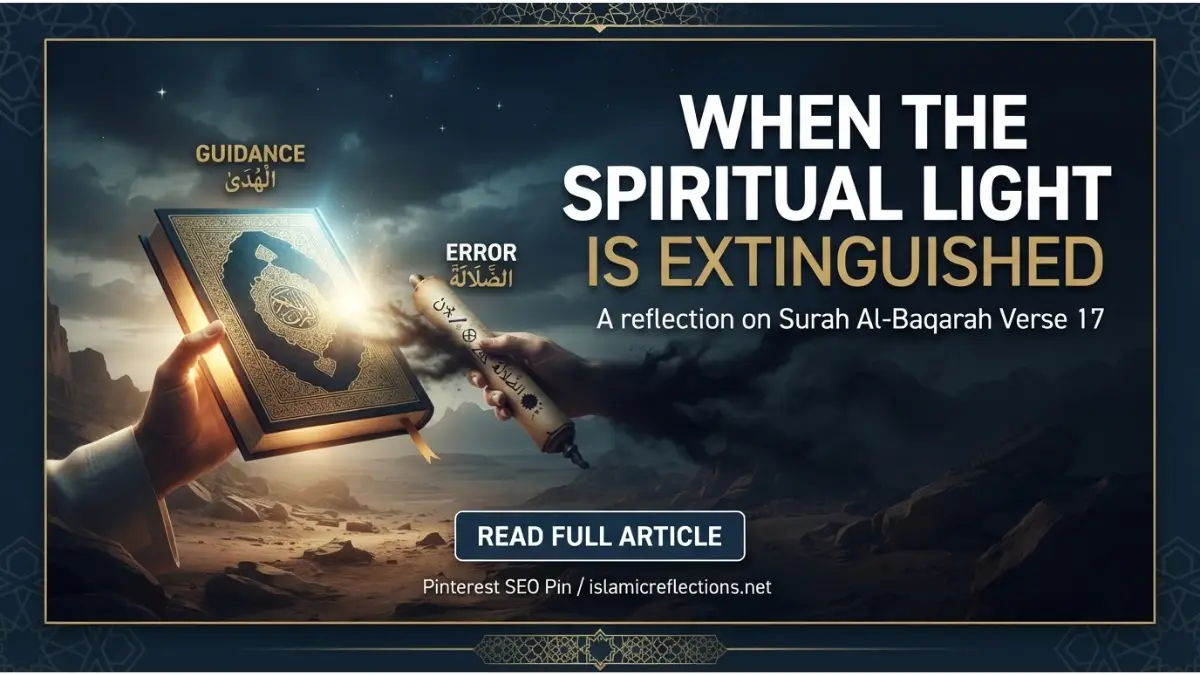
Have You Ever Been Lost in a Pitch-Black Storm?
Following the previous verse, which described those who made an unprofitable transaction by exchanging divine guidance for delusion, Surah Al-Baqarah verse 17 presents an exceptionally cinematic, vivid, and deeply analytical parable illustrating their internal spiritual chaos, psychological disorientation, and ultimate existential loss:
“Masaluhum kamasalil-ladhis-tawqada nāran fa lammā aḍā’at mā ḥaulahū dhahaballāhu binūrihim wa tarakahum fī ẓulumātin lā yubṣirūn.”
Translation: “Their example is that of one who kindled a fire, but when it illuminated what was around him, Allah took away their light and left them in darknesses [so] they could not see.” (QS. Al-Baqarah: 17)
Consider this imagery with acute visual clarity: Imagine walking alone in the dead of night through a dense, unfamiliar, and treacherous wilderness. The darkness is oppressive, and every step carries the hidden danger of falling off a cliff or encountering wild predators. Suddenly, after immense struggle, you manage to kindle a bright bonfire. Instant relief floods your soul. The surrounding terrain becomes visible, hidden threats are exposed, and a temporary sense of security, warmth, and orientation is restored.
However, in a mere fraction of a second, without warning, the fire is abruptly extinguished. A fierce gust of wind sweeps by, plunging you back into an absolute, impenetrable darkness far more suffocating than what you experienced before. Your eyes, which had briefly adapted to the illumination of the flames, are now completely blind to the surrounding environment. The resulting panic, profound disorientation, and psychological helplessness are overwhelming.
This striking mental picture represents the precise spiritual and psychological reality of hypocrites—and indeed anyone who toys with divine truth, treats moral principles as disposable commodities, or arrogantly ignores the quiet warnings of their own conscience.
Linguistic Breakdown: The Subtle Precision of Quranic Imagery
The specific choice of words in this verse contains profound theological, psychological, and linguistic lessons regarding the mechanics of faith and spiritual decline:
- The Phrase Ishtawqada Nāran (Kindling a Fire): In classical Arabic grammar, the prefix ist- denotes effort, seeking, or exertion. Kindling a fire in an ancient wilderness required deliberate physical energy, patience, and resources. This illustrates that hypocrites and insincere seekers often make initial efforts to access the benefits, social stability, or moral prestige of the faith community, or they find themselves placed within an environment rich in divine revelation.
- The Distinction Between Ḍiyā’ and Nūr: When describing the blazing fire, the Quran uses the verb aḍā’at (from ḍiyā’, which signifies a intense, radiant light accompanied by thermal heat). Yet, when describing what Allah removes, the text states: “dhahaballāhu binūrihim”—Allah took away their light (nūr, which signifies pure, cool, illuminating guidance and inner peace). Noticeably, Allah does not say He removed the fire itself; He removed the *cool illuminating light*, leaving them stranded with the oppressive heat, burning smoke, and blinding blackness.
- The Plural Form Ẓulumāt (Layered Darknesses): The Quran intentionally utilizes the plural noun ẓulumāt rather than a singular form. When an individual forfeits divine guidance, they do not merely land in simple darkness. Instead, they become submerged under multiple overlapping layers of confusion: the darkness of intellectual doubt, the darkness of moral hypocrisy, the darkness of emotional anxiety, and the darkness of accumulating unrepented transgressions.
Comparative Analysis: The Kindled Flame vs. The Extinguished Soul
To grasp the depth of verse 17, consider the structural contrast between an individual who preserves their spiritual light versus one who allows their inner flame to be snuffed out through hypocrisy and moral compromise:
| Dimension of Experience | The Person of Sustained Light (Al-Mu’min) | The Extinguished Soul (Al-Munāfiq – Verse 17) |
|---|---|---|
| Origin of the Light | Innate spiritual alignment (fitrah) combined with divine revelation. | External, temporary utilization of faith for self-serving motives. |
| Internal Psychological State | Deep tranquility, moral clarity, and psychological grounding. | Chronic anxiety, hypervigilance, paranoia, and inner emptiness. |
| Response to Moral Warnings | Immediate repentance (tawbaha), humility, and correction. | Arrogant rationalization, delay, and emotional hardening. |
| Ultimate Environmental Outcome | Illuminated pathway through worldly trials leading to salvation. | Total abandonment in layered darknesses (fī ẓulumātin lā yubṣirūn). |
Modern Realities: The Phenomenon of Spiritual Numbness
In our modern fast-paced society, the “light” described in Surah Al-Baqarah verse 17 manifests in tangible daily experiences that shape human well-being:
- The Spark of Conscience and Divine Signals: Divine light often manifests initially as a gentle tug on the heart—a subtle sting of guilt when committing an ethical infraction, a moment of profound awe when observing creation, or a sudden urge to realign one’s life after hearing a sincere reminder. This represents the initial fire kindled in the soul to prevent human disorientation.
- The Danger of Desensitization (Spiritual Callousness): If an individual repeatedly suppresses their conscience, rationalizes bad behavior, or prioritizes short-term ego gains over integrity, that internal light gradually dims. Eventually, the person reaches a catastrophic threshold: total spiritual desensitization. Transgressions no longer produce guilt, deceit becomes second nature, and the soul enters a state of profound moral blindness.
- Existential Emptiness Amid Material Splendor: Contemporary society presents countless examples of individuals who possess immense worldly prosperity, professional status, and social visibility—resembling a brilliant fire illuminating everything around them. Yet internally, their spirits inhabit total darkness. Lacking genuine purpose and divine alignment, they experience chronic angst, disconnection, and loss of direction.
Classical Exegesis: Insights from Great Mufassirūn
Classical Quranic commentators provide rich theological context regarding the deeper meanings embedded in verse 17:
Ibn Kathir notes that this parable applies directly to the hypocrites of Medina who accepted Islam outwardly. By uttering the testimony of faith, they secured physical safety, social protection, and access to community wealth—represented by the temporary light illuminating their immediate surroundings. However, because their hearts remained devoid of true conviction, Allah stripped away their spiritual illumination upon death or during worldly crises, leaving them in absolute darkness when light was needed most.
Al-Qurtubi focuses on the phrasing “dhahaballāhu binūrihim” (Allah took away their light) rather than “atfa’allahu narahum” (Allah extinguished their fire). He emphasizes that removing the light while leaving the elemental properties of fire means that the terrifying heat, smoke, and threat remain, while the benefit of sight and guidance vanishes entirely. This symbolizes the painful internal friction experienced by those who know the truth yet actively live a lie.
Fakhr al-Din al-Razi highlights the psychological aspect of “tarakahum fī ẓulumātin lā yubṣirūn” (left them in darknesses, unable to see). He explains that the sudden loss of light after having experienced illumination produces a far more severe state of terror and confusion than never having seen light at all. The contrast intensifies the agony of spiritual loss.
Case Study: The Trajectory of Neglected Conscience
Consider the story of Marcus (a composite case study), a senior executive at a global technology firm. Early in his career, Marcus possessed a sharp moral compass. When presented with opportunities to inflate performance metrics or deceive investors, his conscience reacted strongly. He felt an intense internal discomfort that prompted him to refuse unethical shortcuts.
Over time, however, corporate pressure and the desire for rapid career advancement began to erode his resolve. The first time he approved an altered financial report, his heart raced and he suffered from severe insomnia for days. Yet, the financial bonuses and accolades he received served as a temporary fire, illuminating his worldly status and shielding him from immediate consequences.
To quiet his persistent guilt, Marcus began actively avoiding mentors who held him accountable, dismissed ethical seminars, and surrounded himself with sycophants. Gradually, the internal warning system shut down completely. He could fabricate data without a single flutter of anxiety. He had achieved total internal numbness.
Years later, when an independent audit exposed the systemic fraud, Marcus lost his executive position, his reputation, and his personal relationships. Sitting alone in an empty apartment, he reflected in a moment of stark self-awareness: “The scariest part wasn’t getting caught. The scariest part was the moment I stopped feeling bad about lying. I thought I was winning, but I had lost my soul long before the auditors arrived.” His trajectory reflects the precise spiritual mechanism detailed in verse 17.
Three Practical Steps to Preserve Your Inner Light
To safeguard your spiritual illumination and prevent the gradual darkening of the soul, incorporate these three proactive measures into your daily routine:
- Respond Instantly to Conscience Signals: The moment you feel a quiet internal sting of guilt regarding a word spoken, a financial decision, or an unethical action, do not rationalize it. Pause immediately, acknowledge the mistake, and make a swift verbal or behavioral correction.
- Conduct Daily Spiritual Audits (Muḥāsabah): Dedicate five minutes before sleep to review your daily conduct. Ask yourself honestly: *”Did my choices today move me closer to divine light or push me deeper into self-serving darkness?”*
- Curate Your Environment: Consciously limit your exposure to toxic environments, media consumption, and social dynamics that encourage cynicism, dishonesty, or spiritual apathy. Surround yourself with individuals whose integrity inspires your own.
Supplication for the Preservation of Spiritual Guidance
We ask Allah Almighty to safeguard our hearts and preserve the light of faith within our souls:
“O Allah, Lord of the Heavens and the Earth, do not extinguish the light of faith and guidance within our hearts. Keep our conscience sensitive to truth, forgive the transgressions that dim our spiritual vision, and protect us from the suffocating darknesses of hypocrisy and self-delusion. Place light in our hearts, light in our sight, and light upon our path until the day we meet You. Amin Yaa Rabbal ‘Alamin.”
Frequently Asked Questions (FAQ)
Question: “How can I reignite my spiritual light if I feel that I have strayed too far and my heart has become cold or dark?”
Answer: The very fact that you feel concern about the state of your heart is definitive proof that your inner light is not completely extinguished! True death of the heart is characterized by total apathy and lack of concern. To reignite your flame, begin with small, consistent steps: make sincere repentance (tawbah), engage in regular remembrance of God (dhikr), rectify a specific wrong you have committed, and perform hidden acts of charity. Divine mercy is vast, and sincere return instantly rekindles spiritual illumination.
Have you ever experienced a moment where a sudden realization restored clarity to your life after a period of confusion? How do you maintain your moral focus amid daily distractions? Share your reflections in the comments below!
This article is part of the thematic study series: Tadabur Al-Qur’an Surah Al-Baqarah