
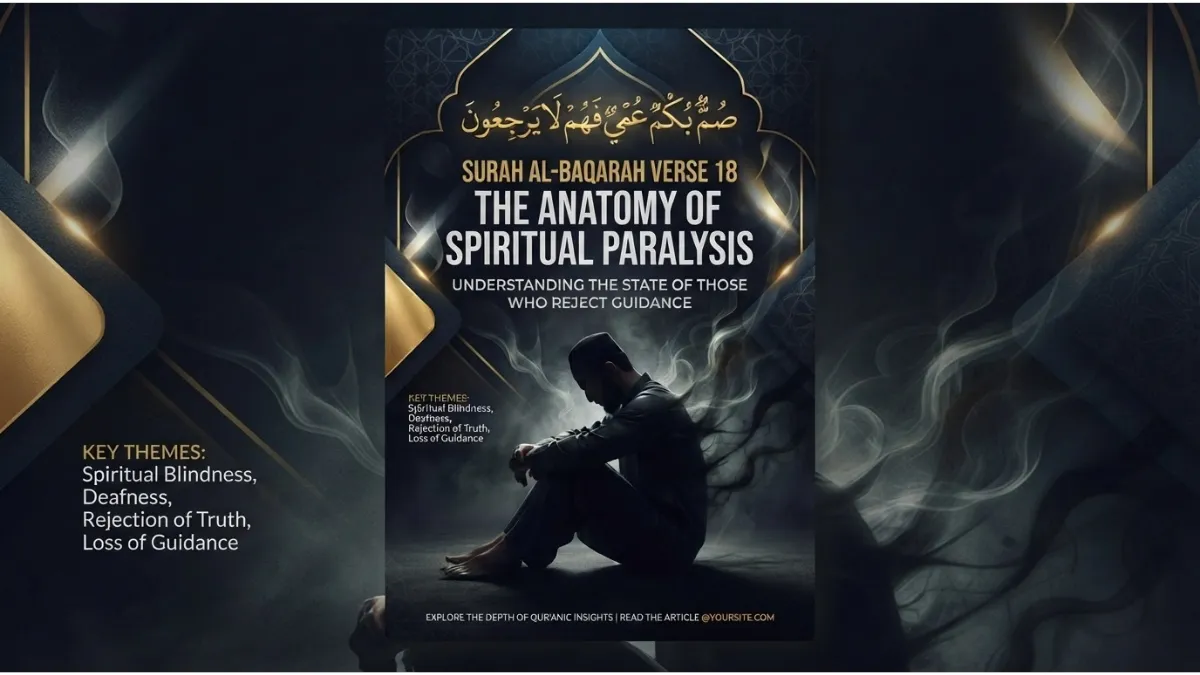
Introduction: When the Gates of Truth Are Intentionally Locked
Following the vivid imagery in verse 17—where the hypocrites are likened to travelers left in pitch darkness after their temporary fire was extinguished—Surah Al-Baqarah verse 18 penetrates deeper into the root cause of this spiritual crisis. This state of profound darkness is not merely a stroke of tragic bad luck; rather, it is the cumulative result of repeated, conscious decisions to reject guidance and shut down internal receptive faculties.
Allah Almighty declares:
“Ṣummun bukmun ‘umyun fa-hum lā yarji‘ūn.”
Translation: “Deaf, dumb, and blind—so they will not return [to the right path].” (QS. Al-Baqarah: 18)
When reading the descriptors “deaf, dumb, and blind,” one might initially assume a reference to physical disabilities. However, classical Quranic commentators unanimously agree that this verse depicts a state of complete spiritual paralysis and psychological insensitivity. Biologically, their eyes, ears, and tongues function perfectly; yet, their hearts continuously refuse to process incoming sensory data into transformative truth and moral integrity.
Deconstructing the Three Fortresses of Ego: Deaf, Dumb, and Blind
Why does the Quran utilize these specific physical metaphors to illustrate the zenith of human character degradation? Examining each sense reveals how internal pride systematically dismantles human perception:
- Deaf (Ṣummun) — Closing Access to Truth and Counsel: A spiritually deaf individual hears audible sounds and articulate sentences, but their mind actively blocks the moral meaning. Whenever they encounter divine warnings, constructive criticism, or ethical corrections that challenge their ego, they instantly trigger a defensive posture. They fall prey to severe confirmation bias, choosing to consume only information that validates their pre-existing desires and prejudices.
- Dumb (Bukmun) — The Inability to Admit Fault and Speak Truth: The tongue of a spiritually paralyzed individual ceases to function for honest self-criticism, genuine repentance, or advocating unvarnished justice. While their vocal cords remain hyperactive in daily conversation, speech is restricted to self-justification, defending falsehoods, twisting facts, and maintaining a polished façade before society.
- Blind (‘Umyun) — The Loss of Inner Vision (Baṣīrah): Their physical eyes observe the grandeur of creation, witness the inevitability of mortality in those around them, and see the logical consequences of corrupt actions. Yet, their inner spiritual vision (baṣīrah) remains entirely dark. Life experiences are dismissed as mere random coincidences rather than meaningful signs calling for self-correction.
Detailed Comparison: Physical Senses vs. Spiritual Perception
To better grasp the profound contrast presented in Surah Al-Baqarah verse 18, the following table breaks down the operational differences between physical sensory capacity and spiritual receptive health:
| Sensory Dimension | Physical Functionality (External) | Spiritual Functionality (Internal / Heart) |
|---|---|---|
| Auditory (Hearing / Al-Sam’) | Processes sound waves, words, and environmental acoustics effortlessly. | Ṣummun (Deaf): Refuses to internalize admonition, moral logic, and divine guidance. |
| Vocal (Speech / Al-Lisān) | Articulates complex language, arguments, and social chatter. | Bukmun (Dumb): Unable to speak sincere truth, apologize, or confess fault. |
| Visual (Sight / Al-Baṣar) | Perceives colors, physical shapes, light, and material environments. | ‘Umyun (Blind): Oblivious to divine signs, moral lessons, and ultimate purpose. |
| Ultimate Trajectory | Navigates the physical world with material awareness. | Fa-hum lā yarji‘ūn: Trapped in a cycle of self-inflicted spiritual disorientation. |
Exegesis & Classical Interpretations: Why “Fahum Lā Yarji‘ūn”?
The concluding clause of the verse, “Fa-hum lā yarji‘ūn” (so they will not return), is frequently misunderstood. Does this mean Allah has permanently sealed off repentance for these individuals regardless of what they do?
Classical scholars like Ibn Kathir and Al-Tabari clarify that Allah never denies repentance to a sincere seeker. Rather, the statement highlights that the individuals themselves have systematically destroyed every avenue of return. If a traveler destroys their compass, covers their eyes, plugs their ears against directional advice, and refuses to ask for help when lost, returning to the correct highway becomes an impossibility by their own choice.
This serves as a stern theological warning: habitually delaying moral improvement, dismissing small misdeeds, and constantly rationalizing ethical compromises gradually hardens into a permanent state of spiritual obstinacy.
Classical Insights: Perspectives from Renowned Mufassirūn
Great scholars throughout Islamic history have provided deep psychological insights into verse 18:
Ibn Kathir notes that hypocrites used their hearing, sight, and speech for worldly gain while remaining completely unbenefited by these faculties in matters of eternal salvation. Thus, in the sight of God, they are classified as though they possess no senses at all, for a tool that fails its primary purpose is functionally non-existent.
Al-Qurtubi points out the literary progression from verse 17 to verse 18. In verse 17, light was taken away externally; in verse 18, the internal receivers (ears, tongue, eyes) are described as completely shut down. The tragedy moves from an environmental loss of light to an organic, internal incapacity to ever perceive light again.
Fakhr al-Din al-Razi explains that when arrogance settles into the human mind, it creates a psychological filter. Information that flatters the ego is welcomed, while information that demands humility is filtered out. Over time, this filter turns into an impenetrable wall, leading precisely to the state of “lā yarji‘ūn” (they will not return).
Modern Context: The Psychological Trap of Cognitive Dissonance and Ego
This Quranic description reflects clearly in contemporary human behavior across professional, personal, and social contexts:
- The Trap of Confirmation Bias: In our modern information era, individuals often isolate themselves in echo chambers. They actively block out opposing viewpoints, expert advice, or ethical critiques, manifesting the exact characteristics of ṣummun (spiritual deafness).
- Defensive Rationalization over Accountability: When confronted with unmistakable evidence of wrongdoing, human ego often triggers intense self-justification. Instead of utilizing speech to admit error (which breaks the state of bukmun), people weaponize language to deflect blame, alter narratives, and attack critics.
- Apathy Toward Life’s Warning Signs: Society frequently witnesses individuals who observe personal health crises, financial collapses, or loss of loved ones, yet draw zero existential lessons. They continue living on autopilot, exhibiting the spiritual blindness (‘umyun) highlighted in the Quran.
Case Study: The Leader Who Refused to Listen
Consider the real-world story of a corporate founder who built a highly successful enterprise. In the early stages, he was open to feedback, held regular team consultations, and adjusted strategies based on market realities.
However, as wealth and fame accumulated, his ego expanded. He began treating honest critique from senior advisors as disloyalty. When accountants presented clear financial data indicating dangerous over-expansion, he dismissed the reports, attacked the messengers, and surrounded himself exclusively with flatterers.
His team eventually stopped offering warnings. He mistook their silence for total validation, unaware that his isolation was self-inflicted. He had rendered himself deaf to advice, dumb to admitting mistakes, and blind to incoming market failure. When the company inevitably went bankrupt, he blamed external conspiracies rather than his own insistence on shutting down every channel of truth. His story is a secular mirror of the spiritual principle articulated in verse 18.
Three Practical Exercises to Cultivate Spiritual Sensitivity
To keep the heart receptive, humble, and protected from the dangers described in Surah Al-Baqarah verse 18, incorporate these practical daily exercises:
- Practice Active Hearing Without Interruption: When a family member, colleague, or friend offers feedback or criticism today, listen completely without interrupting, defending yourself, or formulating a counter-argument. Process the core message with genuine humility.
- Normalize Sincere Apologies: Train your tongue to speak the words *”I was wrong, and I apologize”* whenever you commit an error, rather than inventing elaborate excuses to protect your ego.
- Dedicating Time for Existential Reflection (Tafakkur): Spend 5 to 10 minutes every evening reviewing the events of your day. Ask yourself: *”What lesson, blessing, or reminder did God present to me today that I might have almost overlooked?”*
Supplication for a Receptive Heart
We seek refuge in Allah from spiritual hardness and pray for a heart that remains ever-sensitive to truth:
“O Allah, Turner of the hearts, keep our hearts firm upon Your religion. Do not allow our hearing, sight, and speech to become deaf, blind, and dumb to Your truth. Open the faculties of our souls to receive sincere counsel, grant us the courage to admit our faults, and always guide us back to Your straight path whenever we stray. Amin Yaa Rabbal ‘Alamin.”
Frequently Asked Questions (FAQ)
Question: “How can we help a loved one who seems completely closed off (‘deaf and blind’) to beneficial advice?”
Answer: Confronting someone in a state of high defensiveness often increases their resistance. Instead of arguing endlessly, shift your strategy: model exemplary character, express genuine empathy, choose opportune moments for quiet conversation, and pray sincerely for their heart to soften. Ultimately, guidance belongs to God, but your consistent kindness can help break down their defensive walls over time.
Have you ever experienced a moment where overcoming your own pride allowed you to finally accept a truth you had been avoiding? Share your insights and experiences in the comments below!
This article is part of the thematic study series: Tadabur Al-Qur’an Surah Al-Baqarah