
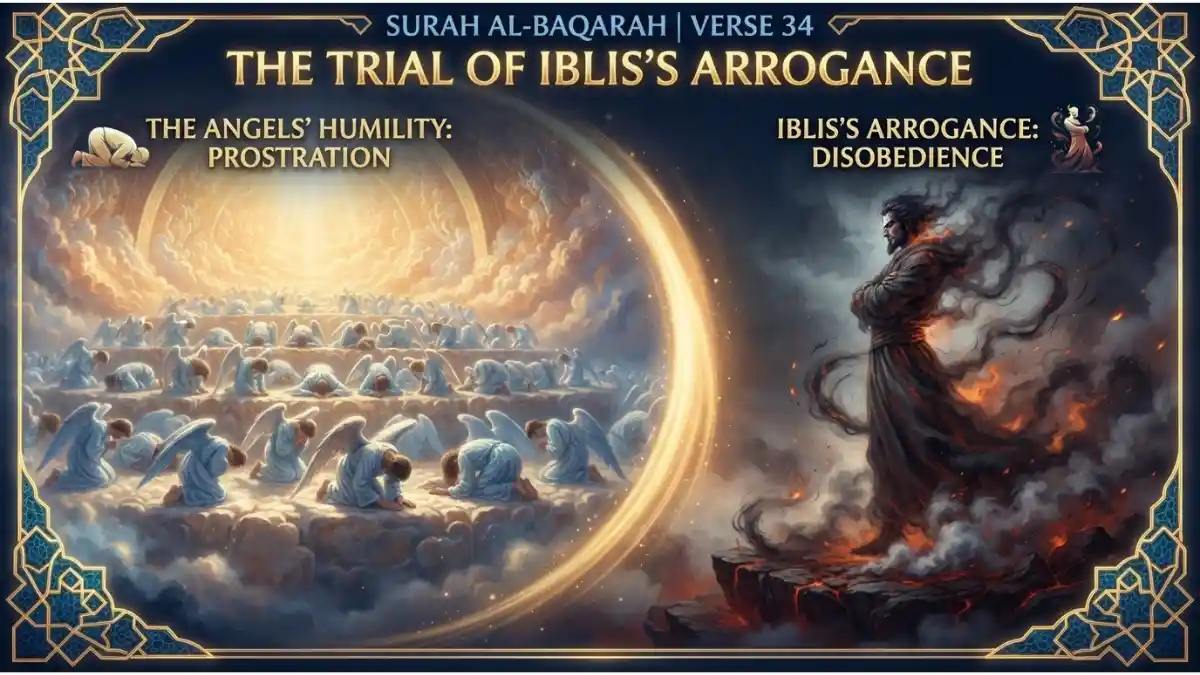
The Dramatic Cosmic Turning Point: When Pride Overrides Obedience
Following the previous verses of Surah Al-Baqarah where humanity was granted honor through the divine bestowal of knowledge and intellectual capability, verse 34 introduces one of the most dramatic turning points in the history of creation. It shifts the scene from an intellectual demonstration to a profound moral test centered on spiritual pride, obedience, and the catastrophic danger of arrogance.
Consider the solemn divine decree recorded in the Holy Quran:
وَإِذْ قُلْنَا لِلْمَلَائِكَةِ اسْجُدُوا لِآدَمَ فَسَجَدُوا إِلَّا إِبْلِيسَ أَبَىٰ وَاسْتَكْبَرَ وَكَانَ مِنَ الْكَافِرِينَ
“Wa idz qulna lil-mala’ikatisjudu li’adama fa sajadu illa iblisa aba wastakbara wa kana minal-kafirin.”
Translation: “And [remember] when We said to the angels, ‘Prostrate before Adam’; so they prostrated, except for Iblis. He refused and was arrogant and became of the disbelievers.” (Surah Al-Baqarah: 34)
Visualize the magnificent atmosphere of this heavenly assembly. Allah Almighty commanded the noble beings gathered before Him—including the entire host of angels—to prostrate before Adam (peace be upon him). It is crucial to understand from a theological standpoint that this prostration was not an act of worship or divine servitude (sujud ‘ibadah), as worship belongs exclusively to Allah alone. Rather, it was a prostration of honor and greeting (sujud tahiyyah), acknowledging the nobility and intellectual distinction that Allah had deposited within the human design.
Without a single moment of hesitation, reservation, or delay, the angels submitted completely to the divine order. They fell into prostration as one unified body, demonstrating flawless obedience. However, amid this harmonious act of surrender, a glaring deviation occurred: Iblis openly refused to comply.
Deconstructing the Psychology of Rejection: The Roots of Spiritual Arrogance
Why did Iblis refuse to prostrate? He was not suffering from a lack of theological certainty. He did not doubt the existence of Allah, nor was he ignorant of the Creator’s authority. He heard the divine command directly within the heavenly realm. His defiance was not born out of intellectual confusion or ignorance (jahl), but out of an acute spiritual disease: ingrained pride, ego, and entitlement (aba wastakbara).
In Surah Al-A’raf verse 12, the Quran reveals the explicit rationalization Iblis offered when confronted: “I am better than him. You created me from fire and created him from clay.” By analyzing this statement, classical scholars and spiritual commentators identify three primary roots of his ruinous mindsets:
- Origin-Based Arrogance (Materialism and Seniority Bias): Iblis fell into a superficial, materialist logic by evaluating honor strictly through physical makeup. In his flawed estimation, fire was superior, brighter, and dynamic compared to dark, passive clay. Furthermore, he considered himself senior in worship, having devoted ages to devotions long before Adam was formed.
- Corrupted Analogical Reasoning (Qiyas Fault): Iblis relied on his personal logic to counter a direct and explicit command from the Almighty. When divine wisdom conflicted with his self-image, he prioritized his ego over divine submission.
- Envy and Jealousy (Hasad): Iblis could not stomach the realization that a new creation was granted a station of honor and leadership that surpassed his own expectations.
The consequence of this single, arrogant choice was immediate and devastating: Iblis was expelled from divine mercy, stripped of his honorable standing, and declared among those who reject the truth (al-kafirin).
The Warning for Believers: How Pride Destroys Lifelong Devotion
The most sobering lesson embedded in Surah Al-Baqarah verse 34 is that a single instant of unchecked pride can dismantle a lifetime of good deeds. Prior to his rebellion, Iblis (referred to as Azazil in various historical traditions) was an extraordinarily devoted worshiper. His rank was so elevated through rigorous worship that he was permitted to stand alongside the noble angels.
Yet, millennia of devotion evaporated in an instant because a subtle seed of superiority took root in his heart: the thought of “I am better than him” (ana khairun minhu). This serves as a stern warning to humanity across all generations.
No individual should ever feel immune to spiritual ruin, nor should anyone consider themselves superior, more holy, or intrinsically better than another human being. Self-righteousness (‘ujub) and looking down upon others represent insidious spiritual traps. The moment a person counts their deeds as plentiful and views others with disdain, they walk precisely in the footsteps of Iblis.
Comparative Framework: Genuine Humility vs. Destructive Arrogance
Understanding the stark contrast between the mindset of Iblis and the posture of genuine servitude helps protect our hearts from arrogance. The table below outlines these two opposing psychological and spiritual states:
| Dimension | Destructive Arrogance (Takabbur) | Genuine Humility (Tawadhu’) | Spiritual & Social Impact |
|---|---|---|---|
| Core Motivation | Driven by ego, desire for self-exaltation, and personal superiority. | Driven by recognition of divine grace and personal limitation. | Determines whether actions lead to spiritual ruin or elevation. |
| Response to Truth | Rejects truth when it contradicts personal desires or pride. | Humbly accepts truth regardless of who delivers it. | Shapes an individual’s openness to guidance and growth. |
| View of Others | Looks down on others with condescension and dismissiveness. | Views others with respect, empathy, and constructive goodwill. | Fosters healthy, trusting, and harmonious relationships. |
| Reaction to Divine Command | Rationalizes disobedience through self-serving logic and excuses. | Submits willingly with immediate compliance and trust. | Leads to ultimate divine acceptance or eternal deprivation. |
Real-World Reflective Story: The Sudden Collapse of an Unyielding Ego
The destructive nature of arrogance is not confined solely to ancient cosmic events or abstract spiritual theology; it manifests vividly in our daily social and professional interactions. To illustrate this reality, consider the poignant experience of a senior workplace colleague from an organization where I once served.
He was an extraordinarily gifted professional, possessing supreme technical expertise, sharp analytical problem-solving skills, and a long track record of spearheading major strategic initiatives. Without a doubt, he was widely regarded as one of the indispensable pillars holding the company together during that era. However, as achievements accumulated and external praise mounted, a subtle yet devastating shift began to alter his character and workplace interactions.
Gradually, he succumbed to the delusion that the organization simply could not function or survive without his presence. Innovative suggestions offered by junior colleagues or new team members were consistently dismissed with condescension, often accompanied by belittling remarks. When executive management initiated a necessary organizational restructuring aimed at modernizing operational procedures for collective growth, he openly revolted. In his mind, his senior stature placed him high above the governance of new corporate rules.
The situation reached its absolute climax during a major company-wide strategy session. In front of executive directors and peers, he voiced his defiance with overt hostility, directly challenging the authority of the leadership. The final outcome was both swift and predictable: management took decisive action by terminating his employment without honor. Years of professional brilliance, technical authority, and prestige crumbled in a matter of moments—not because he lacked intelligence, but because he lost control over his ego and attitude. This real-world story serves as a perfect mirror of Iblis’s tragic fall from the heavenly ranks.
Practical Spiritual Steps to Cultivate Genuine Humility (Tawadhu’)
A meaningful Quranic reflection (tadabur) is never complete without practical application. To protect our hearts from inheriting the subtle pathways of Iblis’s pride, let us actively implement these actionable spiritual exercises into our daily routines:
- Perform Early Heart Detection: Conduct regular internal audits of your thoughts. Whenever fleeting thoughts arise—such as “I am more experienced,” “I am wealthier,” or “I am more spiritually observant than them”—immediately dismiss them. Always remember that whatever talents, knowledge, or assets we hold are temporary trusts from Allah that can be revoked in the blink of an eye.
- Practice Universal Respect Without Bias: Treat every individual you encounter today—from senior managers and professional peers to junior staff and facility maintenance workers—with the exact same level of dignity and honor. Completely eliminate the habit of evaluating human worth through physical appearance, financial standing, or social hierarchy.
- Exercise Humility During Disagreements: When involved in intellectual discussions or personal debates, if you feel you are the most knowledgeable or correct party, restrain yourself from patronizing others. Openly listen to opposing perspectives with a gracious heart, and form the habit of reciting Astaghfirullah (seeking divine forgiveness) to subdue your ego.
- Attribute Success to Divine Grace: Whenever you achieve a milestone or receive praise, attribute the success to Allah’s favor rather than your own sole capability. Replace self-congratulation with sincere expressions of gratitude (Alhamdulillah).
Supplication for Humility and Protection from Arrogance
We turn to the Almighty, seeking continuous purification of our hearts through this sincere prayer:
“O Allah, our Sustainer and Lord, protect our hearts and souls from the disease of arrogance, excessive self-admiration, and the habit of belittling our fellow human beings. Bestow upon us a spirit that is consistently humble (tawadhu’), make us receptive to truth regardless of who delivers it, and grant us steadfastness in sincere obedience to You. Ameen Ya Rabbal ‘Alamin.”
Frequently Asked Questions (FAQ)
Q: How can one distinguish between healthy self-confidence and sinful arrogance (takabbur) condemned by Allah?
A: The essential difference lies within the underlying source and ultimate expression of the feeling. Healthy self-confidence originates from deep gratitude for the potential Allah has entrusted to us, balanced by a clear recognition of human limitations, and manifests as warmth, approachable behavior, and genuine respect for others. Conversely, spiritual arrogance (takabbur) stems from an inflated ego seeking personal superiority, driven by a need for validation, and its ultimate expression is rejecting divine truth and looking down upon (belittling) other people.
Q: Was Iblis originally one of the angels?
A: According to the Quran (Surah Al-Kahf: 50), Iblis was from the Jinn (kana minal-jinni), not the angels. While angels are created from light and lack the capacity to disobey Allah, Jinn possess free will. Iblis had elevated his spiritual standing through intense devotion to be among the ranks of angels, but his free choice revealed his hidden pride when tested.
Have you ever witnessed or personally experienced how unchecked pride can derail a career or ruin valuable relationships? Share your thoughts and stories in the comments section below!