
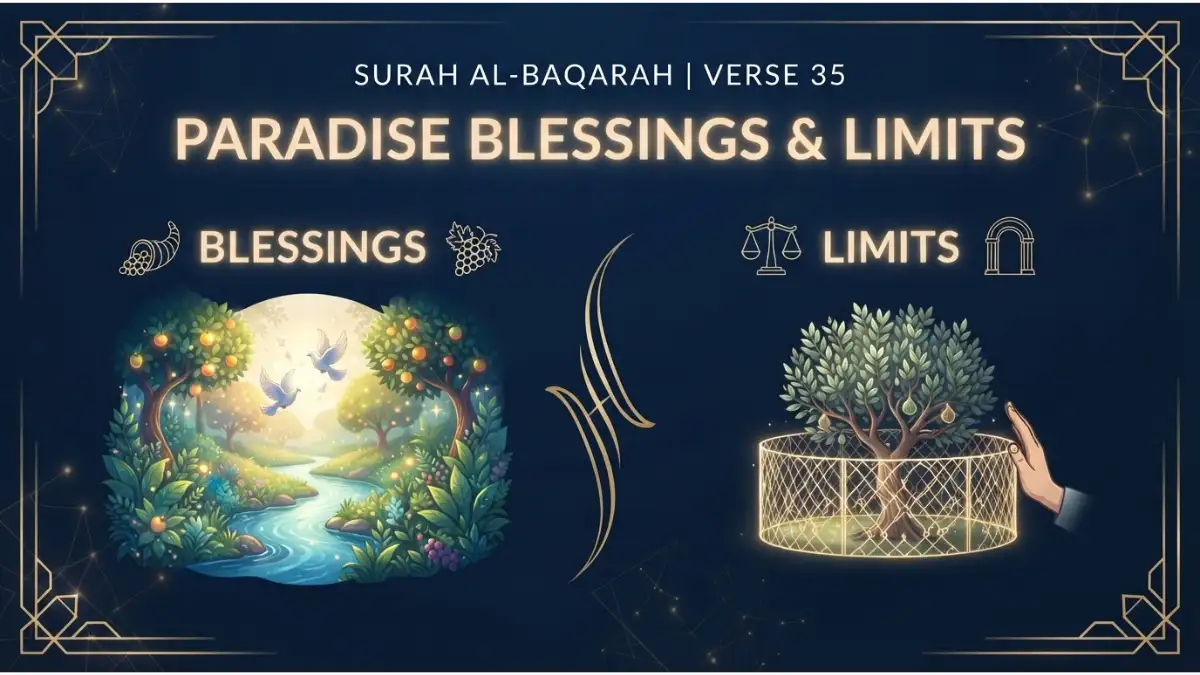
The Paradise Experience: Abundant Provision and a Single Boundary
Following the cosmic turning point in the preceding verse—where Iblis fell from divine grace due to his refusal to prostrate out of arrogance—Surah Al-Baqarah verse 35 introduces Adam (peace be upon him) and his wife, Eve (Hawa), into a new chapter of existence. This phase presents an environment characterized by unparalleled comfort, boundless blessings, and exquisite luxury, while simultaneously introducing a foundational moral test of obedience.
Consider the divine revelation recorded in the Holy Quran:
“Wa qulna ya adamuskun anta wa zaujukal-jannata wa kula minha raghadan haitsu syi’tuma wa la taqroba hadzihis-syajarata fa takuna minas-zhalimin.”
Translation: “And We said, ‘O Adam, dwell, you and your wife, in Paradise and eat therefrom in abundance from wherever you will. But do not approach this tree, lest you be among the wrongdoers.'” (Surah Al-Baqarah: 35)
Visualize the magnificent reality granted to the first human couple. They were welcomed into Paradise—a realm free from physical fatigue, grueling toil, hunger, thirst, or emotional distress. Every imaginable delicacy, fruit, and pleasant drink was made readily available to them without effort. The Quran encapsulates this absolute freedom with the phrase raghadan haitsu syi’tuma, denoting abundant, enjoyable, and unrestricted provision available whenever and wherever they desired.
Yet, right in the midst of this vast expanse of lawful freedom and limitless comfort, Allah established a single clear prohibition:
“But do not approach this tree!”
Methodologically, this mandate served as the primary educational model for human moral agency. Allah did not forbid thousands of other trees or close off access to the infinite bounties surrounding them. He restricted access to only one specific tree. This raises a profound theological and reflective question: Why was a prohibition instituted in an environment as perfect and harmonious as Paradise?
The Philosophy of Boundaries: Why Divine Laws Exist
The introduction of a solitary restriction amidst vast freedom teaches us that moral testing is an indispensable dimension of human existence. Humanity was not created to live passively or indulge mindlessly without moral direction. Rather, humans were created with intellectual freedom and spiritual potential that must be developed through conscious choices.
Divine boundaries and sacred laws (sharia) are not designed to restrict human freedom or inflict unnecessary hardship. On the contrary, they function as essential instruments of moral elevation, training individuals in self-awareness, personal discipline, emotional mastery, and submission to divine wisdom. Without boundaries, true obedience cannot be measured, and moral virtue remains untested.
Human psychology exhibits a unique quirk: a tendency to fixate on the few things that are forbidden rather than appreciating what is abundantly permitted. When ninety-nine doors stand wide open, human attention often drifts toward the single locked door. Unchecked curiosity regarding forbidden boundaries creates the exact vulnerability exploited by spiritual adversaries.
The overarching lesson of this verse emphasizes that believers must enjoy the lawful gifts of life with deep gratitude while respecting the boundaries set by the Almighty. Divine boundaries exist not to withhold happiness, but to safeguard humanity from self-destruction.
Psychological Dynamics: The Paradox of Prohibition and Deception
In modern behavioral psychology, there is a recognized phenomenon known as psychological reactance: when an option is restricted, its perceived attractiveness often increases. When a boundary is declared off-limits, an undisciplined mind tends to grant undue focus to that specific object.
Iblis understood this psychological vulnerability. He did not attempt to convince Adam and Eve to reject God outright or express open rebellion. Instead, he systematically manipulated their focus, leading them to overlook their endless permitted blessings and dwell exclusively on the forbidden tree. He reframed a simple divine boundary into an artificial restriction meant to hold them back from eternal life or angelic status.
Recognizing this pattern is vital for contemporary life. Frequently, people overlook blessings such as health, peaceful families, stable livelihoods, and peace of mind because they become consumed by a single desire that is currently out of reach or explicitly prohibited.
Comparative Framework: Ethical Freedom vs. Unrestrained Desire
Understanding how disciplined living compares to reckless indulgence clarifies why divine boundaries are essential for personal and societal health. The table below contrasts these two approaches:
| Dimension | Disciplined Living Within Boundaries | Unrestrained Indulgence | Long-Term Impact |
|---|---|---|---|
| Core Mindset | Focuses on abundant, lawful gifts with gratitude. | Fixates on forbidden or unobtained items. | Shapes whether one experiences contentment or perpetual agitation. |
| Perception of Rules | Views boundaries as protective barriers ensuring safety. | Views boundaries as oppressive obstacles to freedom. | Determines respect for law, ethics, and moral governance. |
| Self-Control | Practices conscious restraint and delayed gratification. | Acts impulsively based on momentary desires. | Builds either resilience and dignity or regret and vulnerability. |
| Spiritual Status | Maintains trust and closeness with the Almighty. | Exposes oneself to moral compromise (zulum). | Leads to spiritual harmony or inner alienation. |
Real-World Reflective Story: Integrity Tested in the Midst of Abundance
The principle of being tested while surrounded by abundance applies directly to modern professional life. Consider the experience of a promising senior executive named Rendy who was appointed to manage a major regional project.
The corporate board provided Rendy with an exceptional package: an executive salary, a high-end company vehicle, an open expense account for client hospitality, and premium housing allowances. The company offered immense trust and flexibility, enabling him to operate with broad authority.
However, embedded within his employment agreement was a strict condition: “You are granted full authority over operational budgets to execute the project successfully. However, under no circumstances may you access or divert the emergency reserve fund for personal use or unapproved speculative investments.”
Initially, adhering to this rule was effortless. Rendy’s official compensation met all his personal needs comfortably. Over time, however, exposure to wealthy social circles sparked a desire for luxury assets beyond his current financial capacity.
Subtle rationalizations began to surface: “The reserve fund is sitting idle in an account. If I temporarily allocate a portion into a high-yield speculative venture for a week and return it, no one will notice. After all, I am the key driver behind this project’s growth.”
This situation illustrates that the ultimate test of integrity rarely occurs during times of scarcity. Instead, it occurs when an individual possesses broad authority, abundant options, and easy access. Failing to respect a clear boundary in times of prosperity can jeopardize years of honorable achievement through a single compromise.
Practical Spiritual Steps to Manage Freedom and Honor Boundaries
To align our daily lives with the wisdom of Surah Al-Baqarah verse 35, consider incorporating these practical steps:
- Reframe Your Perspective on Rules: View divine guidance, ethical principles, and legal boundaries not as restrictions, but as protective guardrails that preserve personal integrity, family honor, and long-term peace.
- Cultivate Daily Gratitude: Whenever tempted by forbidden pursuits, deliberately review the abundant, lawful blessings already present in your life. Remind yourself that lawful provisions are more than sufficient for fulfillment.
- Establish Preventive Barriers: Note the precise phrasing of the Quranic command: “Do not approach this tree!” The directive forbids even nearing the boundary. Identify personal triggers or environments that lead toward unethical behavior and avoid them proactively.
- Practice Responsible Leadership: When managing family members or leading organizational teams, provide clear support and creative freedom while establishing explicit, uncrossable ethical red lines.
Daily Practice Challenge
- Mindfully Appreciate Permitted Blessings: Dedicate time today to consciously enjoy lawful meals, healthy relationships, and peaceful moments with genuine gratitude.
- Honor Established Boundaries: Review key areas of your life—including religious duties, professional codes, and family commitments—and recommit to respecting those limits.
- Exercise Self-Restraint: When faced with impulsive urges to explore prohibited or harmful choices, pause and firmly remind yourself: “My contentment lies in what is lawful and wholesome.”
Supplication for Contentment and Protection
We ask the Almighty to grant us contentment with lawful provisions and protection from crossing sacred limits:
“O Allah, grant us contentment with the lawful blessings You have provided, and keep us distant from what is forbidden. Guide our hearts to remain steadfast within Your boundaries, and protect us from self-wrongdoing in times of ease and hardship. Ameen, O Lord of the Worlds.”
Frequently Asked Questions (FAQ)
Q: Why do people feel drawn to forbidden things when lawful options are abundant?
A: This stems from human ego, curiosity, and susceptibility to external misdirection. Restricted items are often glamorized to appear more exclusive or thrilling. True freedom lies not in living without limits, but in exercising the self-mastery to stay within wise boundaries.
Q: How can one resist temptation during moments of stress or pressure?
A: Strengthen your core support systems, engage in regular self-reflection, and seek healthy, constructive outlets for stress management—such as physical exercise, restful habits, and supportive dialogue with wise companions.
Have you ever navigated a situation where resisting a small compromise required significant discipline? Share your reflections and experiences in the comments section below!