
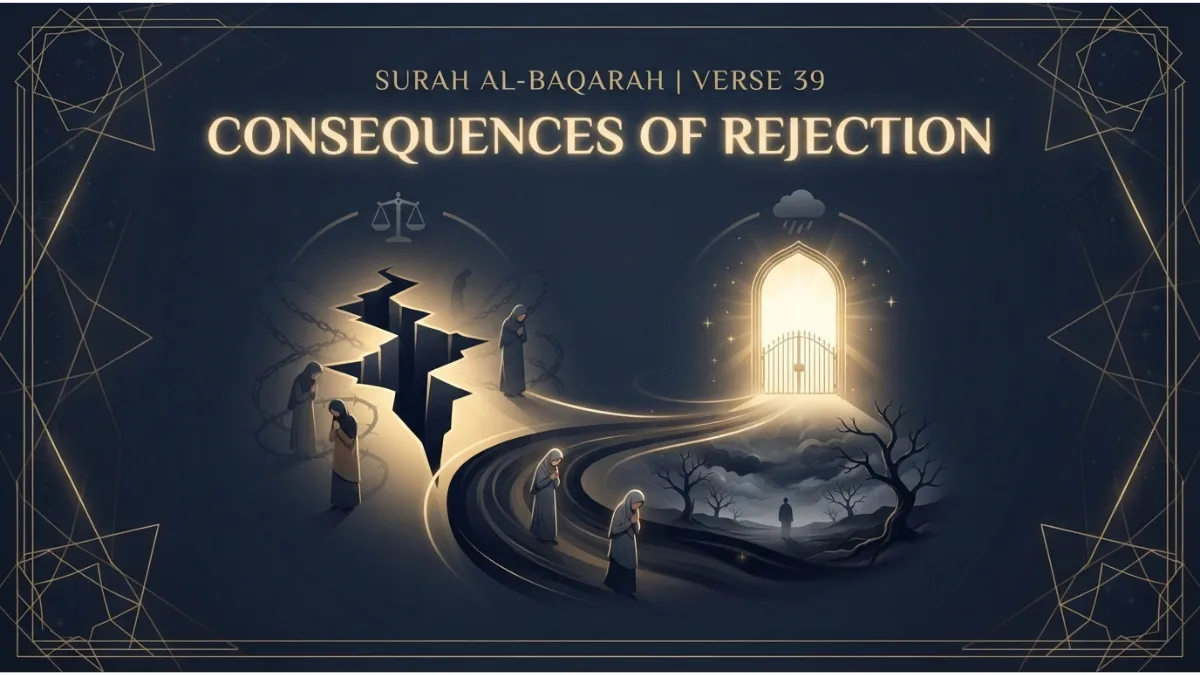
The Stark Contrast: The Gravity of Rejecting Divine Light
Every choice in human life carries an inherent consequence. In the preceding verse (Surah Al-Baqarah: 38), Allah Almighty provided an absolute guarantee of inner peace, spiritual security, and freedom from fear and grief for those who align their lives with divine revelation. In verse 39, the Quran presents a profound thematic contrast (Munasabah al-Ayat). It delivers a firm warning regarding the spiritual and eternal ruin that awaits those who actively choose rebellion, reject divine truth, and deny the signs of their Creator.
Consider the solemn divine decree recorded in the Holy Quran:
وَالَّذِينَ كَفَرُوا وَكَذَّبُوا بِآيَاتِنَا أُولَٰئِكَ أَصْحَابُ النَّارِ ۖ هُمْ فِيهَا خَالِدُونَ
“Wal-ladziina kafaruu wa kadzdzabuu bi aayaatinaa ulaaa’ika ashaabun-naari hum fiihaa khooliduun.”
Translation: “But those who disbelieve and deny Our signs—they are the companions of the Fire; they will abide eternally therein.” (Surah Al-Baqarah: 39)
Reflect upon the logical cause-and-effect relationship between verses 38 and 39. Verse 38 introduced a universal navigation system—a spiritual compass to prevent humanity from losing its way in the earthly wilderness. Verse 39 addresses the specific mindset of those who intentionally discard this map, disable their spiritual conscience, and deny the manifest truth. Understanding this contrast illuminates the profound moral responsibility tied to human free will.
Linguistic Deep Dive: The Meaning of “Kafaru” and “Kadzdzabu”
The Arabic phrasing in Surah Al-Baqarah verse 39 utilizes two key verbs that describe a progressive spiritual decline. Examining these terms reveals the psychological steps that lead to spiritual ruin:
- Kafaru (Covering the Truth): Linguistically, kufr means to cover, conceal, or bury something. In a spiritual context, it describes an individual who deliberately covers up the innate, obvious truth placed within their fitrah (natural disposition) and manifested across creation. It represents a state of ungrateful concealment.
- Kadzdzabu (Active Rejection and Denial): This form denotes an active, persistent effort to deny, mock, or oppose truth. The individual does not merely remain neutral; they actively refute divine signs—both Ayat Kauniyah (the natural signs evident throughout the cosmos) and Ayat Qauliyah (the revealed verses of sacred scripture).
Combining kafaru and kadzdzabu illustrates a complete rejection of divine guidance. When an individual suppresses inner conscience and actively opposes truth, they forfeit moral direction. Consequently, they navigate existence without a compass, elevating personal desires into ultimate authorities and sowing corruption within society.
Spiritual Laws: The Objective Reality of Divine Warning
The severe warning in verse 39 is not an arbitrary threat; it reflects an objective spiritual law (Sunnatullah). Cause and effect govern the spiritual realm just as strictly as they govern the physical world:
- Physical Realm: If a driver intentionally ignores warning signs near a cliff, the vehicle plunges into the abyss.
- Biological Realm: If a person consistently rejects medical advice and consumes toxins, bodily health degrades.
- Spiritual Realm: If a soul deliberately rejects divine guidance and suppresses truth, it experiences spiritual alienation in this life and eternal deprivation in the Hereafter.
The conclusion of the story of Adam emphasizes a fundamental lesson: never treat truth lightly. When conscience and revelation point toward integrity, honesty, and devotion, embrace them. Arrogant resistance to guidance leads to the ultimate loss—the loss of moral grounding and eternal peace.
Root Causes: Why Do Hearts Reject Clear Guidance?
Why do individuals reject clear truth even when presented with overwhelming evidence? Classical Quranic commentators explain that denial rarely stems from a genuine lack of information. Instead, it is driven by underlying spiritual ailments:
- Arrogance (Al-Kibr): An inflated sense of self-importance that prevents an individual from accepting truth from others or submitting to divine authority. Arrogance was the primary flaw that caused Satan’s expulsion.
- Subservience to Desire (Ittiba’ul Hawa): Divine guidance mandates self-discipline, ethical boundaries, and accountability. For those accustomed to unrestricted gratification, moral frameworks are viewed as unwelcome obstacles.
- Blind Conformity (Taklid): Resistance to truth caused by rigid adherence to social norms, ancestral traditions, or peer expectations, even when those norms contradict divine revelation.
Comparative Framework: Receptive Faith vs. Persistent Denial
Understanding the differences between a heart open to divine guidance and one locked in persistent denial highlights the long-term impact of personal choice:
| Dimension | The Receptive Heart (Verse 38) | The Denying Heart (Verse 39) |
|---|---|---|
| Core Posture | Humble, receptive, and actively seeking truth. | Arrogant, resistant, and deliberately covering truth. |
| View of Revelation | Regards divine laws as protective guidance and light. | Regards divine laws as oppressive restrictions. |
| Response to Warning | Engages in self-reflection, repentance, and correction. | Responds with rationalization, mockery, and defiance. |
| Earthly Experience | Tranquility, purpose, and freedom from paralyzing fear. | Inner alienation, anxiety, and spiritual emptiness. |
| Eternal Outcome | Divine pleasure and everlasting Paradise. | Companionship of the Fire (Ashabun-Nar). |
Reflective Narrative: Ignored Warnings and Ultimate Reckoning
The principle of cause and effect illustrated in verse 39 manifests regularly in human experience. Consider the story of an executive who built a corporate empire through exceptional talent. As his influence grew, he began disregarding legal boundaries and ethical standards.
He engaged in financial manipulation and exploited partners for short-term gain. Trusted advisors and family members repeatedly cautioned him: “Return to transparent practices. Sustainable success built on integrity is far better than wealth accumulated through deception.”
He dismissed these warnings with arrogance, believing his sophisticated systems made him immune to exposure. He viewed ethical advice as a limitation meant for less capable individuals.
Eventually, an independent audit exposed the systemic fraud. In a short period, his business collapsed, his assets were confiscated, his reputation was destroyed, and he faced severe legal penalties. The initial arrogance vanished, replaced by profound regret. Dismissing warnings and denying truth leads inevitably to ruin.
Practical Steps: Safeguarding the Heart from Denial
To ensure our hearts remain receptive to truth and protected from subtle forms of denial, implement these practical daily habits:
- Conduct Regular Conscience Audits: Periodically review your daily choices in business, family, and personal conduct. Ask yourself whether your actions align with ethical principles or if you are rationalizing compromises.
- Cultivate Intellectual Humility: Practice accepting constructive feedback graciously. When reminded of a moral boundary or mistake, suppress the urge to act defensively. Accept truth regardless of who delivers it.
- Express Gratitude for Guidance (Hidayah): Regularly thank God for keeping your heart inclined toward faith and goodness. Recognizing guidance as a gift prevents spiritual complacency and arrogance.
Daily Spiritual Practice Challenge
- Identify and Correct Rationalizations: Examine one area of life where you might be minimizing a wrong action, and correct it immediately.
- Listen Without Ego: During conversations today, focus on listening sincerely without preparing defensive counterarguments.
- Pray for Steadfastness: Frequently recite supplications asking for a firm heart anchored in divine light.
Supplication for Protection Against Spiritual Blindness
We ask the Almighty to protect our hearts from arrogance and denial:
“O Allah, Turner of hearts, keep our hearts firm upon Your religion. Protect us from spiritual blindness, arrogance, and the stubborn denial of Your signs. Grant us the humility to accept truth whenever it comes to us, and strengthen our resolve to walk upon the path of righteousness. Ameen, O Lord of the Worlds.”
Frequently Asked Questions (FAQ)
Q: What does “khalidun” (abiding eternally) signify regarding the ultimate outcome in verse 39?
A: The term khalidun underscores the permanent, absolute nature of the consequence for those who die in a state of active disbelief and denial. It emphasizes that choices made in this short earthly life carry eternal weight in the Hereafter.
Q: How can a person protect themselves from unconsciously denying divine guidance?
A: Maintain continuous learning, surround yourself with sincere companions who encourage moral integrity, engage in regular self-examination, and pray consistently for spiritual guidance and humility.
Have you ever observed how ignoring moral boundaries or sincere advice leads to avoidable hardship? Share your personal thoughts and reflections in the comments below!