
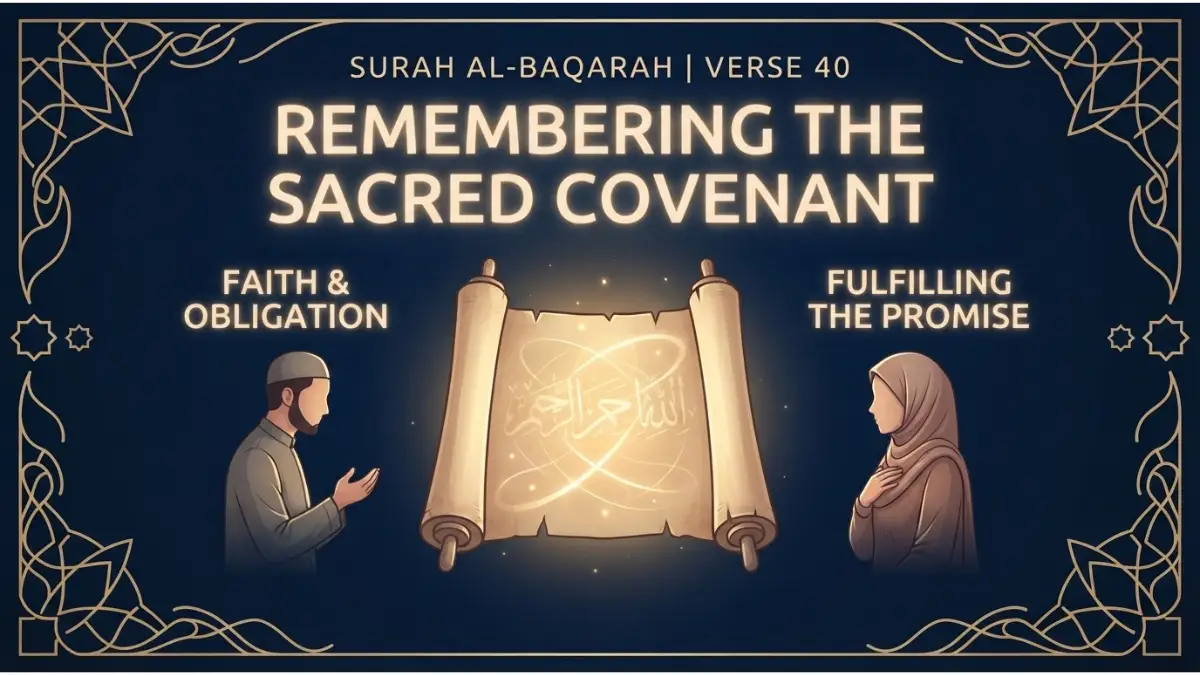
The Pivotal Pivot: A Direct Call to Honor the Divine Covenant
Following the cosmic recount of human origins—tracing the appointment of Prophet Adam (peace be upon him) as Earth’s steward, the angelic dialogue, the intellectual demonstration, the deception of Satan, and the establishment of divine guidance—Surah Al-Baqarah verse 40 marks a significant structural pivot in Quranic discourse. At this juncture, divine revelation shifts from universal human archetypes to address a specific historical community: the Children of Israel (Bani Isra’il).
Consider the divine words revealed in the Holy Quran:
يَا بَنِي إِسْرَائِيلَ اذْكُرُوا نِعْمَتِيَ الَّتِي أَنْعَمْتُ عَلَيْكُمْ وَأَوْفُوا بِعَهْدِي أُوفِ بِعَهْدِكُمْ وَإِيَّايَ فَارْهَبُونِ
“Yaa banii isrooo-iiladzkuruu ni’matiyal-latiii an’amtu ‘alaikum wa aufuu bi ‘ahdii uufi bi ‘ahdikum, wa iyyaaya farhabuun.”
Translation: “O Children of Israel, remember My blessings which I have bestowed upon you and fulfill your covenant [to Me], indeed I will fulfill My covenant [to you], and fear Me alone.” (Surah Al-Baqarah: 40)
This verse introduces a comprehensive textual block (spanning roughly from Verse 40 to Verse 123) dedicated to addressing the theological history, spiritual privileges, moral failures, and psychological tendencies of the descendants of Prophet Jacob (peace be upon him). While the immediate historical audience comprised the Jewish communities living in and around Medina during the prophetic mission of Prophet Muhammad (peace be upon him), the moral and spiritual principles embedded within this address are universal, offering essential lessons for all believers across time.
The Three Core Pillars of Spiritual Relationship in Verse 40
In this concise yet profound command, the Almighty establishes three interconnected pillars that govern the relationship between humanity and the Divine:
1. Evoking Gratitude and Sacred Memory (Udzkuru Ni’matiya)
The divine address begins with a imperative: “Udzkuru ni’matiya”—”Remember My favor.” From a psychological perspective, human beings frequently suffer from spiritual amnesia. When confronted with immediate hardships, trials, or shifting social circumstances, people tend to overlook the vast ocean of divine blessings that sustained them through past difficulties.
Historically, the Children of Israel experienced exceptional divine favors: liberation from the tyranny of Pharaoh, the parting of the Red Sea, miraculous shade under clouds in the desert, and food sent directly from above (Manna and Salwa). By invoking memory, God calls them back to gratitude. For contemporary believers, regularly reviewing personal blessings—ranging from health and sustenance to guidance and safety—serves as the foundational fuel for sincere devotion and moral steadfastness.
2. The Reciprocal Covenantal Commitment (Aufuu bi ‘Ahdii Uufi bi ‘Ahdikum)
The second pillar establishes a sacred contract: “Fulfill My covenant that I will fulfill your covenant.” The human obligation in this covenant includes maintaining monotheistic faith, practicing justice, abiding by moral laws, recognizing true prophets, and refusing to compromise divine truth for temporal material gain.
In response, God guarantees the fulfillment of the divine promise: continuous protection, inner tranquility, spiritual elevation, forgiveness, and eternal salvation in the Hereafter (uufi bi ‘ahdikum). God never breaks a covenant. Therefore, whenever divine support appears distant in human experience, the primary point of evaluation must always be the degree to which humanity has fulfilled its own obligations.
3. Re-orienting Fear and Reverence (Wa Iyyaya Farhabun)
The verse concludes with an intense monotheistic boundary: “Wa iyyaaya farhabuun”—”And be afraid of Me alone.” In Arabic, the term rahbah refers to an awe-inspired fear that motivates proactive, careful action and drives an individual to seek refuge in the ultimate source of safety.
A primary reason individuals compromise moral integrity or break solemn promises is misdirected fear—fear of financial loss, social exclusion, political pressure, or human disapproval. By directing reverence exclusively toward the Almighty, a believer gains the moral courage to stand firmly upon truth regardless of social pressures.
Linguistic Deep Dive: “Bani Isra’il”, “Ahd”, and “Rahbah”
Analyzing the classical Arabic vocabulary used in Surah Al-Baqarah verse 40 exposes deeper layers of spiritual meaning:
- Bani Isra’il (Children of Israel): Isra’il is the honorific title of Prophet Jacob (Ya’qub), meaning “Servant of God.” Addressing them through their ancestral connection honors their noble lineage while reminding them of the righteous standard set by their forefathers.
- ‘Ahd (Covenant/Contract): In classical Arabic, an ‘ahd represents a binding obligation that requires active care, fidelity, and continuous preservation. It is not a casual agreement, but an oath tied to personal honor and spiritual standing.
- Farhabun (Awe and Vigilance): The grammatical structure places the object first (Wa iyyaaya), creating an exclusive focus: “And toward Me—and Me alone—you shall direct your awe.” This excludes all created entities from holding ultimate power over the human conscience.
Comparative Framework: Historical Context vs. Universal Application
Understanding how the message of verse 40 bridges its historical setting and modern relevance highlights its timeless nature:
| Dimension | Historical Audience (Bani Isra’il) | Universal Application (Believers Today) |
|---|---|---|
| Divine Favor (Ni’mah) | Physical liberation, scriptures, prophets, manna, and salwa. | Health, guidance, intellect, community, and revelation. |
| Human Covenant (‘Ahd) | Fulfilling Torah commands and recognizing the final Prophet. | Adhering to ethical boundaries, worship, and truth. |
| Misdirected Fear | Fear of losing tribal status, wealth, or political power. | Fear of economic hardship, social rejection, or authority. |
| Divine Promise | Earthy honor and spiritual elevation in the Holy Land. | Inner peace, divine support, and eternal Paradise. |
Reflective Story: Integrity at the Crossroads of Crisis
The principle of honoring covenants over temporary gain is illustrated in contemporary experience. Consider the account of a software entrepreneur who faced potential bankruptcy during a severe economic downturn.
During this financial crisis, an opportunity emerged to secure a lucrative contract with a major corporation. However, securing the deal required an unethical concession: he was asked to falsify data security compliance records and pay an undisclosed bribe to an executive.
Associates urged him to compromise, arguing: “Without this contract, the company will fail and employees will lose their jobs. Everyone handles business this way.” The financial and social pressure was intense.
Reflecting on his ethical commitments and faith, he refused to compromise. He declined the proposal, stating that long-term integrity outweighed immediate financial survival. As a result, the contract was lost, and his firm underwent painful downsizing.
Months later, his firm’s refusal to falsify records became known to an ethical investment group. Recognizing his unyielding commitment to transparency, the group offered substantial venture backing to rebuild his platform properly. Honoring moral commitments may bring short-term challenges, but it secures lasting dignity and ultimate success.
Practical Action Steps: Living the Covenant Today
To implement the timeless lessons of Surah Al-Baqarah verse 40 in your daily life, apply these three practices:
- Maintain a Daily Gratitude Journal: Spend five minutes each evening noting specific divine favors received throughout the day. Documenting subtle blessings strengthens spiritual awareness and counters negativity.
- Audit and Fulfill Outstanding Promises: Review your personal and professional commitments. Identify any unfulfilled promises made to family, colleagues, or God, and create an immediate plan to fulfill them.
- Align Fear with Ethical Boundaries: When experiencing anxiety regarding financial or social outcomes, remind yourself that ultimate control belongs to God alone. Choose ethical compliance over expediency.
Daily Practice Challenge
- Memorize Verse 40 Key Phrasing: Learn the Arabic text and meaning of “aufuu bi ‘ahdii uufi bi ‘ahdikum,” using it as a mental reminder during times of moral testing.
- Honor a Delayed Obligation: Identify one long-delayed pledge or commitment and fulfill it today.
- Share a Moral Lesson: Discuss the importance of integrity and keeping promises with a friend, family member, or colleague.
Supplication for Steadfastness in Covenants
We pray for divine guidance to fulfill our commitments faithfully:
“O Allah, Fulfiller of all true promises, guide our hearts to remain continuously grateful for Your endless favors. Grant us the moral strength to honor our sacred commitments to You and our fellow human beings. Purify our souls from the fear of creation, and anchor our hearts in reverence toward You alone. Ameen, O Lord of the Worlds.”
Frequently Asked Questions (FAQ)
Q: Why does the Quran address the Children of Israel extensively in Surah Al-Baqarah?
A: The extensive focus on the Children of Israel serves as an educational mirror for all faith communities. By detailing their history—their blessings, challenges, and errors—the Quran instructs believers on how to preserve covenantal integrity and avoid spiritual complacency.
Q: What constitutes a person’s covenant with God in modern life?
A: The covenant includes accepting monotheism, practicing moral integrity, fulfilling religious duties, treating others with justice, and upholding ethical principles in daily personal and professional conduct.
Have you ever experienced a moment where honoring an ethical promise was difficult, but ultimately brought peace and resolution? Share your reflections in the comments below!