
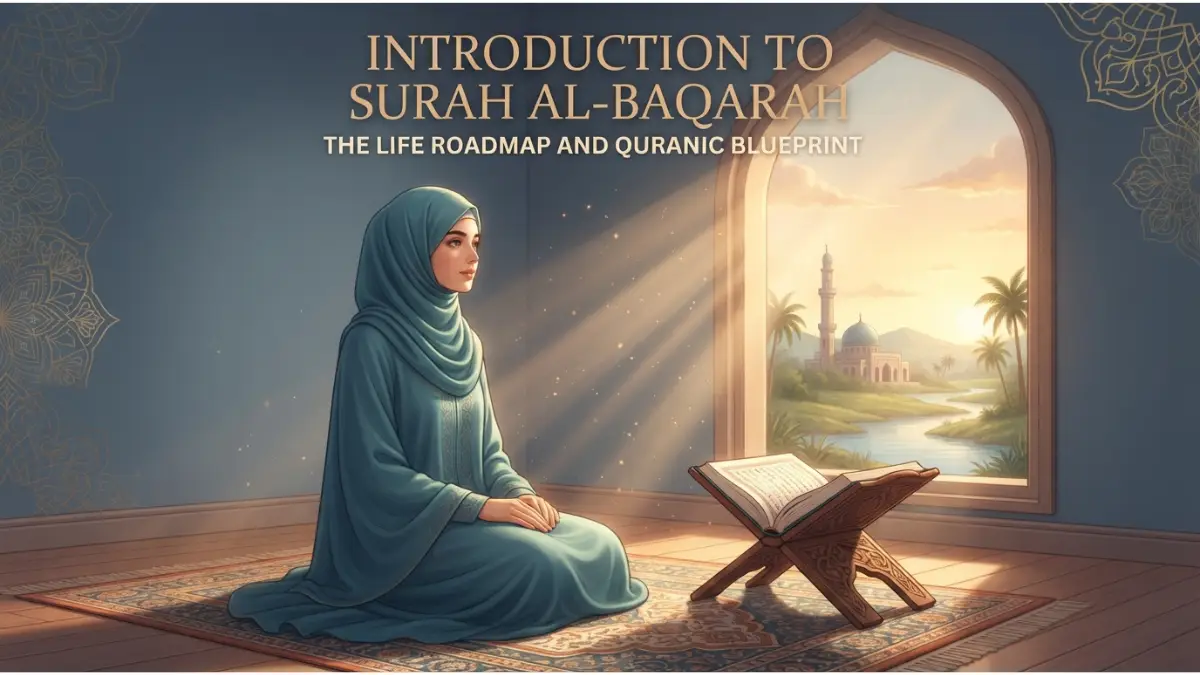
The Back-bone of Islamic Civilization: Unlocking the Majestic Blueprint of Revelation
Surah Al-Baqarah stands as the foundational pillar of Islamic civilization built upon the bedrock of divine revelation. As the longest chapter in the Holy Quran, it is far more than a mere collection of formal legal rulings. Instead, it serves as a comprehensive existential blueprint designed to guide humanity through the intricate mazes and turbulent storms of earthly existence. To study the introduction (Muqaddimah) of this noble surah is akin to unlocking the grand gates of a majestic palace of sacred knowledge—a sanctuary where every corner offers absolute clarity amid the chaos of the modern age.
Throughout Islamic history, scholars and seekers of truth have approached Surah Al-Baqarah with profound reverence. It is not merely a text to be recited for ritual blessing; it is an active, dynamic guide for individual transformation, family governance, economic integrity, and societal justice. By diving deep into its opening themes, we equip ourselves with the intellectual and spiritual tools necessary to build a life anchored in unwavering faith and practical wisdom.
Essential Snapshot: Characteristics and Virtues of Surah Al-Baqarah
Before embarking on a verse-by-verse contemplation, it is essential to understand the structural identity and unique spiritual properties of this chapter:
- Surah Title: Al-Baqarah (The Cow)
- Place of Revelation: Madaniyah (Revealed during the Madinan period following the Migration)
- Surah Order: Chapter 2 in the Quranic compilation, containing 286 verses
- Core Spiritual Virtue: The Messenger of Allah (ﷺ) said: “Do not turn your houses into graveyards. Verily, Satan flees from the house in which Surah Al-Baqarah is recited.” (Narrated by Sahih Muslim). This chapter acts as a dynamic shield against spiritual harm, an overflowing source of divine blessing, and an ultimate antidote for souls weary from existential anxiety.
Textually and teologically, Surah Al-Baqarah functions as a direct, immediate response to the prayer we utter in Surah Al-Fatihah. When we beseech Allah SWT in Al-Fatihah, “Guide us to the Straight Path,” Surah Al-Baqarah arrives as the detailed navigation map that unfolds that exact path in full detail. Grasping the grand introduction of this surah enables us to capture “the big picture,” ensuring that our subsequent reflection on individual verses remains focused, structured, and deeply meaningful.
1. The Five Core Themes: Building the Complete Human Being
Thematically, Surah Al-Baqarah weaves together five grand integrated pillars designed to cultivate a balanced individual and an equitable, civilized society. Understanding these pillars allows us to appreciate how divine law harmonizes with human psychology:
Pillar I: Faith and God-Consciousness (Iman & Taqwa)
At the absolute center of Surah Al-Baqarah is the establishment of an unshakeable inner belief system. The surah begins by defining the attributes of true believers—those who believe in the unseen, establish prayer, and spend from what Allah has provided. Faith here is not presented as an abstract dogma, but as a living force that transforms human behavior, cleanses the heart of arrogance, and connects the finite creation to the Infinite Creator.
Pillar II: Human Stewardship (Viceregency / Khalifah)
The surah outlines the strategic role assigned to humanity as khalifah (stewards or deputies) on Earth. Through the narrative of Prophet Adam (AS), Allah reveals that human beings were created with the intellect and capacity to learn, govern, and build civilization under divine guidance. This theme reminds us that life is a sacred trust, and every talent, resource, and position of authority we possess must be used responsibly.
Pillar III: Divine Law and Social Governance (Shariah & Muamalah)
Surah Al-Baqarah provides the most extensive framework of legislation in the Quran. It meticulously details regulations covering personal worship, dietary laws, marital relations, divorce procedures, inheritance rules, commercial transactions, and the prohibition of usury (Riba). This demonstrates that spirituality in Islam cannot be separated from daily life, legal integrity, and social justice.
Pillar IV: Psychological Auditing of Past Nations (Bani Israil)
A substantial portion of the surah critically analyzes the historical trajectory and psychological downfalls of the Children of Israel. This historical review is not meant as a mere chronicle of the past, but as a mirror for the Muslim community. By examining their stubbornness, covenant-breaking, and selective obedience, we are warned against falling into the same traps of spiritual complacency and religious arrogance.
Pillar V: Resilience Through Life’s Trials
Surah Al-Baqarah provides a clear methodology for navigating adversity, loss, fear, and socio-economic hardship. It teaches that trials are an inevitable feature of earthly existence, designed not to destroy us, but to elevate our spiritual status and refine our character through patience (Sabr) and prayer (Salah).
2. Contemporary Relevance: Why We Must Contemplate Al-Baqarah Today
In our modern era, humanity faces a unique paradox: we are flooded with an unprecedented abundance of information, yet we suffer from an acute starvation of spiritual meaning. Contemporary society traps individuals in relentless cycles of consumerism, hyper-competition, and the artificial validation of social media metrics. This constant noise leaves the modern soul vulnerable to burnout, existential dread, and deep emotional emptiness.
Surah Al-Baqarah serves as an essential recalibration tool to realign our distorted life orientation. There are three major reasons why engaging in deep contemplation (Tadabur) of this surah is urgent for every modern seeker:
- Eliminating Intellectual Confusion: It offers absolute clarity regarding our origin, our purpose, and our ultimate destination, cutting through the noise of secular philosophies and moral relativism.
- Building Emotional Resilience: It instills the profound paradigm that every trial and stressor in life is part of a divine design intended to strengthen our character and elevate our spiritual rank.
- Harmonizing Worldly Pursuits with the Hereafter: It teaches us how to pursue career success, financial stability, and healthy family lives within the boundaries of divine law, turning everyday efforts into acts of worship.
Classical and contemporary scholars alike unanimously affirm the supreme status of this chapter. In his celebrated commentary, Ibn Kathir notes that Surah Al-Baqarah represents the pinnacle of Islamic legislation due to its comprehensive coverage of human affairs. Similarly, contemporary thinkers highlight that the surah offers an unmatched masterclass in community organization and social health. Both perspectives converge on one truth: this surah is the definitive foundation for a balanced, righteous life.
3. Architectural Journey: The 5-Phase Tadabur Roadmap
Given the vast depth and length of Surah Al-Baqarah, we have structured our spiritual journey into five tactical phases. This roadmap ensures that your learning process remains accessible, focused, and transformational:
- Phase 1 (Verses 1–20): Human Typologies and Faith Foundations
Analyzing the three psychological profiles of humanity—the True Believers (Mu’minin), the Disbelievers (Kaffirun), and the Hypocrites (Munafiqun)—and understanding the internal dynamics of faith. - Phase 2 (Verses 21–167): Stewardship, History, and Divine Mandate
Examining the creation of Adam (AS), the historical legacy and fall of leadership among Bani Israil, and the formal transfer of spiritual stewardship to the Ummah of Prophet Muhammad (ﷺ). - Phase 3 (Verses 168–253): Social Ethics, Family Law, and Economic Justice
Establishing the practical laws governing halal living, family dynamics, marriage, divorce, societal defense, and financial morality. - Phase 4 (Verses 254–283): Divine Sovereignty and Financial Integrity
Anchoring faith through Ayat al-Kursi (The Throne Verse), exploring the nature of divine authority, and enforcing strict regulations against usury while mandating honesty in commercial contracts. - Phase 5 (Verses 284–286): Total Submission and Divine Comfort
Concluding with a powerful affirmation of human accountability, complete surrender to Allah, and the immortal prayer asking for divine mercy and assistance.
4. Navigation Table: Thematic Study Guide for Surah Al-Baqarah
Use this interactive navigation table to track your progress and access detailed thematic reflections for each section of Surah Al-Baqarah as you journey through the text:
Surah Al-Baqarah is a profoundly emotional and deeply transformative space. As we move through its verses, we encounter the overwhelming patience of Allah SWT as He continuously guides human beings who fall, forget, and stumble time and time again. Approach this journey not with the cold detachment of a critic, but with the humble, open heart of a traveler thirsty for divine light.
Closing Supplication for Beginning Surah Al-Baqarah
“O Allah, make this contemplation of Surah Al-Baqarah a key that opens the doors of my heart. Grant me deep understanding, bless me with patience to practice its teachings, and transform this majestic surah into a shining light that dispels all darkness within my soul. Amin ya Rabbal ‘alamin.”
This guide is part of our master manual: Tadabur Exploration: A Roadmap Through 114 Surahs of the Quran