
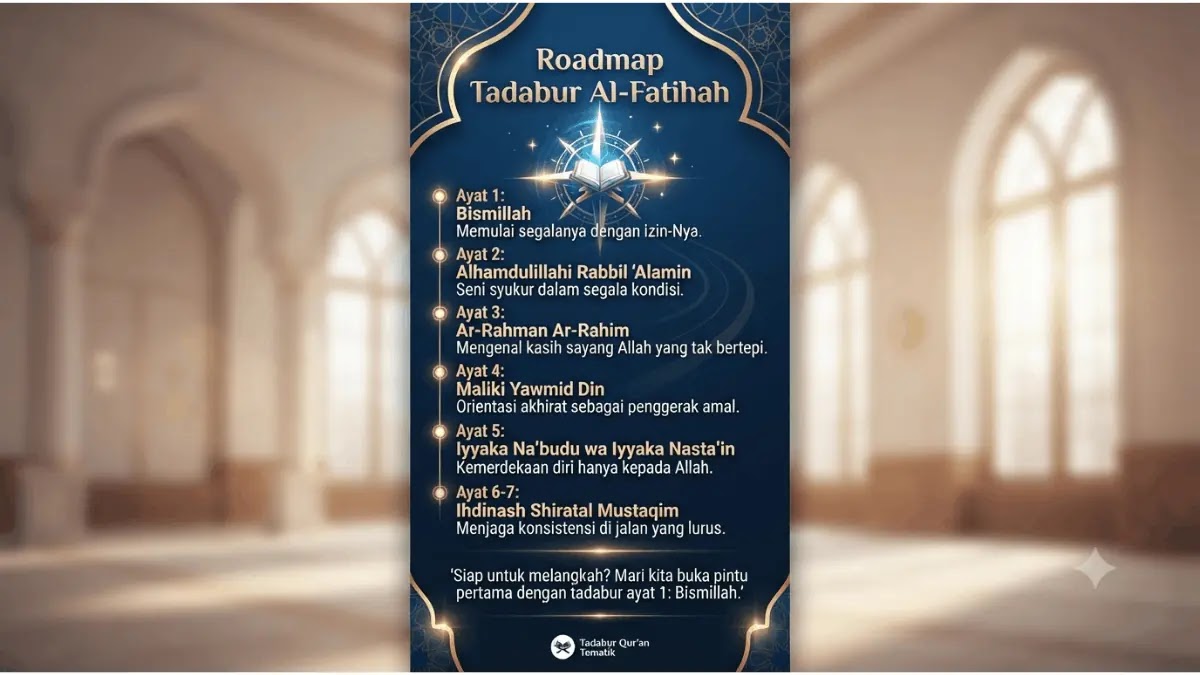
The Roadmap to Tadabbur Surah Al-Fatihah: An In-Depth Guide to Understanding the First Seven Verses of the Qur’an as a Curriculum for Life
Surah Al-Fatihah is not merely an introductory chapter placed at the beginning of the Quranic text. It is Umm al-Kitab—the Mother of the Book—a divine masterpiece that encapsulates the totality of heavenly messages ever revealed to humanity. The phrase “Alhamdulillahi Rabbil ‘Alamin” (All praise is due to Allah, Lord of the worlds) is something we recite dozens of times every single day across the units of our daily prayers. Yet, a fundamental question we must all pause to reflect upon is this: Have we ever stopped, taken a deep breath, and truly felt the profound spiritual resonance behind every single word we utter?
In an era defined by rapid disruption, fierce competition, and endless streams of digital noise, many of us struggle with emotional exhaustion and an unsettling sense of spiritual emptiness. We may read the Qur’an regularly out of habit, yet feel that its verses rarely influence our emotional responses, stress levels, or daily decision-making processes. This pillar page serves as a spiritual navigation guide to lead us back to understanding Al-Fatihah—not as a passive, mechanical routine, but as a living, two-way interactive dialogue between a servant and the Creator.
Why Surah Al-Fatihah Is the Ultimate Compass for Modern Life
Amidst the volatility and unpredictability of modern existence, human beings are exceptionally vulnerable to existential disorientation. We frequently find ourselves feeling lost, anxious, overwhelmed by competing priorities, and disconnected from our ultimate purpose. In this precise context, Surah Al-Fatihah stands as an unshakeable spiritual compass for any soul searching for a way back home. This surah is far more than a mandatory requirement for valid prayers; it is a dynamic navigational map ensuring that our steps remain steady, unswayed by the chaotic currents of worldly pursuits.
Through these seven majestic and concise verses, we are guided step-by-step through a deeply systematic spiritual methodology:
- Establishing a Foundation of Pure Monotheism (Tawhid): We are trained to offer sincere, proportioned praise and gratitude exclusively to Allah.
- Recognizing the Nature of Divine Mercy: Internalizing that Allah’s boundless compassion (Ar-Rahman Ar-Rahim) continually precedes and envelops all aspects of creation.
- Realigning Our Internal Compass: Learning how to seek authentic guidance and strength when the lines between truth and falsehood become blurred.
Al-Fatihah systematically reconstructs a believer’s worldview, restores our innate spiritual nature (Fitrah), and re-establishes the relationship between the creation and the Creator upon its proper foundation. When an individual recites Al-Fatihah with full mindfulness (Tadabbur), they participate in a direct, two-way conversation with Allah. As recorded in authentic prophetic traditions, Allah responds specifically to each segment of the verses recited by His servant during prayer. This vertical connection generates a profound inner peace—a tranquil state of heart that no material wealth in the world could ever purchase. Consequently, deeply understanding Al-Fatihah is the ultimate key to transforming our daily prayers from mere ritualistic obligations into living, soul-stirring spiritual encounters.
A Complete Curriculum for Life Encapsulated in Seven Verses
On this thematic Quranic reflection platform, our commitment is to unpack Surah Al-Fatihah not just as a ritualistic recitation, but as an actionable blueprint and practical curriculum for daily life. Each verse was divinely designed as an interconnected spiritual step, elevating our consciousness from worldly attachment toward pure, unadulterated devotion to God.
Let us embark on this transformative spiritual journey with an open heart through the structured roadmap detailed below:
The Systematic Roadmap for Tadabbur Al-Fatihah (7-Verse Navigation)
- Verse 1: Bismillah – Invoking Blessings in the Modern World — The foundational step to cultivating the awareness that no power or effort exists except through Allah’s permission, effectively dismantling arrogance within the human ego.
- Verse 2: Alhamdulillahi Rabbil ‘Alamin – The Art of Gratitude in Hardship — Teaching us the art of genuine gratitude under all circumstances, enabling us to view divine decree through the lens of praise and peaceful acceptance.
- Verse 3: Ar-Rahman Ar-Rahim – Experiencing His Boundless Mercy — The bedrock of spiritual optimism, reminding us that God’s grace and mercy always overpower His anger.
- Verse 4: Maliki Yawmid Din – The Necessity of Accountability — A powerful visual reminder of the Day of Judgment, training us to maintain a long-term vision that transcends the physical realm.
- Verse 5: Iyyaka Na’budu wa Iyyaka Nasta’in – Freedom from Material Slavery — The pinnacle of monotheistic declaration, liberating human beings from servitude to creation and granting true spiritual freedom.
- Verse 6: Ihdinash Shiratal Mustaqim – Seeking the Straight Path — A perpetual daily prayer for divine guidance, steadfastness, and clarity along the straight path.
- Verse 7: Shirathalladzina An’amta ‘Alaihim – The Path of the Blessed — Defining our social circles, role models, and moral boundaries so that we avoid the paths of anger and astrayness.
The Impact of Reflecting on Al-Fatihah on Mental and Emotional Health
Engaging in Tadabbur (deep reflection) upon Al-Fatihah on a consistent basis is far more than an academic exercise aimed at mastering Arabic grammar or linguistics. Beyond intellectual comprehension, reflection is a deliberate internal effort to revive a heart that may have become hardened or indifferent due to routine and worldly distractions. Too often, we slip into mechanical worship: our lips fluently recite the words while our minds wander toward work, finances, or personal problems, leaving a disconnect between our hearts and our Creator.
Yet, every single word within Surah Al-Fatihah serves as a spiritual remedy for modern psychological ailments:
- Overcoming Chronic Anxiety: Internalizing the reality of Rabbil ‘Alamin reassures the heart that the entire universe is governed by an all-powerful, loving Sustainer.
- Relieving the Pressure of Expectation: Deeply absorbing Iyyaka Nasta’in allows us to release the exhausting burden of over-relying on human validation or self-sufficiency alone.
- Healing Existential Emptiness: Remembering Maliki Yawmid Din redirects our focus toward an eternal, meaningful purpose that gives weight to every daily action.
When we unpack these verses sequentially, we construct an unshakeable foundation of faith. This foundation ensures that we remain resilient, grounded, and hopeful when confronted by life’s inevitable storms, losses, or trials. This spiritual journey is structured to progress naturally: from recognizing whom we praise, to immersing ourselves in His mercy, and finally aligning our daily priorities with eternal success.
The Gateway to Understanding the Entire Qur’an
Classical scholars of Quranic exegesis have unanimously agreed that to truly comprehend the message of the Qur’an in its totality, one must first enter through the doorway of Surah Al-Fatihah. Why is this the case? Because the macro-structure of the entire Qur’an—comprising 114 chapters—is, in essence, an elaboration, expansion, and detailed explanation of the core themes introduced in Al-Fatihah.
For instance, the divine laws, historical narratives of past nations, promises of paradise, and warnings of accountability found throughout Surah Al-Baqarah to Surah An-Nas all stem directly from the practical implementation of “Iyyaka na’budu wa iyyaka nasta’in” and the plea for “Ihdinash shiratal mustaqim”. In other words, Al-Fatihah is a miniature of the entire divine revelation. Once we grasp the essence of this miniature, every subsequent page of the Qur’an becomes significantly more accessible, deeply felt, and practical to implement in our everyday lives.
Through this deep understanding, we aim to eliminate functional illiteracy regarding the Qur’an—a state where one can recite the text beautifully according to rules of tajweed, yet fails to capture the moral transformation and spiritual wisdom intended by the Revelation. Surah Al-Fatihah is the master key, a spiritual manifesto that reshapes how we view ourselves, our communities, and our ultimate destiny.
Practical Steps: Applying Tadabbur to Your Daily Prayers
The ultimate goal of Quranic reflection is not merely intellectual satisfaction or expanding religious knowledge. The true fruit of Tadabbur lies in transformed behavior, elevated worship, and refined character. Therefore, after learning the deeper meanings behind each verse of Al-Fatihah, our immediate next step is to bring this newfound awareness directly onto our prayer mats.
Here are practical guidelines to revitalize your daily prayers:
- Pace Your Recitation (Thuma’ninah): Avoid rushing through Surah Al-Fatihah. Pause briefly at the end of every single verse to allow the meaning to settle in your heart.
- Visualize the Divine Conversation: Remain conscious of the fact that Allah SWT is actively listening and responding to every line you recite during your prayer.
- Internalize Divine Attributes: Feel the majesty of Rabbil ‘Alamin, absorb the warmth of Ar-Rahman Ar-Rahim, and cultivate a healthy balance of awe and hope when acknowledging the Master of the Day of Recompense.
Our sincere hope is that after exploring and reflecting upon all seven stages of this Al-Fatihah series, the way you stand before God, bow, prostrate, and connect with the Lord of the worlds will be permanently elevated. Your prayer will transform into a tranquil spiritual sanctuary that you eagerly look forward to every day.
Frequently Asked Questions (FAQ)
Question: “Can someone who is not fluent in Arabic still experience deep spiritual connection through Tadabbur during prayer?”
Answer: Absolutely. The primary language of Tadabbur is the mindfulness of the heart and a sincere intention to connect with God. You do not need to be a scholar of the Arabic language to benefit deeply from Al-Fatihah. Simply study the translation and thematic meanings of these seven verses outside of prayer time. During prayer, recall those core concepts as your tongue recites the verses. Allah looks at the sincerity of a servant’s heart seeking to understand and draw closer to His words.
Ready to take the next step in elevating your spiritual life? Begin your journey now with our deep dive into Verse 1: Bismillah – Invoking Blessings in the Modern World!
Explore the Al-Fatihah Series & Navigation Links:
- [Proceed to Verse 1: Bismillah – Invoking Blessings in the Modern World]
- [Return to Main Roadmap: Exploring All 114 Surahs of the Qur’an]