
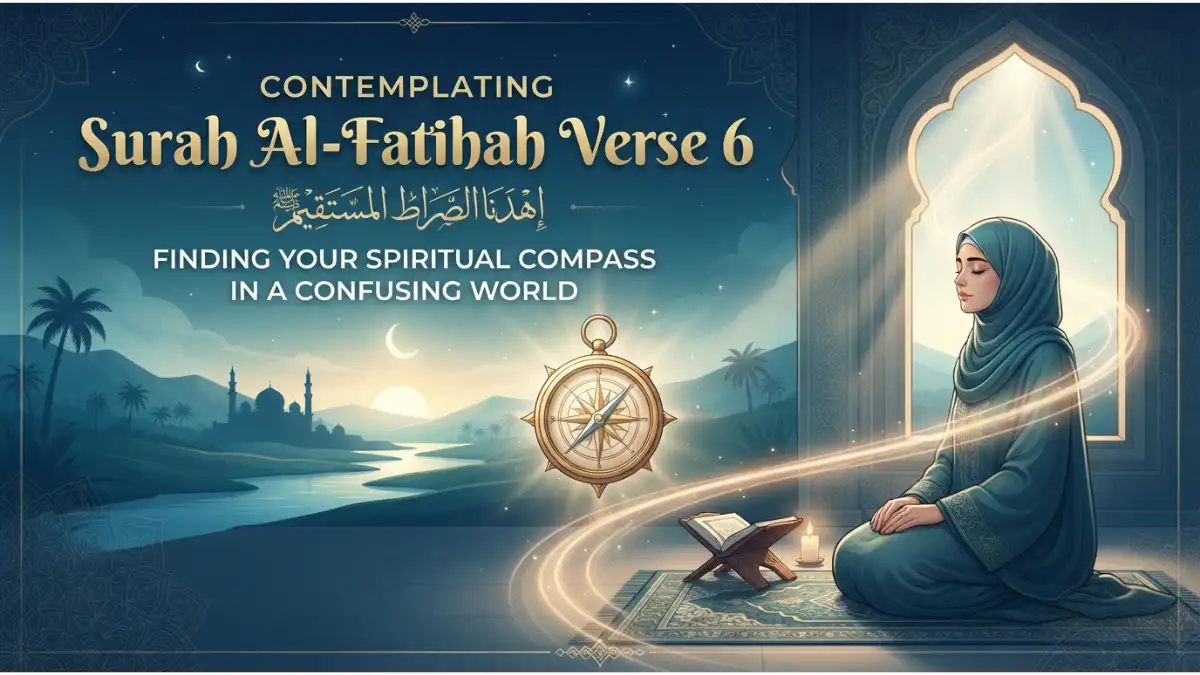
Understanding Surah Al-Fatihah: The Universal Roadmap for Humanity
Surah Al-Fatihah stands as both the opening chapter and the ultimate spiritual essence of the entire Holy Qur’an. Within its seven concise yet profoundly rich verses, Allah SWT outlines the overarching framework for human existence. It takes the believer on a structured journey: starting with an acknowledgment of God’s supreme lordship, moving through an appreciation of His infinite mercy, emphasizing the ultimate reality of the Day of Judgment, and establishing our core covenant of worship and reliance upon Him alone.
Far from being a mere repetitive ritual recited during daily prayers, Al-Fatihah provides an active, transformative roadmap. It prevents us from becoming consumed by worldly ambitions and continuously realigns our daily focus with our primary ultimate objective: returning safely to our Creator with a tranquil heart.
When we reach the sixth verse, we transition from establishing our devotion to offering the single most important petition a human being can make to God:
Ihdinaṣ-ṣirāṭal-mustaqīm
“Guide us to the straight path.” (QS. Al-Fatihah: 6)
Why Do We Ask for the ‘Straight Path’ Every Single Day?
Have you ever put forth immense effort into your career, personal relationships, or daily projects, only to feel as though you are going in circles? Or perhaps you frequently find yourself paralyzed at a critical crossroads—debating a major career shift, choosing a life partner, or deciding how to handle a complex personal dilemma?
In Verse 6 of Surah Al-Fatihah, we are taught the most essential prayer for human clarity: Ihdinash Shiratal Mustaqim.
Consider this question deeply: Why must a practicing Muslim repeat this plea dozens of times every single day? If we are already performing our prayers, striving to lead moral lives, and identifying as believers, why do we constantly ask to be guided to the straight path?
The answer is simple: Because life is an ever-changing maze, and human inclination is naturally volatile.
Modern society is exponentially more distracting and complex than any era prior. We are bombarded with endless streams of information, rapidly changing societal trends, and artificial benchmarks of success curated by digital algorithms. Often, people do not lose their way because they intend to do evil; rather, they drift off course because they lose their internal compass. Without realizing it, we begin taking paths that slowly erode our peace of mind and distance us from spiritual fulfillment.
Shiratal Mustaqim (The Straight Path) does not imply a path free of trials, resistance, or heavy lifting. In classical Arabic geometry and geography, the straightest path between two points is always the shortest, most direct, and most efficient route. In spiritual terms, it is the direct pathway to Allah’s pleasure and salvation. Imagine driving along a winding mountain highway in dense fog; praying Ihdinash Shiratal Mustaqim acts as high-powered fog lights, revealing sharp turns and keeping your vehicle safely centered.
Every time we recite this verse during our daily prayers, we perform a vital spiritual synchronization (a GPS re-sync for the heart). We declare: “O Allah, the noise of this world is overwhelming, and my intellect is limited. Please show me the exact path I should take so that I do not wander away from Your light.”
This prayer is an act of profound humility. It requires acknowledging that our intellectual capacity, personal experience, and social status are insufficient to guarantee true wisdom. What appears impressive or lucrative to the world is not necessarily “straight” in the sight of God.
Linguistic and Exegetical Analysis of Ihdinash Shiratal Mustaqim
To truly absorb the power of this short petition, classical Quranic scholars (Mufassirun) and linguists have broken down its core terminology to reveal rich layers of spiritual guidance.
1. The Depth of ‘Hidayah’ (Guidance)
The verb Ihdina comes from the root word Hidayah. In classical Arabic terminology, Hidayah goes far beyond simply receiving directions or reading a map. Scholars classify guidance into key distinct stages:
- Hidayat al-Irshad (Guidance of Direction): Pointing out where the road is, similar to a street sign informing you of the destination.
- Hidayat al-Tawfiq (Guidance of Internal Inspiration and Enablement): Allah placing the desire, strength, and ability directly within your heart to walk along that road and remain steadfast upon it.
When praying Ihdina, we ask Allah not only to show us what is right, but to grant us the internal resolve, courage, and strength to actually act upon that truth.
2. The Meaning of ‘Al-Sirat’
Linguistically, Al-Sirat refers to a path that possesses clear characteristics: it is wide, clear, accessible, and direct. Unlike secondary pathways or minor trails (known in Arabic as Subul), Al-Sirat is the primary highway. It is wide enough to accommodate every soul seeking God, yet clear enough that its direction cannot be mistaken when illuminated by Divine revelation.
3. The Meaning of ‘Al-Mustaqim’
Derived from the root Qama (to stand upright or firm), Al-Mustaqim denotes something that is perfectly straight, balanced, and unyielding. It contains no erratic twists, hidden traps, or deceptive detours. Therefore, Al-Shiratal Mustaqim represents an unwavering framework of truth—one that remains consistent across generations regardless of temporary cultural shifts.
Inspirational Reflection: A Choice at the Crossroads
Consider the story of an ambitious professional who was presented with two vastly different career paths:
The first job offer promised a corporate title and a exceptionally high salary. However, taking the position required compromising on ethical values, ignoring questionable business practices, and sacrificing personal well-being. The second offer provided a modest salary, but the work environment was built on integrity, moral responsibility, and community support.
From a purely material standpoint, the high-paying job was exceptionally tempting. He spent weeks experiencing intense anxiety, weighing financial gain against moral peace. Eventually, he decided to slow down and seek Divine guidance through prayer. He began reciting Ihdinash Shiratal Mustaqim not as a routine sentence, but as a genuine plea for heart-clarity.
After careful reflection, he chose the second path. Over time, he discovered a deep sense of contentment and tranquility that money could never purchase. While his bank account did not multiply overnight, his life gained harmony, purpose, and freedom from guilt. This illustrates the essence of the Straight Path: it may not always yield the largest immediate material payout, but it preserves the health and safety of the human soul.
Practical Action Steps: Living Out Verse 6 Today
To turn this contemplation into practical daily guidance, implement these three simple exercises:
- Pray Before Making Decisions: Before making any choice today—whether negotiating a contract, responding to an emotional situation, or making a financial commitment—pause briefly. Recite Ihdinash Shiratal Mustaqim silently, asking Allah to align your heart with what pleases Him most.
- Conduct a Directional Audit: Take ten minutes to review where your time and mental energy have gone over the past week. Are your primary activities bringing you closer to emotional stability and spiritual clarity, or are they driving higher anxiety? If an activity consistently generates spiritual distress, it may be time to re-evaluate that path.
- Seek Compass Over Convenience: When feeling overwhelmed or confused, resist the urge to immediately seek distraction through social media or impulse spending. Instead, make ablution (wudhu), perform two units of voluntary prayer, and ask Allah to restore your internal compass.
Short Supplication for Continuous Guidance
Recite this supplication to request steadfastness upon the truth:
“O Allah, guide my steps onto the Straight Path. Whenever I am faced with difficult choices, direct my heart toward what You love most, and keep me safe from paths that lead away from Your grace and peace. Amin.”
Questions & Answers Corner (FAQ)
Question: “Sometimes it feels like staying on the Straight Path makes life more difficult and full of obstacles. Why is that?”
Answer: Obstacles and trials are not signs that you are on the wrong road; rather, they serve as exercises to strengthen your faith and character. A straight path going up a mountain requires physical exertion, but it is the most direct way to reach the summit. Facing difficulties while standing upon principles teaches patience, reliance on God, and resilience. The Straight Path does not guarantee a life devoid of problems, but it guarantees that every problem you encounter becomes a platform for personal growth and spiritual reward.
Question: “How can I know if a decision I made aligns with ‘Shiratal Mustaqim’?”
Answer: Alignment with the Straight Path leaves clear spiritual indicators: it conforms to ethical and divine guidance, brings a sense of internal peace (even amid external difficulty), and does not require you to compromise your integrity or harm others.
What difficult decision or crossroads are you facing today? Has there been a time in your life when turning to Divine guidance saved you from taking the wrong path? Share your stories in the comments below!