
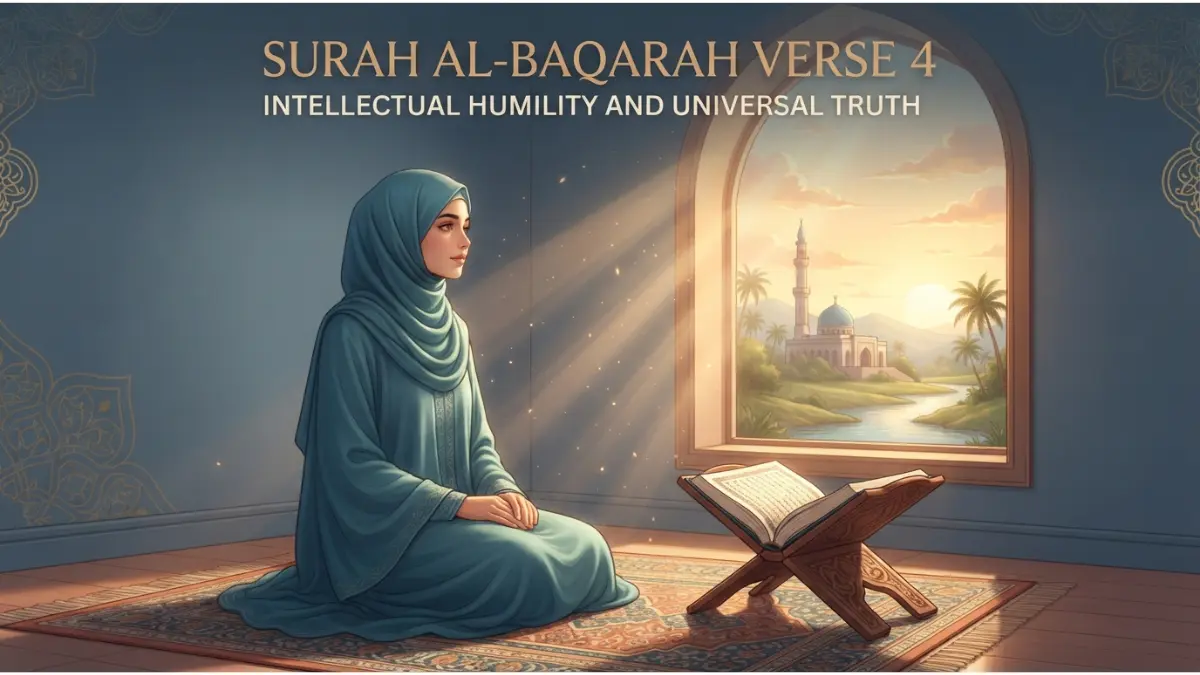
Learning Wisdom from Every Direction: Breaking Echo Chambers and Embracing Intellectual Humility
In an age defined by digital polarization, information fatigue, and tribalism, modern society is increasingly prone to falling into “echo chambers”—environments where individuals only engage with, read, and accept ideas that strictly validate their existing worldview. This phenomenon quietly breeds intellectual arrogance, cognitive narrowness, and social fragmentation. People routinely reject objective truth, valuable insights, or sound wisdom simply because the message originates outside their specific social circle, cultural background, or ideological school of thought.
However, when we turn our attention back to the Quran, we discover that Islam establishes a profound foundation of spiritual and intellectual openness from the very beginning of Surah Al-Baqarah. Following Verse 3—which outlines the vertical relationship with Allah through prayer and the horizontal relationship with society through charitable giving—Verse 4 completes the archetype of the conscious, God-fearing individual (al-muttaqin). It does so by highlighting three pivotal qualities: broadness of mind, respect for the historical continuity of divine revelation, and an unshakeable conviction in the eternal reality of the Hereafter.
Allah SWT proclaims in the glorious revelation:
“Walladhina yu’minuna bima unzila ilaika wama unzila min qablik, wabil-akhirati hum yuqinuun”
“And who believe in what has been revealed to you, [O Muhammad], and what was revealed before you, and of the Hereafter they are certain [in faith].” (QS. Al-Baqarah: 4)
Historical Context and the Grand Continuity of Divine Message
To grasp the philosophical depth of this verse, one must analyze the broader prophetic history presented by the Quran. Islam does not present itself as an isolated spiritual movement that suddenly materialized in Seventh-Century Arabia, detached from the spiritual history of humanity. On the contrary, the Quran establishes its role as the final guardian, criteria, and confirmation (muhaimin) of the original monotheistic messages delivered by earlier prophets—from Adam, Abraham, and Moses with the Torah, to Jesus with the Gospel (peace be upon them all).
From a historical standpoint, when these verses were revealed in Medina, the local social landscape was remarkably diverse, comprising the Anshar (local supporters), Muhajirin (emigrants from Mecca), and established communities of the People of the Book (Jews and Christians). Within this multicultural environment, the Quran defined the righteous not as narrow-minded partisans, but as individuals who humbly acknowledge Allah’s ongoing guidance throughout human civilization.
Belief in scriptures revealed prior to the Quran sends a powerful universal message: divine truth, moral justice, and pure monotheism did not originate exclusively in Seventh-Century Medina. Rather, these principles have been continuously communicated by the Creator since the dawn of humanity. This foundational principle trains a believer to possess a broad, respectful worldview that honors the sacred history of human faith without adopting a posture of spiritual superiority.
Linguistic Breakdown and Classical Exegesis (Tafsir)
Renowned classical Quranic commentators—including Ibn Kathir, Imam Al-Qurtubi, and Wahbah Az-Zuhaili—have highlighted several subtle yet profound nuances embedded within the vocabulary of Surah Al-Baqarah Verse 4:
1. The Universal Mandate of “Bima Unzila Ilaika Wa Ma Unzila Min Qablik”
The phrase “what has been revealed to you and what was revealed before you” establishes a comprehensive obligation of faith. True belief in the Quran logically requires an individual to affirm that Allah granted genuine guidance and scripture to previous messengers. This linguistic structure dismantles local, national, or ethnic chauvinism. Divine truth transcends geographical boundaries and historical eras.
2. The Openness to Universal Wisdom
Ali bin Abi Talib (RA) articulated a well-known principle regarding wisdom: “Wisdom is the lost property of the believer; wherever he finds it, he has the greatest right to it.” Surah Al-Baqarah Verse 4 demands that a believer remain receptive to truth regardless of its source. As long as a concept, scientific discovery, or ethical insight promotes human well-being and aligns with monotheism, a conscious believer possesses the intellectual maturity to embrace it.
3. The Weight of “Wabil-Akhirati Hum Yuqinuun” (وَبِالْآخِرَةِ هُمْ يُوقِنُونَ)
The selection of the verb yuqinuun (they are certain) is distinct from passive agreement or mere intellectual assent. Yaqin denotes the highest level of absolute conviction—a state of certainty free from lingering doubt that permeates an individual’s subconscious and drives their daily behavior. Placing certainty in the Hereafter at the conclusion of this description serves as the ultimate moral anchor for all worldly actions.
Three Philosophical Pillars for Navigating Modern Life
This verse establishes three structural pillars that are immensely relevant for navigating the complexities of modern society:
- Intellectual Humility: Recognizing divine guidance prior to the Quran teaches believers profound humility. It prevents individuals from assuming they possess a monopoly on all knowledge while remaining blind to the good in others. A God-conscious person retains a continuous willingness to learn, absorb universal wisdom, and appreciate positive contributions across different cultures.
- Dismantling Ideological Echo Chambers: Blind fanaticism toward a specific group or echo chamber hardens the heart and narrows perspective. By recognizing that divine truth spans a vast historical arc, believers are inspired to break free from intellectual bubbles and engage with the world with wisdom, empathy, and maturity.
- An Eschatological Vision that Calms and Disciplines: Unshakeable certainty regarding the Day of Judgment (al-akhirah) acts as a internal moral compass. This awareness prevents individuals from recklessly pursuing short-term worldly gains or yielding to despair when witnessing worldly injustices. A believer understands that every intention, piece of knowledge, and action will ultimately be weighed with perfect justice by the Creator.
Real-World Case Study: Overcoming Fanaticism to Find Inner Peace
The transformative power of internalizing Surah Al-Baqarah Verse 4 is clearly illustrated in the journey of a modern academic and social activist:
For many years, this individual operated within a rigid, highly insular environment. From a young age, he had been conditioned to view any perspective outside his immediate ideological group with deep suspicion. He viewed individuals with differing opinions or intellectual backgrounds as fundamentally misguided adversaries. Consequently, his social interactions were filled with tension, his heart was frequently agitated, and his social circle remained small. While he maintained a strong sense of self-righteousness, he privately suffered from isolation and chronic anxiety.
A turning point occurred when he undertook a detailed study of Surah Al-Baqarah Verse 4. He was struck by the fact that Allah SWT explicitly praises those who recognize and believe in the truth revealed prior to the Prophet Muhammad (peace be upon him). He began to reflect: if Allah commands believers to respect the historical continuity of divine message, why was he harboring such hostility toward others who held differing views?
Gradually, he began to expand his intellectual horizons. He read historical literature, explored works across diverse academic disciplines, and listened attentively during discussions with individuals outside his usual circle. The results were transformative: his inner life became significantly calmer and more expansive. He no longer approached conversations as battles to be won, but as opportunities to discover wisdom. His genuine openness earned him widespread respect, enabling him to serve as a bridge builder in community disputes.
Daily Action Protocols: Practical Steps to Cultivate Openness
To embody the principles outlined in Surah Al-Baqarah Verse 4 in daily life, consider adopting these three actionable steps:
- Practice Active Listening Without Immediate Judgment: When participating in discussions with individuals who hold differing perspectives, consciously resist the urge to interrupt or formulate a immediate rebuttal. Listen attentively until they finish speaking, and identify at least one point of shared value or constructive insight.
- Diversify Your Reading and Knowledge Sources: Dedicate time periodically to read books, articles, or research papers written by authors outside your typical preference. Train your mind to evaluate information critically and objectively while maintaining the Quran as your primary ethical compass.
- Apply the “Hereafter Compass” to Daily Decisions: Before making significant decisions in business, family matters, or digital communications, ask yourself: “Will I be comfortable accounting for this choice on the Day of Judgment?” Allow this eschatological awareness to serve as your ultimate moral filter.
“O Allah, Lord of truth and guidance, expand our hearts and open our minds so that we may readily accept wisdom wherever it originates. Purify our souls from intellectual pride, narrow fanaticism, and self-righteousness. Plant within us an unshakeable faith in Your revelations and an unwavering conviction in the Hereafter, so that all our steps remain guided by Your pleasure. Amin.”
Spiritual Q&A Corner (Tadabur FAQ)
Question: Does the command to believe in previous scriptures mean that a Muslim is required to read and practice the laws found in current texts of other religions?
Answer: No, classical Islamic scholars have clarified this legal distinction carefully:
- The Required Belief: Believing in previous scriptures (such as the original Torah, Psalms, and Gospel) means affirming with absolute certainty that Allah revealed those original texts to His earlier messengers.
- The Status of the Quran: Following the advent of the Prophet Muhammad (peace be upon him), the Quran serves as the final, superseding revelation (naskh) and the ultimate criterion over previous scriptures (muhaimin). While we respect the sacred history of divine guidance, our daily legal and spiritual practices are derived exclusively from the Quran and authentic Sunnah.
What is a valuable lesson or piece of wisdom you have gained from interacting with someone whose background or worldview was completely different from your own? Share your experiences in the comments below to enrich our community discussion!
This article is part of our comprehensive study series: Tadabur Exploration: A Roadmap Through 114 Surahs of the Quran