
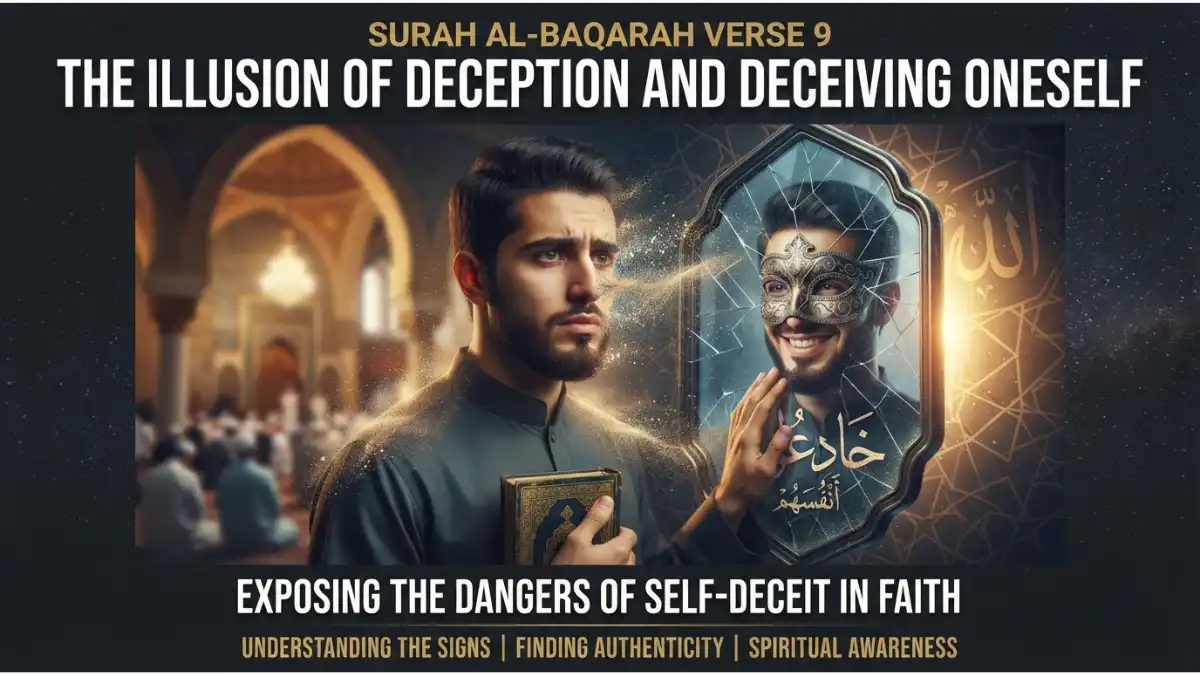
The Great Illusion: Can Human Ingenuity Ever Outsmart the Creator?
In our modern, performative culture, humans are constantly tempted to construct carefully curated personas. We polish our digital profiles, tailor our speech to suit different crowds, and hide personal failings under masks of righteousness. When society praises our constructed image, our egos whisper a dangerous lie: that we have successfully mastered the game of impression management.
However, the Holy Qur’an pierces through this delusion in Surah Al-Baqarah, verse 9. Continuing the psychological dissection of hypocrisy introduced in the preceding verses, Allah SWT exposes the hidden motives, false logic, and self-destructive nature of those who operate with a double face.
Let us reflect upon the Divine word in Surah Al-Baqarah, verse 9:
“Yukhadi’unallaha walladzina amanu wama yakhda’una illa anfusahum wama yash’urun”
Translation: “They seek to deceive Allah and those who believe, but they deceive except themselves and perceive it not.” (QS. Al-Baqarah: 9)
This verse delivers a profound wake-up call to the human consciousness. Attempting to deceive the All-Seeing Creator is not merely an act of rebellion; it is a manifestation of utter foolishness. Trying to hide one’s true nature from Allah is like attempting to cover the sun with the palm of one’s hand—a meaningless gesture that only leaves the perpetrator in complete darkness.
Linguistic and Exegetical Analysis: Unpacking the Mechanics of Spiritual Deceit
Classical classical scholars of tafsir—including Ibn Kathir, Al-Qurtubi, and Imam Al-Tabari—have meticulously analyzed the grammatical and spiritual depth of this verse. Every word serves a specific diagnostic function in revealing the hypocritical mindset.
1. The Verb “Yukhadi’un” (Attempted Deception)
The verb Yukhadi’un originates from the root khada’a, which historically referred to hiding something in a secret vault or concealing an intention beneath a false exterior. The form used here implies an ongoing, active attempt to pull off a scheme. The hypocrites do not merely commit a single lie; they engage in a continuous strategy to project faith outwardly while harboring disbelief or indifference inwardly.
2. How Do They “Deceive” Allah?
Mufassirun raise an essential theological question: How can a mortal ever deceive Allah, who possesses absolute knowledge of the seen and unseen? The scholars clarify that “deceiving Allah” refers to one of two meanings:
- Deceiving the Prophet and His Laws: By attempting to trick the Messenger of Allah (peace be upon him) and the Muslim community, they act as if they are tricking Allah Himself, for the Prophet represents Divine authority on earth.
- Inward Arrogance: They operate under the absurd assumption that their inner thoughts remain hidden from God, revealing a fundamental defect in their understanding of Allah’s attributes (*Asma wa Sifat*).
3. The Reality of “Wama Yakhda’una Illa Anfusahum”
Allah uses the restrictive particle illa (except) to highlight a stark reality: their scheme fails entirely at its intended target and rebounds exclusively upon themselves. In Islamic theology, every deception practiced against Divine guidance damages the actor’s own soul (*nafs*). The harm they intended for the believers—such as sabotaging the community from within—ultimately strips away their own spiritual light and forfeits their eternal salvation.
The Anatomy of “Wama Yash’urun”: The Tragic Loss of Spiritual Awareness
The most chilling segment of this verse lies in its concluding phrase: wama yash’urun—”and they perceive it not.”
Why does Allah emphasize their lack of perception? Because when hypocrisy takes root in a person’s heart, it degrades their spiritual intellect (*basirah*). The individual begins to view their duplicity not as a moral failing, but as tactical intelligence or social diplomacy. They congratulate themselves on successfully navigating multiple social circles without committing to genuine faith.
This loss of awareness leads to a severe internal breakdown, as outlined in the following stages:
| Stage of Self-Deception | Psychological State | Spiritual Reality |
|---|---|---|
| 1. Initial Duplicity | Rationalizing small lies to preserve status or avoid discomfort. | The heart develops its first dark stain of insincerity. |
| 2. Identity Fragmentation | Constantly shifting behaviors depending on the audience. | Loss of authentic self; the individual forgets who they truly are. |
| 3. Spiritual Numbness (*Wama Yash’urun*) | Feeling pride in successfully manipulating public perception. | Complete blindness to one’s own spiritual degradation and upcoming judgment. |
When a person lives a double life, the primary victim is their own peace of mind. They must expend immense mental energy to maintain their false narrative, constantly terrified that a slip of the tongue or a change of circumstances will unmask them before society.
Modern Applications: The Performative Trap in the Digital Era
While Surah Al-Baqarah verse 9 was revealed regarding the hypocrites of Madinah, its warning applies directly to our modern lives. The digital age has amplified the temptation to prioritize impression over substance.
The Social Media Paradox
On social platforms, individuals are encouraged to broadcast stylized versions of their lives. We share moments of charity, profound religious quotes, and ideal family scenarios, often seeking validation in the form of likes and followers. While sharing good deeds with a pure intention is permissible, the line between spreading goodness and performative piety is exceptionally thin.
If our motivation shifts from seeking Allah’s pleasure to securing human admiration, we enter the perimeter of spiritual insincerity (*Riya’*). We become like the subjects of this verse: collecting temporary human applause while remaining bankrupt in the court of Divine justice.
Professional and Personal Duplicity
In professional environments, this phenomenon manifests as corporate hypocrisy—praising leaders to their faces while undermining colleagues behind closed doors. In personal relationships, it appears as feigned loyalty. People often view these practices as shrewd career strategies, forgetting that wealth and status acquired through duplicity carry no barakah (divine blessing).
Illustrative Reflection: The Exhausting Drama of a Double Life
Consider the story of a talented professional whom we will call Julian. Julian possessed a natural charm and knew precisely what to say to gain favor with his superiors. In management meetings, he enthusiastically endorsed company initiatives and praised his team members lavishly.
However, when speaking privately with rival departments, Julian would disparage those same colleagues, leak confidential discussions, and claim credit for work he did not perform. He viewed this double-dealing as sophisticated corporate strategy, believing it kept him safe from office politics while accelerating his promotion.
For a time, Julian’s strategy appeared successful. He rose through the ranks and earned public recognition. Yet, as years passed, the weight of his false persona began to crush him. He suffered from severe insomnia, consumed by constant anxiety that his conflicting statements would expose his true character. Worse still, Julian realized he had no genuine friends; every relationship in his life was built on calculated advantage rather than authentic trust.
Julian had fallen into the exact trap described in Surah Al-Baqarah verse 9. He believed he was outsmarting everyone around him, but in reality, he was destroying his own mental health, moral character, and capacity for genuine human connection.
Three Actionable Steps to Cultivate Spiritual Authenticity
To ensure our reflection on this verse yields tangible spiritual growth, we must actively audit our intentions and behaviors. Here are three daily practices to dismantle insincerity:
- Implement a Private Good Deed (The Hidden Charity): Establish at least one regular act of worship or charity that remains entirely secret between you and Allah. Whether it is praying in the late hours of the night or giving anonymous financial assistance, hidden deeds act as an antidote to performative piety.
- Audit Your Verbal Intentions: Before posting online or speaking in a public gathering, pause for three seconds and ask yourself: *”Why am I saying this? Am I seeking Allah’s approval, or am I hunting for human admiration?”* If the primary driver is ego, choose silence.
- Engage in Honest Solitary Confession (*Istighfar*): Dedicate time during your night prayers or daily remembrance to acknowledge your hidden flaws directly to Allah. Admitting your weaknesses in solitude dismantles the false self-image that fuels self-deception.
A Supplication for Sincerity of Heart
Let us turn to Allah SWT, asking Him to purify our hearts from all forms of hypocrisy and self-deceit:
“O Allah, Purifier of hearts, protect our souls from the trap of self-deception and insincerity. Grant us the blessing of authenticity, both when we are hidden from human eyes and when we stand before the public gaze. Cleanse our intentions, illuminate our inner sight, and make our inner state better than our outer appearance. Amin.”
Frequently Asked Questions (FAQ)
Question: “How can I tell the difference between healthy social tact and the hypocrisy warned against in Surah Al-Baqarah verse 9?”
Answer: Social tact involves exercising wisdom, politeness, and restraint to maintain peace without violating truth or justice. Hypocrisy, however, involves active deceit—pretending to hold principles or feelings that you fundamentally reject in order to manipulate others for personal gain. Tact seeks to protect others; hypocrisy seeks to exploit them.
Have you ever experienced the mental fatigue of trying to maintain a false expectation or persona for society? What defining moment helped you return to living an authentic life? Share your reflections and stories in the comments section below!
This article is part of the thematic study series: Tadabur Al-Qur’an Surah Al-Baqarah