
Why Do We Feel Played by Circumstances?
Following verse 14—which thoroughly exposed the chameleon-like behavior of hypocrites who pretend to belong with believers while privately reassuring their corrupt circles of their loyalty—Surah Al-Baqarah verse 15 delivers a decisive closing response. Allah Almighty instantly shatters their superficial confidence and false sense of intellectual superiority:
“Allahuyastahzi’u bihim wa yamudduhum fi tughyanihim ya’mahun”
Translation: “Allah mocks them and prolongs them in their transgression [so] they wander blindly.” (QS. Al-Baqarah: 15)
Reading the opening phrase of this verse might initially evoke a sense of profound awe or confusion. A fundamental theological question naturally arises: what does it mean for Allah, the Supreme and All-Wise Creator, to “mock” His creation?
Classical scholars of exegesis explain that this phrasing represents divine requital (*musyakalah*)—a principle of exact justice. Allah does not engage in petty human mockery. Rather, He permits the hypocrites’ own schemes, false cleverness, and duplicitous strategies to turn against them, resulting in self-destruction from within.
It presents a tragic portrait of individuals who have lost their moral orientation while remaining trapped in self-congratulatory delusions of cleverness.
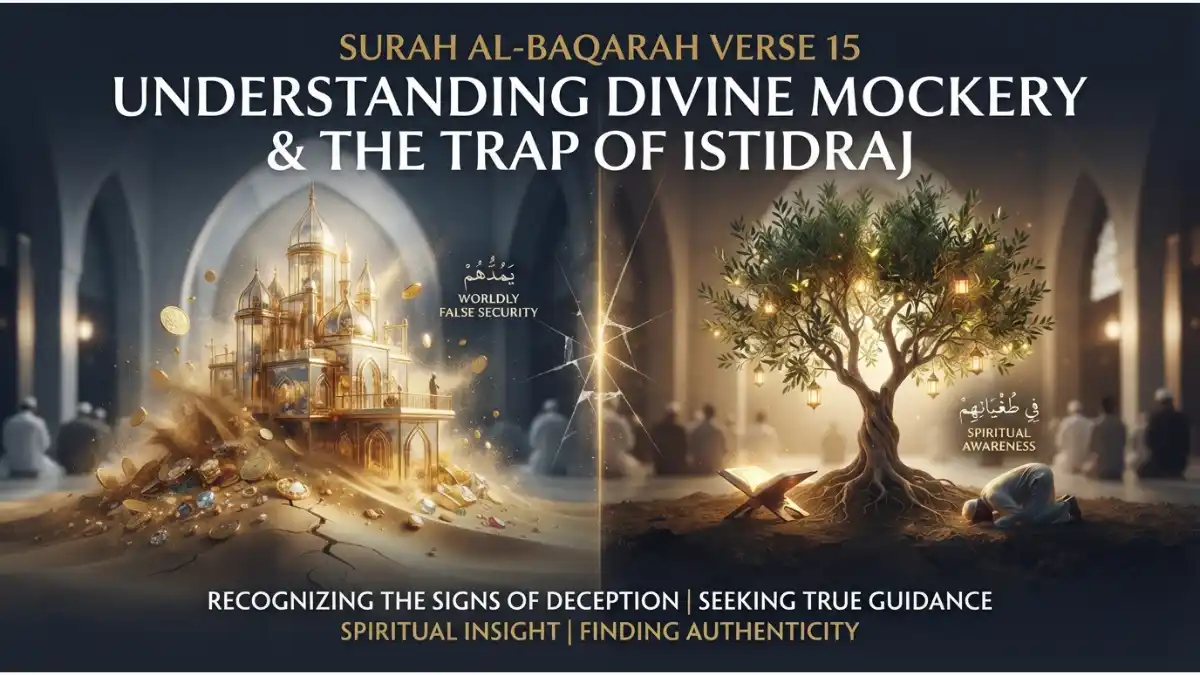
Decoding the Scenario of *Istidraj*: The Trap of False Comfort
Observe modern social dynamics: we frequently witness individuals who routinely manipulate circumstances, practice deception, or bypass ethical boundaries to climb professional and social ladders, yet appear entirely unpunished. In fact, their material wealth expands, their influence grows, and their social standing flourishes.
This dynamic often triggers internal doubt for observers trying to live ethically: “If deceit yields rapid advancement, why does staying honest feel like an uphill battle?”
This is precisely where the mechanism of wa yamudduhum (granting them leeway/prolonging their rope) operates. In Islamic spiritual jurisprudence, this phenomenon is termed Istidraj—a gradual divine deception where transgressors are granted temporary ease, material abundance, and an inflated sense of security.
Because their unethical choices produce no immediate negative consequences, they assume immunity from divine law. However, each unearned success pulls them closer to the brink of ultimate ruin.
From a psychological perspective, this process of gradual moral decay inflicts severe damage on the human psyche:
- Desensitization of the Conscience: The first instance of dishonesty typically triggers guilt. When deceit goes unpunished and yields immediate rewards, the conscience numbs, leading the individual to view manipulation as strategic intelligence.
- Loss of Life’s Navigational Compass (*Ya’mahun*): The term ya’mahun describes someone wandering blindly in a vast desert without a compass. Confused and disoriented, they mistake mirages for water sources, expending energy in pursuit of empty illusions.
- Exhaustion from Sustaining Falsehoods: Maintaining a life built on deceit requires immense psychological energy. The soul suffers chronic anxiety, forced to fabricate new fabrications to cover previous inconsistencies.
The Spiritual vs. Worldly Mechanics of Istidraj
To understand how *Istidraj* functions in daily life, it is crucial to contrast it with authentic divine blessings (*barakah*). While both may involve material growth, their spiritual trajectories and psychological outcomes are diametrically opposed.
| Metric | The Path of Istidraj (Verse 15) | The Path of Authentic Blessing (Barakah) |
|---|---|---|
| Immediate Reality | Rapid material accumulation accompanied by ethical shortcuts. | Sustainable growth grounded in ethical integrity and patience. |
| Spiritual Attitude | Arrogance, self-reliance, and contempt for moral boundaries. | Humility, gratitude, and heightened awareness of divine accountability. |
| Psychological Impact | Internal restlessness, chronic fear of exposure, and blind orientation (*ya’mahun*). | Deep internal tranquility, clarity of purpose, and emotional resilience. |
| Ultimate Outcome | Sudden collapse when false foundations fail under pressure. | Long-term structural success and eternal salvation. |
Linguistic and Classical Exegesis: Unpacking *Yastahzi’u*, *Tughyan*, and *Ya’mahun*
Classical mufassirun (commentators) such as Ibn Kathir, Al-Qurtubi, and Al-Tabari offer detailed linguistic evaluations of verse 15.
The verb Yastahzi’u is used here as a linguistic response to the hypocrites’ claim in verse 14 (“innama nahnu mustahzi’un”—we were only mocking). In Arabic rhetoric, when Allah responds using the same term, it signifies that the consequences of their mockery will be returned upon them in full measure. Divine mockery means exposing their foolishness in the Hereafter and allowing their worldly plots to backfire.
The term Tughyanihim originates from *tagha*, which means to overflow or exceed proper bounds (as water overflowing a dam). In this context, *tughyan* refers to deep-seated transgression where an individual’s ego exceeds human limits, making them blind to moral guidance.
The verse concludes with Ya’mahun, derived from *’amah*, which denotes spiritual blindness or mental disorientation. Unlike physical blindness (*’ama*), *’amah* refers to an inability of the heart to perceive reality. They move through life believing they are advancing strategically, while in truth they are wandering aimlessly in moral darkness.
Case Study: The Fall of a Manipulative Corporate Strategist
Consider the experience of Richard (a representative composite case), a senior strategist at an international financial firm. Richard was widely celebrated for his ability to exploit regulatory loopholes, manipulate internal performance evaluations, and undermine colleagues to secure high-value accounts.
For years, his unethical tactics yielded promotions, substantial financial bonuses, and social prestige. In private conversations, he mocked peers who adhered strictly to compliance protocols, viewing ethical standards as constraints designed for less capable minds. He felt invincible, believing he had mastered the system.
However, the law of cause and effect remained active. Over time, the corporate culture Richard helped foster—one rooted in suspicion and political maneuvering—turned inward. During a sudden regulatory audit, the very subordinates he had exploited leaked documented evidence of his financial manipulations to protect their own standing.
Within weeks, his career collapsed. He faced immediate termination, public reputational loss, and severe legal liability. Reflecting on his fall, Richard confessed to a friend: “It feels as though circumstances were intentionally setting me up for failure.”
In reality, circumstances had not set him up; he was simply harvesting the cumulative consequences of the dishonest seeds he had sown throughout his career.
Three Practical Steps to Protect Yourself from Moral Disorientation
To avoid falling into self-deception and protect your soul from the trap of *Istidraj*, incorporate these three practical habits into your daily routine:
- Commit to Absolute Honesty: Choose total transparency even when a minor manipulation offers temporary convenience. Breaking the cycle of small compromises protects your internal moral compass.
- Conduct Regular Self-Audits: Before sleeping, dedicate five minutes to evaluate your recent choices. Ask yourself: *”Did any of my decisions rely on deceit, manipulation, or unfair treatment of others?”* Correct missteps immediately before they compound.
- Seek Divine Protection Against Arrogance: Routinely pray for spiritual clarity and humility. Recognize that human intellect without divine guidance easily strays into self-serving justification.
Supplication for Spiritual Clarity and Truth
We ask Allah Almighty to grant us genuine insight and preserve our moral compass:
“O Allah, All-Just and All-Seeing, protect us from self-deception, arrogance, and the illusion of unearned success. Do not allow us to fall into the trap of Istidraj, where ease leads to spiritual carelessness. Guide us firmly upon the straight path, grant us the clarity to see truth as truth and follow it, and enable us to recognize falsehood as falsehood and abstain from it. Amin.”
Frequently Asked Questions (FAQ)
Question: “How can one distinguish between being tested by Allah to elevate one’s status versus being trapped in Istidraj?”
Answer: The primary distinction lies in your **spiritual state during the experience**. A constructive test (*ibtilā’*) softens the heart, increases humility, draws you closer to prayer, and fosters internal tranquility despite outward hardship. Conversely, *Istidraj* is marked by an increasingly hardened heart, rising arrogance, a loss of fear regarding sin, and persistent internal anxiety despite outward material ease.
Have you ever experienced a situation where temporary success turned out to be a spiritual test? How did you regain your orientation? Share your reflections in the comments below!
This article is part of the thematic study series: Tadabur Al-Qur’an Surah Al-Baqarah