
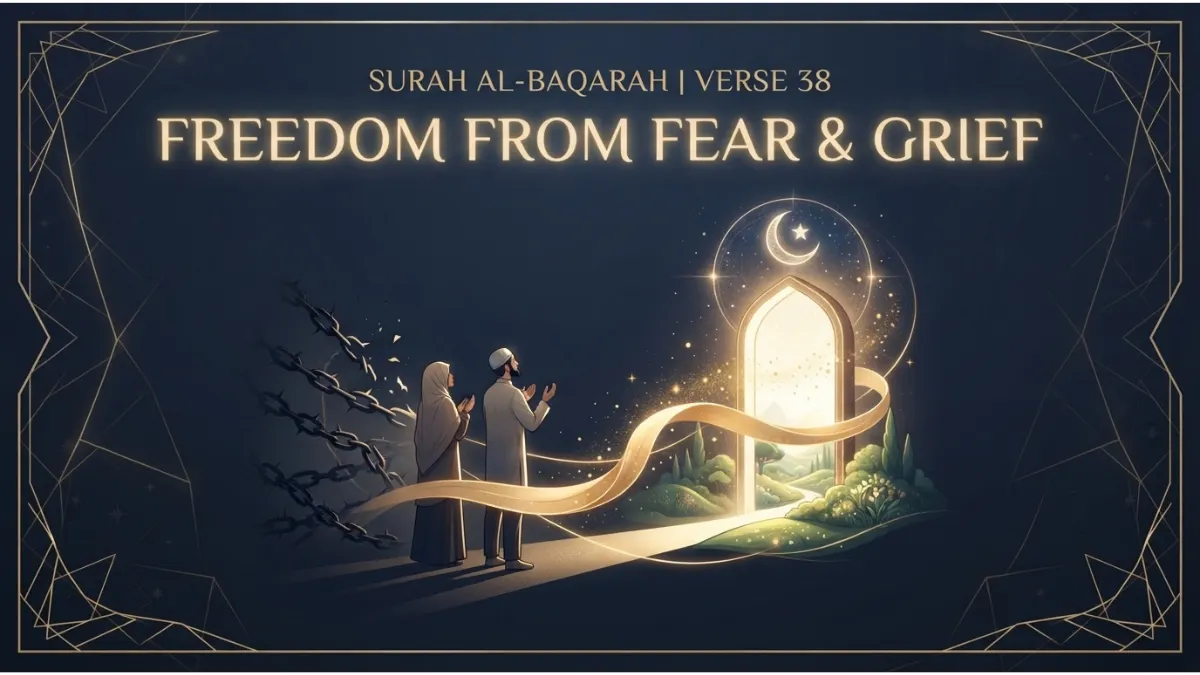
The Ultimate Guarantee: Divine Navigation in an Uncertain World
Following the emotional scene in the preceding verse—where Allah Almighty accepted the repentance of Prophet Adam (peace be upon him) and taught him the sacred words of forgiveness—Surah Al-Baqarah verse 38 marks a pivotal transition in human history. This verse provides a divine guarantee, an unshakeable law of spiritual safety, and a timeless navigation system for humanity as we step onto the earthly realm to fulfill our noble mandate as stewards (khalifah).
Consider the divine command revealed in the Holy Quran:
قُلْنَا اهْبِطُوا مِنْهَا جَمِيعًا ۖ فَإِمَّا يَأْتِيَنَّكُم مِّنِّي هُدًى فَمَن تَبِعَ هُدَايَ فَلَا خَوْفٌ عَلَيْهِمْ وَلَا هُمْ يَحْزَنُونَ
“Qulnahbitu minha jami’an, fa imma ya’tiyannakum minni hudan fa man tabi’a hudaya fa la khaufun ‘alaihim wa la hum yahzanun.”
Translation: “We said, ‘Go down from it, all of you. And when guidance comes to you from Me, whoever follows My guidance—there will be no fear concerning them, nor will they grieve.'” (Surah Al-Baqarah: 38)
Reflect upon the dramatic shift in humanity’s existential journey. Having left Paradise—an abode of absolute security, effortless comfort, and total peace—Adam and Eve entered an unfamiliar planet characterized by physical labor, moral trials, natural hazards, and unpredictable changes.
Yet, the Almighty did not dispatch humanity onto Earth to wander aimlessly or suffer in spiritual exile. The descent was not a punitive expulsion, but the commencement of a deliberate, noble mission. To equip humanity for this rigorous expedition, God provided an infallible spiritual GPS—divine revelation—guaranteeing complete immunity from emotional ruin for those who choose to align with its guidance.
Psychological Context: From Paradisiacal Security to Earthly Vulnerability
To fully appreciate the solace offered in verse 38, one must visualize the psychological reality experienced by our first parents at that moment. In Paradise, Adam and Eve knew no hunger, thirst, physical fatigue, climate extremes, or psychological anxiety. Transitioning to Earth meant facing an environment where survival required constant effort and vigilance.
Naturally, entering an unknown world would induce deep-seated apprehension, vulnerability, and anxiety about future survival. How would they navigate moral choices? How would their descendants protect themselves from the deceptive tactics of Satan?
In response to these natural human fears, Allah delivered a profound decree of reassurance: human beings would never be left stranded without light or direction. Through a continuous line of prophets, messengers, and revealed scriptures, divine guidance would perpetually illuminate the human path, ensuring that no individual need feel helpless or abandoned.
Linguistic Deep Dive: The Anatomy of the Divine Guarantee
The precise linguistic structure of Surah Al-Baqarah verse 38 outlines a clear cause-and-effect relationship between divine alignment and inner tranquility. Classical Quranic scholars highlight several key components:
- “Qulnahbitu minha jami’an” (The Universal Mandate): The plural command to descend highlights that this earthly framework applies to all human beings across all generations. Earth is the designated arena for moral growth and spiritual testing.
- “Fa imma ya’tiyannakum minni hudan” (Emphatic Divine Promise): The Arabic particle imma combined with the energetic suffix on ya’tiyannakum emphasizes absolute certainty. Guidance from God is not a vague possibility; it is an absolute certainty. God actively reaches out to humanity through revelation.
- “Fa man tabi’a hudaya” (Active Human Choice): Guidance is provided universally, but its benefits are realized only through conscious adherence (tabi’a). The individual must actively study, internalize, and implement divine principles in daily life.
- “Fa la khaufun ‘alaihim wa la hum yahzanun” (The Ultimate Output): The total negation using la signifies complete exemption from paralyzing fear and lingering grief for those who follow the light.
Deconstructing the Dual Afflictions: Anxiety (Khauf) and Depression (Huzn)
In modern Islamic psychology and spiritual care, the concepts of khauf and huzn directly address the two primary psychological burdens that plague modern society:
| Psychological State | Quranic Term & Orientation | Core Symptoms & Spiritual Remedy |
|---|---|---|
| Future-Oriented Anxiety | Khauf (خَوْف): Fear, dread, or apprehension regarding future unknowns. | Manifests as worry over financial instability, health decline, career failure, or social rejection. Cured by trusting in divine providence (Tawakkul) and realizing the future rests in the hands of the Almighty. |
| Past-Oriented Depression | Huzn (حُزْن): Deep sorrow, regret, and grief over past events. | Manifests as lingering pain over lost opportunities, personal mistakes, traumatic experiences, or betrayals. Cured by accepting divine decree (Qadar) and embracing God’s infinite mercy and renewal. |
By offering a spiritual framework that resolves past regrets and anchors future hopes, the Quran provides a complete mental health fortress. When a person anchors their heart in divine revelation, their perspective on time transforms: the past becomes a lesson draped in mercy, and the future becomes an opportunity protected by divine wisdom.
Why Following Divine Guidance Eliminates Fear and Grief
Why does strict adherence to divine principles create such profound mental resilience and inner stability? Islamic theology points to three foundational shifts:
- Unshakable Monotheistic Consciousness (Tawhid): A believer understands that not a single leaf falls without God’s knowledge and permission. Because ultimate control rests with a loving Creator rather than chaotic chance, fear of worldly outcomes loses its sting.
- Redefined Metrics of Success: When success is measured by divine pleasure rather than public applause, material wealth, or social status, societal pressure evaporates. Even when worldly trials occur, the believer remains grounded in spiritual purpose.
- Exclusively Divine Reliance: Emotional pain (huzn) frequently stems from placing absolute hope in fragile created things—people, positions, or possessions. When one’s ultimate hope is anchored in God, worldly disappointments cannot break the spirit.
Comparative Framework: Guided Living vs. Unanchored Living
Contrasting a life rooted in divine guidance with one guided purely by ego or worldly trends highlights the transformative power of revelation:
| Dimension | Unanchored Worldly Approach | Guided Quranic Approach |
|---|---|---|
| Source of Direction | Fluctuating societal norms, personal desire, and cultural trends. | Immutable divine revelation and prophetic wisdom. |
| Response to Adversity | Despair, resentment, panic, and existential confusion. | Patience (Sabr), reflective learning, and ultimate reliance on God. |
| Outlook on the Future | Chronic apprehension over loss, aging, and death. | Hopeful anticipation of divine reward and eternal peace. |
| Inner Emotional State | Vulnerable to constant anxiety (khauf) and regret (huzn). | Serene, resilient, balanced, and spiritually secure. |
Reflective Story: Finding Calm in the Midst of Chaos
The psychological guarantee in verse 38 is demonstrated in real life. Consider the experience of an entrepreneur who suddenly faced total financial ruin when his business partner absconded with company assets, leaving him with massive debt, unpaid staff, and immediate legal exposure.
In the opening weeks, panic and sleepless nights threatened to break his resolve. He found himself consumed by severe anxiety over his family’s future and crushing regret over placing misplaced trust in his partner.
Realizing that panic was eroding his health, he decided to realign his life around divine guidance. He established consistent night prayers, studied the Quran daily, simplified his lifestyle, and tackled his debts with honesty and transparency.
Months later, though his financial recovery was still underway, his internal state had transformed completely. He reflected: “When I stopped relying on my own intellect alone and surrendered my future to God’s plan, the paralyzing dread vanished. I realized that my wealth was never my true security—my connection to my Creator was. I felt an inner tranquility that money could never purchase.”
Practical Action Steps: Implementing the Spiritual GPS Today
To experience the freedom from fear and grief promised in Surah Al-Baqarah verse 38, incorporate these practical daily practices:
- Dismantle Future Anxiety (Khauf): When future uncertainties cause overthinking, pause and remind yourself that tomorrow is held by God. Divide your life into what you can control today (righteous effort) and what lies outside your control (outcomes), surrendering the latter to God.
- Release Past Regrets (Huzn): If past mistakes or betrayals haunt your thoughts, seek forgiveness, extract the practical lesson, recite Alhamdulillah ‘ala kulli hal (praise be to God in all circumstances), and move forward with a clean slate.
- Establish a Daily Quranic Reflection Routines: Do not treat the Quran merely as a text to recite, but as a living navigation guide. Spend at least 15 minutes daily reading its translation and pondering its real-world application.
- Align Decisions with Ethical Boundaries: Before making major financial, personal, or professional moves, evaluate them against divine guidance. Ethical integrity brings long-term peace of mind.
Daily Spiritual Practice Challenge
- Memorize Verse 38 Key Phrase: Internalize the Arabic words “fa man tabi’a hudaya fa la khaufun ‘alaihim wa la hum yahzanun” and repeat them during moments of stress or worry.
- Practice Conscious Reliance (Tawakkul): Identify one major fear currently holding you back, make a practical plan to address it ethically, and pray to hand the final result to God.
- Share Encouragement: Reach out to someone struggling with anxiety or sorrow, sharing this Quranic message of divine hope and guidance.
Supplication for Inner Peace and Guidance
We ask the Almighty to anchor our hearts in His revelation:
“O Allah, Turner of hearts, anchor our spirits upon Your divine guidance. Protect our minds from future anxiety and relieve our hearts from past sorrows. Make the Noble Quran the light of our chest, the spring of our hearts, the banisher of our sadness, and the reliever of our distress. Guide every decision we make on this Earth until we return safely to Your Eternal Paradise. Ameen, O Lord of the Worlds.”
Frequently Asked Questions (FAQ)
Q: Does following divine guidance mean a person will never experience sad or fearful emotions?
A: Natural emotional reactions to loss, danger, or grief are human and were experienced even by prophets. The phrase “la khaufun ‘alaihim wa la hum yahzanun” means these emotions will not paralyze, ruin, or permanently dominate a believer’s life. Faith provides the resilience needed to process emotions healthily and recover swiftly.
Q: How do I practically align my daily choices with divine guidance when facing modern dilemmas?
A: Continuously seek authentic Islamic knowledge, consult scholars, prioritize moral integrity over short-term material gain, and perform the prayer of guidance (Salat al-Istikharah) whenever facing critical life decisions.
Have you ever experienced an undeniable sense of calm during uncertain times by placing your trust in God’s guidance? Share your personal thoughts and reflections in the comments below!