
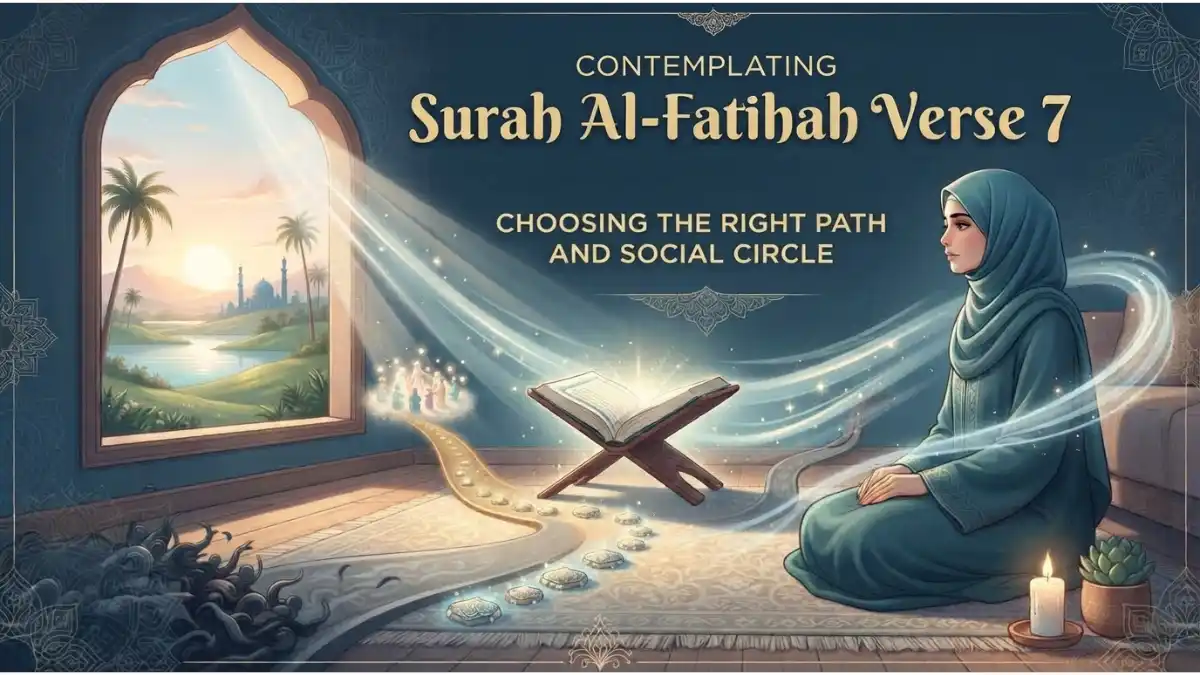
Life’s Ultimate Roadmap: Examining Human Psychology, Social Circles, and Moral Destiny
Welcome to the climax and conclusion of our thematic contemplation series on Surah Al-Fatihah. Verse 7 serves as the masterwork conclusion to the spiritual blueprint that we have systematically examined since the opening verse. Through deep reflection, this final ayah invites us to analyze a comprehensive synthesis of social psychology, criteria for selecting our social circles, and the ultimate destination toward which every human breath and decision leads.
Amid the chaotic whirlwinds of modern life—characterized by constant technological disruption, unhealthy comparison, and hyper-materialistic definitions of accomplishment—people frequently experience existential disorientation. We routinely imitate the lifestyles of others without verifying where their paths ultimately lead. Verse 7 does not exist merely to mark the end of our daily ritual recitations; rather, it functions as an essential, crystal-clear moral and spiritual compass for every believer navigating the complexities of contemporary society.
Philosophical Summary and Grand Design Structure of Surah Al-Fatihah
Surah Al-Fatihah is known as Umm al-Kitab (The Mother of the Book) because it encapsulates the complete core curriculum of human existence. Within its seven concise verses, Allah SWT outlines our complete spiritual roadmap: beginning with absolute recognition of His oneness and sovereignty (Tawhid), establishing divine mercy (Ar-Rahman Ar-Rahim) as the foundational principle of action, instilling awareness of the Day of Judgment, and establishing our formal covenant of exclusive worship and reliance upon Him alone (Iyyaka na’budu wa iyyaka nasta’in).
A structural analysis reveals that Al-Fatihah is divided into two symmetrical parts: praise and acknowledgment of Allah SWT in the first half, followed by human supplication in the second half. Verse 7 acts as the operational bridge to the prayer we utter in Verse 6. When we pray to be guided to the Straight Path (Shiratal Mustaqim), Allah does not leave us with an abstract concept. In Verse 7, He immediately provides a concrete visualization of what that path looks like and identifies the specific travelers who walk upon it.
Deep Reflection on Verse 7: Selecting the Right Circle in the Modern Era
Consider the divine words and their English translation:
“Ṣirāṭallaḏīna an‘amta ‘alaihim, ġairil-maġḍūbi ‘alaihim wa laḍ-ḍāllīn”
“The path of those upon whom You have bestowed favor, not of those who have evoked Your anger or of those who are astray.” (QS. Al-Fatihah: 7)
In closing this sacred chapter, Allah SWT directs our attention toward social environments and interpersonal relationships. The verse establishes a principle of social psychology: human character, mindset, and spiritual trajectory are fundamentally shaped by the role models we choose to emulate. Social structures, digital media algorithms, and daily interactions quietly forge our definitions of happiness, success, and personal worth.
1. The Hazard of Influence Pollution and False Validation
Modern culture exposes us to massive “influence pollution.” Daily, we encounter figures who appear materially successful, highly famous, and affluent, yet remain spiritually empty or act in direct opposition to moral guidelines. People frequently obsess over imitating those showcased across digital media platforms without examining whether those individuals walk upon the Straight Path.
The culture of ostentatious display, the relentless pursuit of social metrics (likes, views, and followers), and artificial benchmarks of popularity often warp our moral judgment. Verse 7 functions as a spiritual emergency brake. Allah SWT reminds us to remain highly selective regarding our social inputs. Material achievement without a spiritual foundation is a mirage that leads ultimately to disappointment, internal emptiness, or divine disfavor. We must redefine what true “favor” (ni’mah) actually means in our lives.
2. Analyzing the Three Categories of Humanity in Verse 7
Commentators of the Qur’an (Mufassirun) explain that in this verse, Allah categorizes humanity into three distinct groups regarding their response to Divine Truth:
- The Group of An’amta ‘Alaihim (Those Granted Divine Favor): As elaborated in Surah An-Nisa verse 69, this category comprises four groups: the Prophets (Nabi), the truthful firm believers (Siddiqin), the martyrs/witnesses to truth (Syuhada), and the righteous (Shalihein). These individuals possess inner peace, enrich their communities, remain humble during times of success, and maintain resilience during adversity. We are instructed to attach our hearts to their character and legacy.
- The Group of Al-Maghdhubi ‘Alaihim (Those Who Evoked Anger): Classic scholars explain that this refers to individuals who possess knowledge of the truth but deliberately reject, defy, or bypass it out of arrogance or personal interest. In modern contexts, this applies to those who understand moral principles yet knowingly violate them for immediate personal gain.
- The Group of Ad-Dhallin (Those Who Are Astray): This group refers to those who act without knowledge, refuse to learn, and navigate life based on ignorance or unexamined assumptions. They mistakenly believe they are doing good while drifting away from real truth.
Feelings of spiritual burnout often arise from spending excessive time in environments that pull us away from God. This realization requires an honest self-evaluation: “Does my primary social circle encourage me to remember Allah, or does it deepen my obsession with worldly validation?” Choosing the path of the favored does not demand immediate perfection, but it requires establishing clear standards and authentic role models for our spiritual growth.
Inspirational Story: The Power of Community and Social Transformation
The practical reality of internalizing Surah Al-Fatihah Verse 7 is reflected in the experience of a young corporate professional:
A few years ago, an office employee found himself severely stressed by his workplace culture. His immediate social environment was dominated by office politics, gossip, intense lifestyle comparison, and unhealthy rivalries. Each evening, he returned home feeling exhausted, anxious, and depleted. His energy was drained, and his life felt increasingly empty. He felt trapped in an environment that eroded his peace and moral principles.
Recognizing the strain on his well-being, he made a conscious decision to seek out a new social environment outside of work hours. He joined a local weekly Quranic study circle. There, he encountered a completely different community dynamic. Their conversations did not revolve around corporate titles, designer labels, or expensive vacations, but focused on personal development, spiritual tranquility, mutual support, and Quranic reflection.
While his office workload did not vanish overnight, his internal state shifted significantly. He no longer felt trapped by workplace negativity because he possessed a healthy emotional and spiritual anchor. Re-aligning his social circle toward individuals seeking authentic grace protected his peace of mind and strengthened his faith.
Practical Action Steps: 3 Exercises for Daily Life
Reflection requires practical implementation to produce meaningful change. Here are three actionable steps to apply the principles of Al-Fatihah Verse 7 today:
- Audit Your Social and Digital Inputs: Examine the 3 to 5 people you interact with most frequently and the primary media accounts you follow daily. Do their words and content inspire you to become a more mindful person close to God? If yes, value those connections. If not, gradually adjust your time spent with those influences to protect your spiritual health.
- Identify Authentic Role Models: Seek out at least one person in your community—a teacher, mentor, or trusted friend—who exhibits emotional maturity, gentle speech, and consistent integrity. Observe how they handle challenges and incorporate their positive traits into your own character.
- Conduct an Evening Reflection: Before going to sleep, take two minutes to ask yourself: “Did my actions, business choices, and speech today reflect the path of those blessed with divine favor, or did they lean toward the habits of those who are lost or arrogant?”
Closing Supplication for the Al-Fatihah Series
To conclude this journey through Surah Al-Fatihah, let us offer a sincere prayer:
“O Allah, the Most Compassionate, the Most Merciful, gather us among those You have favored—the Prophets, the truthful, the martyrs, and the righteous. Protect our hearts and steps from following the paths of those who evoke anger or wander astray. Keep us firm upon the Straight Path, the road of Your grace and forgiveness, until the day we meet You in a state of peaceful faith. Amin ya Rabbal ‘alamin.”
Questions & Answers Corner (FAQ)
Question: “What if my closest environment—such as immediate family or unchangeable coworkers—does not support a spiritual path? Should I cut ties with them?”
Answer: Absolutely not. Cutting off family ties (Silaturahim) or abandoning workplace professionalism is strictly discouraged. Family obligations require respect, kindness, and duty, while work responsibilities demand integrity. What you must filter is the negative influence, not the human connection:
- Maintain Excellence and Kindness: Remain polite, helpful, and professional without joining in harmful habits like gossip or unethical shortcuts.
- Filter Non-Essential Conversations: Keep daily interactions focused on constructive work matters or healthy family topics.
- Build a Positive External Support System: Balance your life by maintaining a positive social circle outside that environment. Over time, your consistent calm, wisdom, and kindness can serve as a positive influence on those around you.
Alhamdulillah! We have completed the full thematic reflection series on Surah Al-Fatihah from Verse 1 through Verse 7. We welcome you to continue this journey in our upcoming series on Surah Al-Baqarah!