
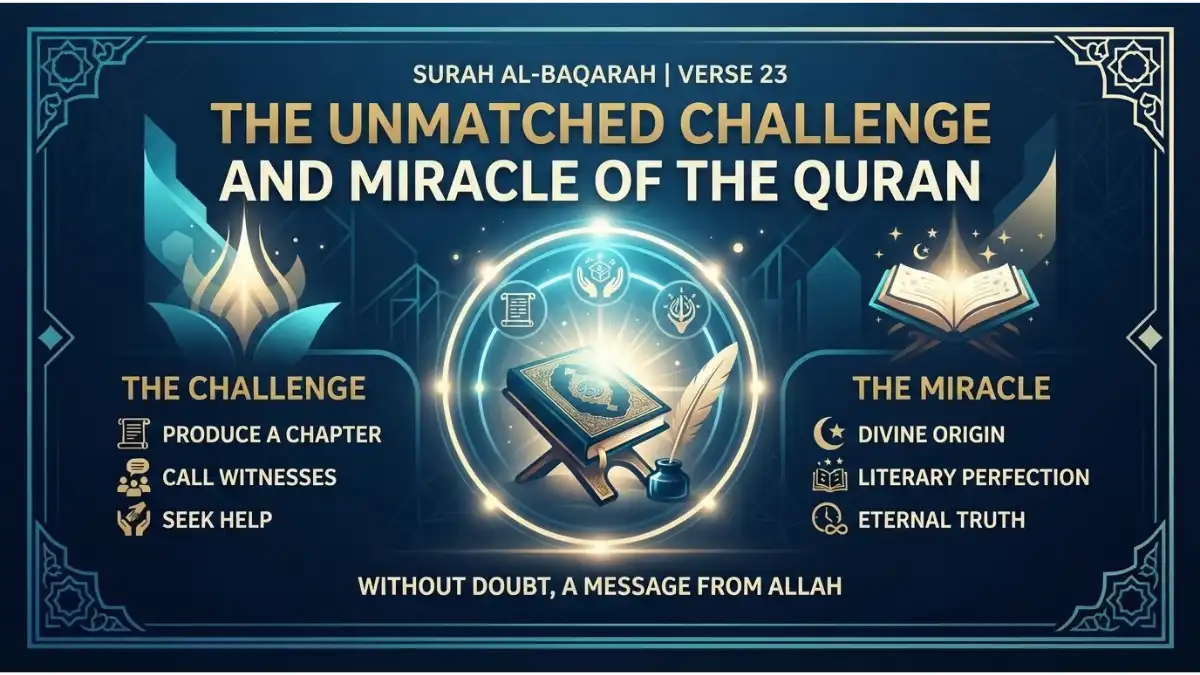
Introduction: Transitioning from Earthly Provisions to Spiritual Guidance
In the preceding verses of Surah Al-Baqarah, Almighty Allah provided humanity with a breathtaking inventory of physical provisions. He reminded us of the Earth fashioned as a comfortable dwelling place, the sky engineered as a protective canopy, and the rain sent down to produce fruits and vegetation for human survival. These material blessings sustain physical life. However, physical existence without moral purpose and spiritual direction leads to ethical bankruptcy. Therefore, in Verse 23 of Surah Al-Baqarah, the divine narrative seamlessly transitions from physical life-support systems to the ultimate spiritual provision: the miracle of divine revelation.
If physical provisions prove God’s sole right to be worshipped, the Quran proves the authentic prophethood of Muhammad (peace be upon him) and the indisputable truth of Islam. Rather than demanding blind faith, Allah issues an open, highly rational challenge to anyone who harbors doubt regarding the divine origin of the Quran.
“Wa in kuntum fī raibim-mimmā nazzalnā ‘alā ‘abdinā fa’tū bisūratim-mim-mithlihī wad‘ū shuhadā’akum min dūnillāhi in kuntum ṣādiqīn.”
Translation: “And if you are in doubt about what We have sent down upon Our Servant, then produce a surah like thereof and call upon your witnesses other than Allah, if you should be truthful.” (QS. Al-Baqarah: 23)
Historical Context: The Golden Age of Arabic Eloquence
To fully appreciate the profound weight of this challenge, one must examine the socio-cultural landscape of pre-Islamic Arabia during the seventh century. The Arabs of that era did not excel in massive architectural projects, advanced engineering, or naval fleets. Instead, they reached the absolute pinnacle of human achievement in a different domain: linguistic arts, rhetoric, and poetry.
Language was the supreme pride of Arab society. Poets were not merely artists; they were the custodians of tribal history, political strategists, and public relations masters. Annual literary festivals, such as the famous market of ‘Ukaz, served as competitive arenas where master poets recited complex odes. The most exceptional poems—known as the Mu‘allaqat (The Hanging Odes)—were written in gold ink and hung upon the walls of the Ka’bah as symbols of unmatched mastery. The native Arab possessed an extraordinarily refined ear, capable of instantly detecting subtle shifts in meter, rhythm, and grammatical nuance.
It was into this hyper-eloquent society that Prophet Muhammad (peace be upon him) was sent. He was known historically as Ummi—an unlettered man who had never formally studied grammar, written prose, or composed poetry. Yet, when he began reciting the verses of the Quran, the master poets and chieftains of Quraysh were completely stunned. The text was neither traditional poetry (shi‘r) with rigid meters, nor standard prose (natsr). It was an entirely unprecedented literary form possessing a hypnotic rhythm, flawless precision, and a transformative spiritual weight.
Unwilling to surrender their social power, tribal rivalries, and idol-worshipping traditions, the leaders of Quraysh resorted to ad hominem attacks. They falsely accused the Prophet of being a poet, a fortune-teller, a sorcerer, or someone copying ancient myths. Verse 23 was revealed to dismantle these baseless allegations through a direct, empirical test.
The Gradual Method of the Divine Challenge (Tahaddi)
In Islamic scholarship and Quranic sciences (‘Ulum al-Quran), this open challenge is known as Tahaddi. It represents the formal challenge posed by God to human and jinn intellects to produce anything comparable to the Quran, thereby establishing its miraculous nature (I‘jaz).
A striking aspect of this divine challenge is its gradual, stepped down approach, which systematically stripped the skeptics of every possible excuse:
- Challenge to Produce an Entire Book:
In Surah Al-Isra (17:88), Allah issued the widest challenge, declaring that even if all humans and jinn were to combine their resources and intellects, they could never produce a book like the entire Quran. The skeptics remained completely silent.
- Challenge to Produce Ten Surahs:
When they failed, Allah lowered the threshold in Surah Hud (11:13), challenging them to produce just ten invented surahs comparable in beauty, wisdom, and rhetoric. Again, the elite poets failed to respond.
- Challenge to Produce a Single Surah:
Finally, in Surah Al-Baqarah (2:23) and Surah Yunus (10:38), Allah reduced the challenge to the absolute minimum: produce just a single surah like it. This includes even the shortest chapter of the Quran, Surah Al-Kawthar, which consists of merely three short verses and ten words.
Furthermore, Allah permitted them to assemble all their experts, scholars, helpers, and deities (wad‘ū shuhadā’akum min dūnillāh) to assist in this literary competition. Despite having every political, financial, and linguistic incentive to dismantle Islam at its root through a single short chapter, they failed completely.
Instead of accepting a clean literary contest, the enemies of Islam chose the most cost-ineffective and dangerous alternative: waging bloody military campaigns, enduring economic boycotts, and risking their lives. This historical choice serves as absolute proof that their native linguistic intuition recognized the impossibility of matching the Quran’s divine style.
Analytical Breakdown: The Dimensions of Inimitability (I‘jaz)
Scholars of classical rhetoric (Balaghah) and Quranic exegesis have exhaustively analyzed why human beings are inherently incapable of imitating the Quran. The inimitability of the revelation spans multiple interconnected dimensions:
| Dimension of I‘jaz | Human Literature Features | Quranic Divine Reality |
|---|---|---|
| Linguistic Architecture | Bound by strict poetic meter or mundane prose; suffers from wordiness or obscurity. | A unique genre combining melodic resonance, perfect brevity, and absolute grammatical precision. |
| Consistency & Harmony | Human works written over decades reflect shifts in mood, contradictions, and stylistic decay. | Revealed over 23 years across diverse circumstances, maintaining zero internal contradictions or drop in quality. |
| Impact of Repetition | Repeated reading of human masterpieces eventually causes mental fatigue and loss of interest. | Recited daily by millions for centuries without diminishing in freshness, beauty, or emotional resonance. |
| Unseen Knowledge (Ghayb) | Limited to historical hindsight or speculative, fallible future projections. | Accurate historical details of ancient civilizations and fulfilled future prophecies. |
Insights from Classical Tafsir Scholars
Prominent Quranic commentators throughout history have offered illuminating insights into the depth of Surah Al-Baqarah Verse 23:
1. Ibn Kathir’s Analysis on Prophetic Authenticity
Imam Ibn Kathir notes the intentional use of the phrase ‘alā ‘abdinā (“upon Our Servant”). By linking the revelation to the Prophet’s status as a servant of God, Allah highlights that true honor lies in complete servitude to the Divine. Furthermore, Ibn Kathir explains that the Prophet’s unlettered background (Ummiyyah) serves as a monumental proof: an unlettered man producing a book that baffled the greatest scholars in history can only mean the book came directly from the All-Knowing God.
2. Al-Razi on the Structural Perfection
Fakhr al-Din al-Razi highlights that human composition is inherently selective. A human poet may excel at writing about war, love, or sorrow, but fails when trying to articulate legal rulings, theology, or historical narratives with equal beauty. The Quran, however, maintains the exact same supreme level of literary elegance whether detailing complex inheritance laws, describing the Day of Judgment, or narrating ancient history.
3. Al-Qurtubi on the Universal Challenge
Imam Al-Qurtubi emphasizes that the words in kuntum ṣādiqīn (“if you should be truthful”) expose the moral dishonesty of the critics. Their skepticism did not stem from intellectual flaws in the revelation, but rather from arrogance, tribal jealousy, and fear of losing social hegemony.
Historical Reflection: The Softening of Omar ibn al-Khattab’s Heart
The power of the Quran’s rhetoric is not merely an academic concept; it possesses a proven power to transform human lives. A notable historical illustration is the conversion of Omar ibn al-Khattab (may Allah be pleased with him).
Before his conversion, Omar was one of the most fierce persecutors of the early Muslim community. Possessing an intimidating personality and an unwavering devotion to ancestral traditions, he set out one day with a sword drawn, determined to end the life of the Prophet Muhammad. En route, he was informed that his own sister, Fatimah, and her husband had secretly embraced Islam.
Enraged, Omar diverted his course to his sister’s house. As he approached the door, he heard the soothing recitation of Surah Taha being read from a parchment sheet. After an intense confrontation inside, Omar demanded to read the parchment. As his eyes scanned the opening verses of Surah Taha:
“Tā Hā. We have not sent down to you the Quran that you should be distressed, but only as a reminder for those who fear [Allah]…” (QS. Taha: 1-3)
The sheer majesty, rhythm, and truth of the divine speech dismantled his defenses. The man who had entered with anger and a drawn sword began to weep, stating: “How noble and beautiful are these words!” He immediately proceeded to the Prophet Muhammad not to fight, but to declare his faith in Islam. The literary miracle of the Quran had conquered one of the strongest hearts in Arabia.
Relevance in the Modern Era: Beyond Arabic Rhetoric
A common question raised by non-Arabic speakers or modern readers is: “How does the challenge of verse 23 apply to someone who does not speak classical Arabic?”
While the primary linguistic challenge remains active, the Quran’s miracle manifests in several universal ways accessible to modern global audiences:
- Societal Transformation:
No book in human history has reshaped primitive, warring tribes into a world-spanning civilization based on justice, law, and scientific inquiry within a mere two decades, as the Quran did.
- Preservation of Text:
The Quran remains the only ancient religious scripture preserved word-for-word in its original language, memorized cover-to-cover by millions of people across every continent.
- Timeless Psychological Comfort:
Across generations, individuals from vastly different cultures experience profound emotional healing, clarity, and existential purpose when listening to or reflecting upon its message.
Three Practical Steps for Daily Tadabur Implementation
To integrate the lessons of Surah Al-Baqarah Verse 23 into your daily spiritual routine, consider implementing these three practical steps:
- Engage in Daily Reflective Reading (Tadabur):
Move beyond mere mechanical recitation. Set aside 15 minutes daily to read a few verses alongside a reliable translation and concise commentary (such as Tafsir Ibn Kathir or Tafsir Ma’arif-ul-Quran). Ponder how the verse directly addresses your current life situations.
- Use the Quran as Your Moral Compass:
Whenever you face complex ethical dilemmas in your profession, family life, or personal relationships, consult the principles laid out in the Quran. Measure worldly philosophies against the timeless guidance of divine revelation.
- Listen Mindfully to Professional Recitations:
Incorporate the listening of proper Quranic recitation (Tajweed) by master reciters into your daily commute or rest periods. Pay attention to the natural cadences and emotional tones embedded within the text.
A Short Prayer for Guidance and Connection with the Quran
“Allāhummaj‘alil-Qur’āna al-‘Aẓīma rabī‘a qulūbinā, wa nūra ṣudūrinā, wa jalā’a aḥzāninā, wa dhahāba humūminā. Allāhumma dhakkirnā minhu mā nasīnā, wa ‘allimnā minhu mā jahilnā, warzuqnā tilāwatahū ānan’al-laili wa aṭrāfan-nahār.”
Translation: “O Allah, make the Magnificent Quran the spring of our hearts, the light of our chests, the banisher of our sadness, and the reliever of our anxieties. O Allah, remind us of what we have forgotten from it, teach us from it that which we are ignorant of, and grant us its recitation during the hours of the night and the ends of the day.”
Frequently Asked Questions (FAQ)
Question: “Why did Allah use the word ‘Servant’ (‘abdinā) to refer to Prophet Muhammad in verse 23?”
Answer: The term ‘abd (servant or slave of God) represents the highest spiritual status a human can achieve. By describing the Prophet as “Our Servant,” Allah honors him while simultaneously clarifying his human status, ensuring that Muslims never elevate the Prophet to divine status, unlike previous religious traditions.
Question: “Has anyone ever attempted to respond to the challenge of producing a surah like the Quran?”
Answer: Yes, historically a few individuals like Musaylimah al-Khadhdhab attempted to compose rival verses. However, their attempts were so absurd, grammatically weak, and devoid of meaning that even their own contemporaries mocked them. Their compositions quickly faded into obscurity, serving only as historical examples of failed imitations.
This article is part of the thematic study series: Summary of Tadabur Surah Al-Baqarah