
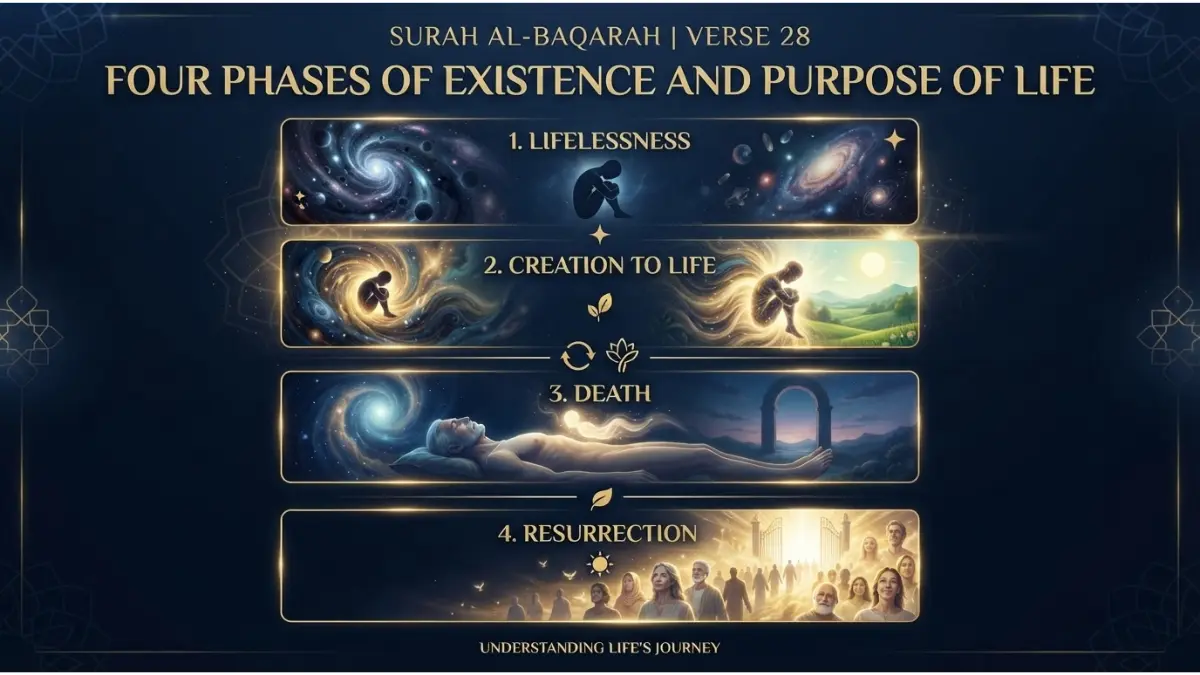
Introduction: A Divine Challenge to Human Consciousness
Following the previous verses that cautioned humanity against breaking sacred covenants, severing ties of kinship, and spreading corruption on Earth (Surah Al-Baqarah Verse 27), the Noble Quran presents a profound, fundamental wake-up call. Surah Al-Baqarah Verse 28 directly addresses the core of human existence, inviting us to contemplate our humble origins, the fleeting nature of worldly life, and our inevitable return to the Creator.
The verse presents a rhetorical question framed in divine astonishment. Almighty Allah does not inquire out of a need for information; rather, He poses a logical challenge to awaken human conscience and dismantle ungrounded intellectual arrogance:
“Kaifa takfurūna billāhi wa kuntum amwātan fa-aḥyākum, thumma yumītukum thumma yuḥyīkum thumma ilaihi turja‘ūn.”
Translation: “How can you disbelieve in Allah when you were lifeless and He brought you to life; then He will cause you to die, then He will bring you [back] to life, and then to Him you will be returned?” (QS. Al-Baqarah: 28)
Engaging in contemplative reflection (tadabur) over this verse reveals a complete framework of human destiny. How can a creature that did not exist, was granted life without personal merit, will inevitably face death, and will be resurrected for judgment possess the audacity to act arrogantly or deny its Creator?
The Four Phases of Human Existence
Surah Al-Baqarah Verse 28 outlines the complete timeline of human journey through four distinct, orderly phases. Understanding this sequence provides essential perspective on our place in the universe:
Phase 1: Absolute Non-Existence (Kuntum Amwātan)
Prior to our creation, we were in a state of complete non-existence. We did not possess names, forms, consciousness, or presence. We did not choose our parents, determine our birthplaces, select our genetic traits, or engineer our own entry into the world. Our beginning was marked by absolute helplessness and absence.
Phase 2: The Worldly Life (Fa-Aḥyākum)
By pure divine grace and decree, Allah brought us into living existence. He endowed us with biological life, sensory faculties, intellect, emotional capacity, and an Earth equipped with resources to sustain us. Worldly life is an unearned gift and a temporary trust designed as a testing ground for moral agency.
Phase 3: Physical Death (Thumma Yumītukum)
Upon completion of our allocated time, every human being will experience physical death. Regardless of accumulated wealth, social influence, political power, or physical strength, every individual must leave worldly assets behind. The biological body returns to the earth from which it was formed.
Phase 4: Resurrection and Ultimate Accountability (Thumma Yuḥyīkum Thumma Ilaihi Turja‘ūn)
Death is not the final end of human consciousness; it is a transition. Following physical death, humanity will be resurrected in the Hereafter to give a complete account of every opportunity, choice, intention, and action undertaken during the second phase. All souls return to the Owner of Life for ultimate justice.
Analytical Framework: The Four Stages of Human Journey
To visualize the structural progression outlined in Verse 28, the following breakdown contrasts human assumptions during worldly life with the objective realities established by divine revelation:
| Phase | Quranic Term | Human Illusion | Objective Reality |
|---|---|---|---|
| Phase 1 | Kuntum Amwātan | Overlooking our humble, non-existent origin. | We were nothing; our existence is entirely dependent on God. |
| Phase 2 | Fa-Aḥyākum | Feeling self-sufficient and believing ownership is permanent. | Life is a brief, temporary test and a divinely granted trust. |
| Phase 3 | Thumma Yumītukum | Avoiding thoughts of death and acting as if worldly life never ends. | Physical death is absolute, unavoidable, and non-negotiable. |
| Phase 4 | Thumma Ilaihi Turja‘ūn | Assuming there are no lasting consequences for moral choices. | Full resurrection, absolute justice, and eternal accountability. |
Root Causes of Human Arrogance and Forgetfulness
Why do human beings frequently fall into rebellion and arrogance? The primary cause lies in what scholars term “existential amnesia”—forgetting our initial non-existence and ignoring our inevitable end.
During Phase 2 (worldly life), individuals often succumb to the illusion of absolute ownership. Achieving high positions, accumulating material riches, or possessing superior intellect can convince a person that they are self-sufficient. They begin to act as though they created themselves and will remain on Earth indefinitely.
However, when evaluated through the lens of Surah Al-Baqarah Verse 28, human pride is revealed as irrational. Every asset we boast of—beauty, intelligence, health, and status—is borrowed property that can be reclaimed at any second. Remembering our origin (non-existence) and our destination (death and resurrection) serves as an effective spiritual brake against ego, injustice, and mistreatment of others.
Classical Exegesis (Tafsir) Perspectives on Verse 28
Classical scholars of Quranic commentary have carefully analyzed the meanings and implications of Verse 28:
1. Tafsir Ibn Kathir
Imam Ibn Kathir notes that this verse presents undeniable proof of Allah’s supreme power. Citing early authorities such as Abdullah ibn Abbas and Abu Al-Aliyah, he explains that “you were dead” means human beings were non-existent before creation. Allah then gave them life (birth), will cause them to die at their appointed time, and will bring them back to life on the Day of Resurrection. Ibn Kathir emphasizes that observing the first creation (birth) logically proves the inevitability of the second creation (resurrection).
2. Tafsir Al-Qurtubi
Imam Al-Qurtubi highlights the linguistic force of the opening question: “Kaifa takfurūn” (“How can you disbelieve?”). He explains that this is a question of rebuke and astonishment. Given the clear evidence of creation, death, and seasonal cycles in nature, disbelief in the Creator is intellectually indefensible. Al-Qurtubi also discusses how remembering these four stages instills deep humility in the heart of a believer.
3. Tafsir At-Tabari
Imam At-Tabari elaborates on the phrase “thumma ilaihi turja‘ūn”. He explains that the return to Allah signifies that no creation can escape His judgment. While humans may evade earthly laws or human oversight, the final return ensures that justice will be meted out with absolute precision.
Reflective Narrative: Returning Without Material Possessions
The reality of returning to the Creator empty-handed is vividly demonstrated in real-life human experiences. Consider the story of a well-known community leader and wealthy property developer who spent his life accumulating vast real estate holdings, luxury vehicles, and high-yielding financial assets. He was known for his relentless drive, often neglecting family and health in pursuit of material expansion.
At his funeral, a striking contrast unfolded. Hundreds of acres of prime land he owned remained untouched. His fleet of luxury vehicles remained parked at his estate. The high-rise buildings bearing his name offered no protection or warmth. As his body was lowered into the quiet, modest grave, the only covering that accompanied him was a simple white burial shroud without pockets.
An attendee standing by the graveside remarked softly: “Standing at the edge of the grave makes everything clear. We spend decades arguing, competing, accumulating, and boasting over things we cannot keep for a single second past our last breath. Ultimately, we return to the soil carrying nothing except our faith, our intentions, and our deeds.”
This reality underscores the message of Verse 28: Worldly life is a temporary venue for planting seeds; the true harvest occurs in the return to God.
Four Practical Steps to Align Life Purpose with Verse 28
To translate the contemplation of Surah Al-Baqarah Verse 28 into meaningful daily action, we can adopt four practical habits:
- Cultivate Genuine Humility (Tawāḍu‘):
Whenever you experience a sense of superiority or pride over personal accomplishments, remind yourself of your non-existent origin. Attribute all blessings to divine favor rather than personal merit.
- Re-align Daily Intentions with Ultimate Purpose:
Ensure that daily activities—whether pursuing a career, managing a business, studying, or raising a family—are performed with honest intentions as acts of worship and preparation for the Hereafter.
- Practice Regular Self-Evaluation (Muḥāsabah):
Dedicating a few minutes each evening to evaluate actions, thoughts, and words helps ensure we remain on a path pleasing to our Creator. Seek forgiveness for shortcomings and express gratitude for blessings.
- Hold Material Possessions with an Open Hand:
Use wealth, influence, and resources as tools to do good, support others, and build lasting spiritual investments rather than allowing material assets to enslave your heart.
A Heartfelt Supplication for Guidance and Good Endings
“Allāhumma aḥsin ‘āqibatanā fil-umūri kullihā, wa ajirnā min khizyid-dunyā wa ‘adhābil-ākhirah. Allāhumma aj‘al khayra ‘umurinā ākhirahu, wa khayra ‘amalinā khawātīmahu, wa khayra ayyāminā yawma nalqāk. Amīn Yā Rabbal-‘Ālamīn.”
Translation: “O Allah, grant us a good outcome in all of our affairs, and save us from the disgrace of this world and the punishment of the Hereafter. O Allah, make the best part of our lives the end of it, the best of our deeds the last of them, and the best of our days the day we meet You. Amin, O Lord of the Worlds.”
Frequently Asked Questions (FAQ)
Question: “Does remembering death and the return to Allah mean one should abandon worldly ambitions and career growth?”
Answer: Not at all. Remembering death provides correct orientation, preventing worldly pursuits from becoming idols. A believer works diligently, excels professionally, and contributes positively to society, but holds the world in their hands to do good rather than in their heart as an end in itself.
Question: “Why does the Quran repeatedly mention resurrection and accountability?”
Answer: Human nature is prone to forgetfulness and distraction due to daily routines and immediate worldly pleasures. Repeated emphasis on resurrection serves as a necessary spiritual reminder to help humanity maintain moral focus, integrity, and long-term perspective.
Question: “How can a person overcome the fear of death and view it constructively?”
Answer: Fear of death often stems from feeling unprepared or holding onto unresolved wrongdoings. Constructive remembrance involves engaging in sincere repentance, mending relationships, performing good deeds, and placing trust in Allah’s mercy. One who strives to live uprightly views the return to God with hope and peaceful anticipation.
This article is part of the thematic study series: Summary of Tadabur Surah Al-Baqarah